Does the TensileTurn CNC Industrial Upgrade Produce Round Specimens That Meet International Standards?
Yes. This round-specimen machining system is built to produce test pieces that meet major international standards, including ASTM E8, ASTM A370, and ISO 6892. It accommodates standard and custom geometries, such as reduced sections, threaded ends, and sub-size blanks, while maintaining consistent diameters, accurate gauge lengths, concentricity, and a smooth surface finish for dependable tensile results and audit-ready documentation.
Operators can run pre-programmed standard profiles or create templates for unique drawings, then apply optimized tooling with material-specific feeds and speeds from the HMI. Rigid workholding and closed-loop servo control support dimensional repeatability across batch runs, and on-screen fields can record heat numbers, operator IDs, and fixture references to strengthen traceability. If formal documentation is required, TensileMill CNC can supply compliance packets and coordinate third-party verification for programs such as NADCAP, as well as support internal or customer-specific quality requirements.
If you would like to explore capabilities and options for round specimen machining, you can review details on the
TensileTurn CNC Industrial Upgrade product page.
Does TensileMill CNC Comply With ASTM, ISO, and Other Global Testing Standards?
Yes. TensileMill CNC designs its tensile sample preparation systems, polishing equipment, and universal testing machines to meet recognized international standards, including ASTM, ISO, EN, and GB.
Machine controls and UTM software include preloaded test method templates and specimen geometries aligned to widely used methods such as ASTM E8 and ISO 6892 for metals tension, and ISO 527 and ASTM D638 for plastics. Application engineers track revisions to these documents and keep templates, operator prompts, and documentation current as editions change. In daily practice, operators can select a template, confirm specimen dimensions and compatible grips or fixtures, and run repeatable tests that match the selected standard across flat and round samples. If your lab requires additional wording or regional variants, custom templates can be added while preserving traceability to the referenced method.
If you would like to review our compliance policies and declarations, you can read more on the
Certification for Testing Equipment page.
Why Does ISO/IEC 17025 Certified Calibration Matter for Testing Equipment?
ISO/IEC 17025 certified calibration confirms that measurements from universal testing machines, hardness testers, and impact testers are traceable, repeatable, and backed by a documented uncertainty budget. This gives your lab defensible data for audits, supports NADCAP and quality system requirements, and reduces the likelihood of retests or disputed results.
For mechanical testing, the scope typically covers force verification to ASTM E4 or ISO 7500-1, extensometer calibration to ASTM E83 or ISO 9513, crosshead or displacement checks, and frame alignment per ASTM E1012. A valid certificate includes as-found and as-left results, traceability to national metrology institutes such as NIST, environmental conditions during calibration, and the laboratory’s accreditation details. Establishing a routine interval, often yearly or usage-based, helps keep results consistent across operators, materials, and shifts.
Through the TensileMill CNC Service Plan, calibration is delivered by ISO/IEC 17025 accredited partners for both our equipment and third-party systems, combined with preventive maintenance and functional verification so your lab remains audit ready with reliable performance.
If you would like to review scope details or explore certificate options, you can read more on the
Certification for Testing Equipment page.
Which Alignment Tools and Procedures Prepare TM-EML Series UTMs for NADCAP or Similar Accreditation?
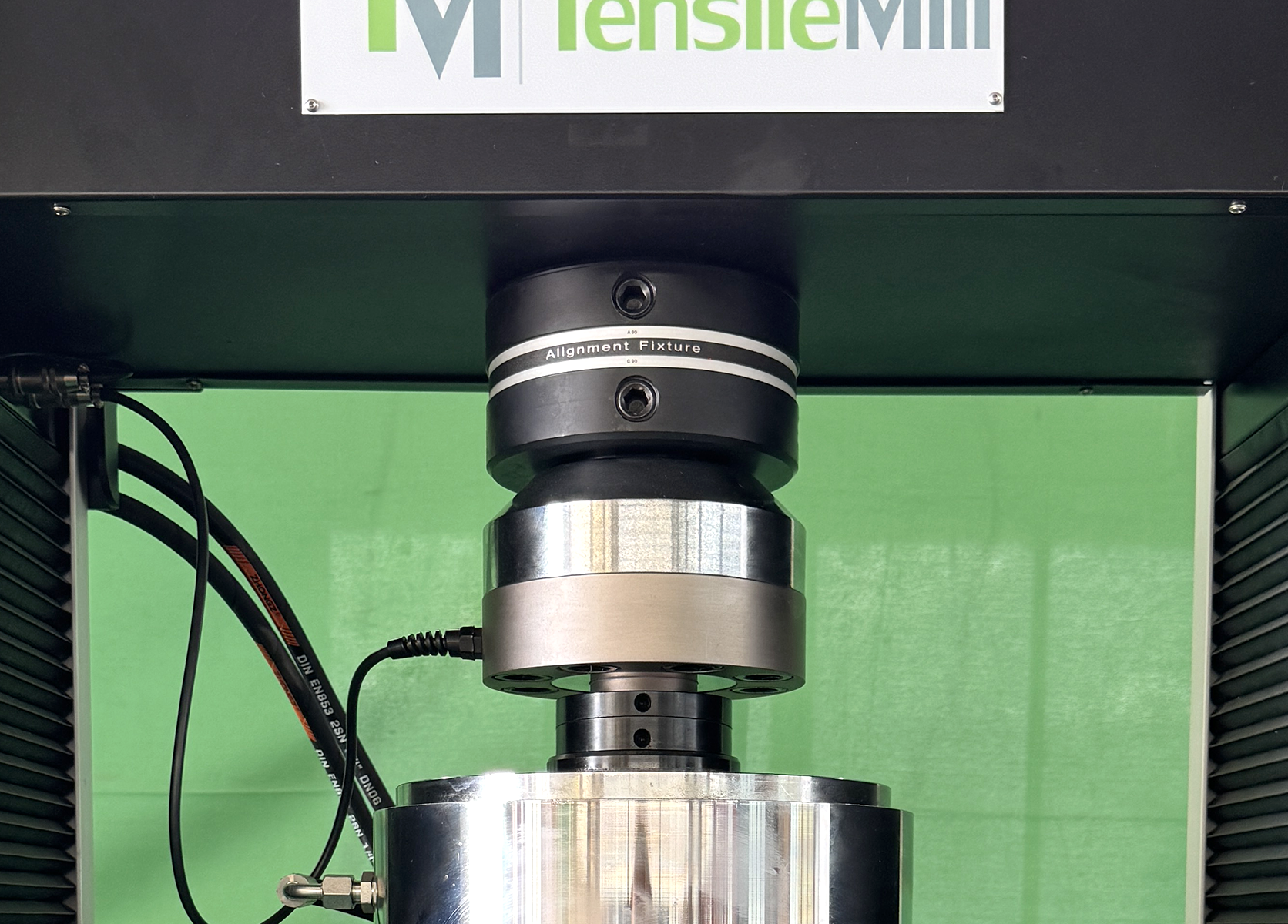
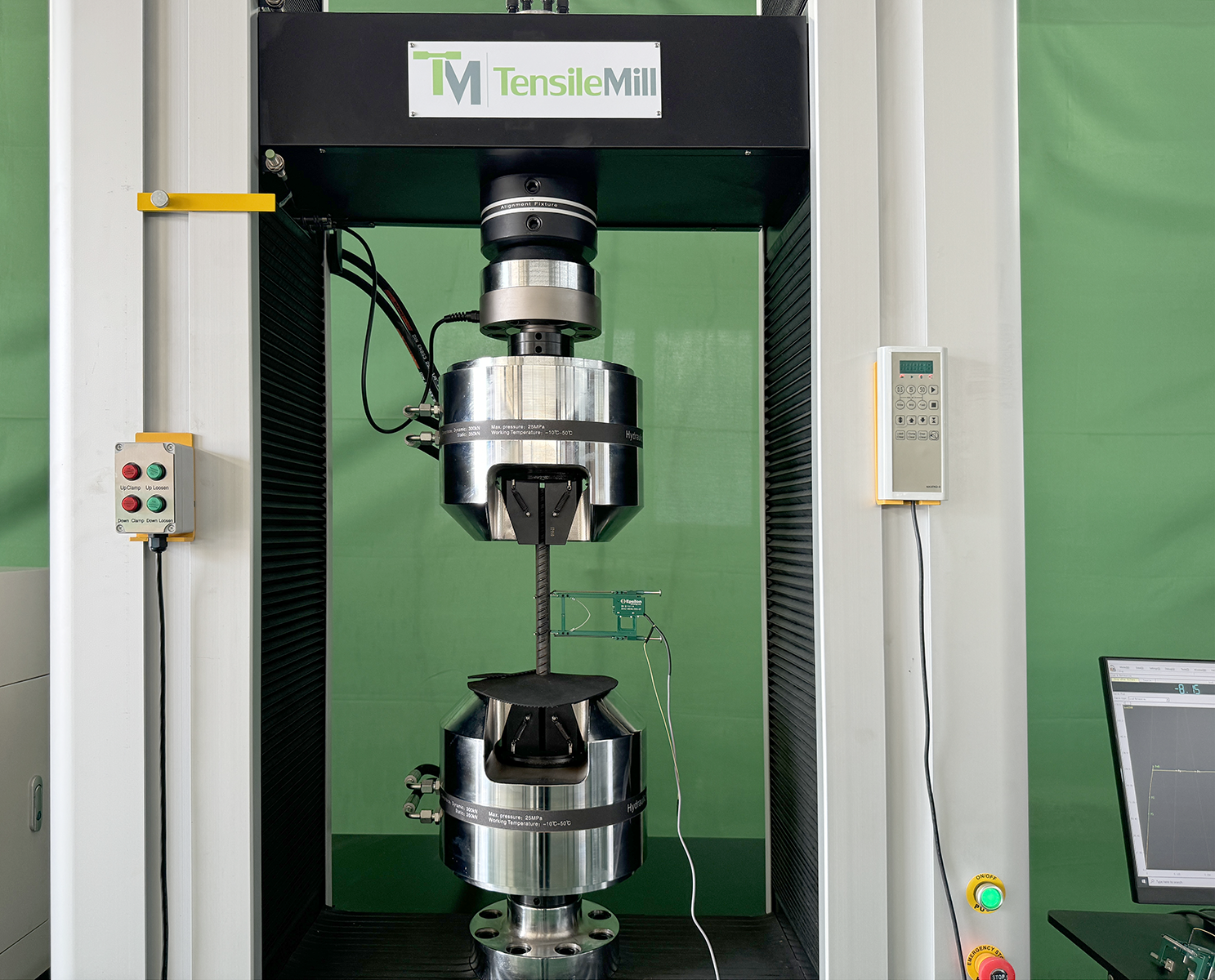
TM-EML testing frames support formal alignment workflows used for NADCAP and comparable audit programs. Operators can verify axiality with alignment fixtures compatible with ASTM E1012 and with ISO-aligned practices. These tools measure load-string symmetry, bending strain, and force distribution so you can adjust grips, adapters, and crosshead centering before a calibration visit. GenTest software guides stepped loading and captures alignment data, then generates a traceable report for auditors.
In practice, select an alignment bar or multi-gage fixture that matches your grip type, install it between the upper and lower adapters, and zero the sensors. Run a controlled tension profile in GenTest, add compression if required by your audit scope, and watch live axiality and bending indicators. If readings show eccentricity, correct grip parallelism, change or reface worn jaw faces, confirm adapter concentricity, and recenter the crosshead, then repeat the sequence until bending falls within your program limits. Save the GenTest protocol with operator ID, instrument serial numbers, and calibration references to document the alignment state. Our team can help match the correct alignment fixture to your frame and jaw style for a smooth audit.
If you would like to review compatibility and reporting features, you can read more on the
TM-EML Series C UTM product page.
Can You Coordinate ISO 17025 Certification For Third-Party UTMs And Extensometers?
Yes. Through ISO/IEC 17025–accredited partners, we coordinate accredited calibration and certification for universal testing machines, load cells, extensometers, and related accessories from most manufacturers. Force verification is performed to ASTM E4 and ISO 7500-1, extensometers are calibrated to ASTM E83 and ISO 9513, and machine alignment checks follow ASTM E1012. Typical force coverage spans 5 lbf to 225,000 lbf (22 N to 1,000 kN), depending on device capacity and fixture configuration.
The process starts with a pre-calibration health check, then on-site verification at multiple force points such as 20, 40, 60, 80, and 100 percent of capacity, with ascending and descending runs. Alignment devices assess bending and coaxiality per ASTM E1012. Extensometers are calibrated across their working range, for example 1 in to 4 in (25 mm to 100 mm) gauge lengths, either on site or by mail-in service when practical.
Deliverables include an ISO/IEC 17025 certificate with as-found and as-left data, measurement uncertainty, and full traceability. Environmental conditions are controlled near 68 F ± 2 F (20 C ± 1 C). Most labs schedule annual intervals, while high-throughput or NADCAP-audited facilities often choose 6 months. We also help prepare audit-ready documentation packages for quality systems tied to ASTM, ISO, and ANSI/NCSL Z540-1 requirements.
For additional guidance on accredited calibration options, you can review details on the
Certification for Testing Equipment page.
What Documentation And Calibration Intervals Do Auditors Expect For ISO 17025 And NADCAP Compliance Of Tensile Test Equipment?
Auditors typically look for ISO/IEC 17025 traceable calibration certificates for each measuring function on your system. For force, certificates should list the UTM and load cell serial numbers, the standard followed, the verified range, and the measurement uncertainty. A complete record includes as found and as left data at multiple points across the working range, for example 10 lbf to 110,000 lbf (44.5 N to 489 kN), with the applicable method noted such as ASTM E4 or ISO 7500-1. Alignment documentation in accordance with ASTM E1012, and extensometer certificates to ASTM E83 or ISO 9513, are expected when those devices are used. Calibration conditions should be stable near 68 F (20 C).
Typical intervals are every 12 months for UTMs, load cells, and extensometers. High utilization or aerospace programs often adopt 6 months. Recalibrate after repairs, overloads, relocation of more than 10 ft (3 m), or significant firmware changes. Alignment verification is commonly performed annually, or any time grips, platens, or fixtures are changed.
To prepare, warm up electronics for at least 30 minutes, keep the load string clean, and confirm the intended force and displacement ranges before the visit. For NADCAP evidence, maintain alignment records demonstrating coaxiality at or below 5 percent, retain operator training logs, and file all certificates with clear traceability to national standards and an uncertainty statement.
For additional guidance on audit readiness and documentation, you can review options on the
Certification for Testing Equipment page.
What Is The Difference Between Calibration, Verification, And Certification For Tensile Testing Equipment?
Calibration aligns an instrument to a traceable standard, compares readings across the working range, and applies corrections if needed. For universal testing machines and load cells, this is performed at multiple force points within the selected range, for example 10%, 50%, and 100% of capacity, so results remain accurate from low loads to the maximum rating. Results include measurement uncertainty and traceability to national standards.
Verification checks that the system continues to meet specified tolerances without making adjustments. Typical examples are force verification to ASTM E4 or ISO 7500-1 accuracy classes, such as ±1.0% or ±0.5% of indicated load, displacement checks per ASTM E2309, and frame alignment to ASTM E1012 with coaxiality error at or below 5%. During alignment work, technicians evaluate specimen gauge length, for example 2.0 in (50 mm), grip separation such as 4.0 in (100 mm), and off-axis bending that can bias strain.
Certification is the formal report package, usually to ISO/IEC 17025, that documents the calibration or verification, uncertainty, environmental conditions like 68 F (20 C), reference standards used, and the next due date. Many laboratories plan certification on a 12-month interval, while high-utilization rigs at or above 100,000 lbf (445 kN) or programs with stringent oversight may opt for 6 months. Keeping consistent intervals, clear labels, and complete records supports NADCAP readiness and internal audits.
For details about scope, methods, and documentation, you can review the latest guidance on the
Certification for Testing Equipment page.
What Does Certification For Testing Equipment Include And How Often Should It Be Renewed?
Certification covers a traceable calibration of load, strain, and motion components, along with verification to applicable standards. For UTMs, force is verified across the working range to ASTM E4 or ISO 7500-1 classifications such as Class 1 or 0.5. Extensometers are checked to ASTM E83 or ISO 9513, and crosshead speed is verified with an accuracy check, typically within ±1 percent. The certificate set includes as-found and as-left data, serial numbers, environmental conditions such as 68 to 77 F (20 to 25 C), uncertainty statements, and NIST traceability.
Most labs renew certification every 12 months, though high-throughput or regulated environments often choose 6 months. Recalibration is recommended after a major repair, load cell replacement, firmware updates, relocation over 10 ft (3 m), or any overload event. Daily or per-shift checks with certified force blocks or reference specimens help catch drift between intervals.
For specimen preparation machines, dimensional results are typically validated using certified gauges and master coupons. Common checks include gauge length at 2 in (50 mm), edge radii per the relevant standard, and thickness or diameter tolerances as tight as ±0.001 in (±0.025 mm). Alignment evaluations per ASTM E1012 and accessory reviews for grips or fixtures may be added when method validation requires it.
If you would like a concise summary of scope and deliverables, you can review details on the
Certification for Testing Equipment page.
Which Certification And Traceability Records Do Auditors Expect For Tensile Sample Preparation Machines And UTMs?
Auditors typically look for ISO/IEC 17025 calibration certificates for universal testing machines, load cells, and extensometers. Certificates should list the instrument ID and serial number, calibration procedure, measurement uncertainty, environmental conditions such as 68 to 77 F (20 to 25 C), and traceability to national standards. If your facility follows NADCAP or similar programs, they will also expect documented competence, scope, and due dates aligned with your quality system.
For UTMs, provide force verification to ASTM E4 or ISO 7500-1 with results that meet the declared accuracy class across the working range. Include extensometer calibration to ASTM E83 or ISO 9513, alignment verification to ASTM E1012, and crosshead speed checks showing agreement within about ±1% over representative rates, for example 0.02 to 20 in/min (0.5 to 500 mm/min). Keep the machine’s verification history, nonconformance records, and corrective actions together with the current certificate.
For specimen preparation equipment, retain capability evidence demonstrating dimensional conformance of machined coupons to the target profile, such as width and thickness within specified limits, for example ±0.002 in (±0.05 mm), and surface finish results when required, for example 32 µin Ra (0.8 µm). Maintain preventive maintenance logs, operator training records, and device labels with calibration due dates. A simple, dated pre-use check routine with certified artifacts supports ongoing readiness and reduces audit risk.
For additional guidance on documentation and audit readiness, you can review details on the
Certification for Testing Equipment page.
Which Standards Should A UTM Calibration Cover And What Records Do Auditors Expect?
Force verification is typically performed to ASTM E4 or ISO 7500-1. Technicians apply traceable forces at several points, often 20 to 100 percent of capacity, using transfer load cells. For a 10,000 lbf (44.5 kN) frame, checkpoints may be 2,000, 4,000, 6,000, 8,000, and 10,000 lbf (8.9, 17.8, 26.7, 35.6, and 44.5 kN). Records include applied versus indicated force, error percentage, measurement uncertainty, ambient temperature such as 68 to 77 F (20 to 25 C), serial numbers, and the calibration due date.
Strain devices are calibrated to ASTM E83 or ISO 9513 using a step gauge or rig across the gauge length, for example 1 in (25 mm) or 2 in (50 mm). The certificate states the classification achieved, the points checked, correction factors if used, and the traceability path.
Frame alignment and motion are addressed by ASTM E1012 and ASTM E2309 or ASTM E2658. Alignment checks use an alignment fixture or strain-gaged coupon to quantify bending at a specified load, then technicians adjust grips, jaws, or shims to reduce off-axis loading. Displacement and speed checks verify crosshead travel and rate, for example 0.50 in/min (12.7 mm/min). Auditors look for ISO/IEC 17025 traceability and documented methods that match your test standards.
If you would like to review scope details and sample certificates, you can explore the
Material Testing Equipment Certification page.
How Often Should A Universal Testing Machine Be Calibrated, And What Does Certification Include?
Most labs schedule force-system calibration every 12 months, with 6-month intervals for high-volume or critical aerospace work. Recalibrate after major repairs, a move, or a load cell swap. Prepare the frame by warming electronics for 30 minutes, cleaning grip faces, and stabilizing the environment near 68 to 77°F (20 to 25°C).
A typical visit verifies force per ASTM E4 or ISO 7500-1 using a traceable transfer device. Points are checked across roughly 20 to 100 percent of capacity in tension and compression, for example on a 10,000 lbf (44.5 kN) machine. Crosshead displacement is checked per ASTM E2309 over a measured travel such as 2.00 in (50.8 mm), and crosshead speed is timed at a set rate like 0.200 in/min (5.08 mm/min). Extensometers are calibrated to ASTM E83 or ISO 9513 over the stated gauge length, for example 1.00 in (25.4 mm). Frame alignment may be verified per ASTM E1012 using an alignment fixture.
The certificate should include As Found and As Left data, uncertainty, traceability to ISO/IEC 17025 and ANSI/NCSL Z540-1, equipment serial numbers, environmental conditions, and stated conformance such as ISO 7500-1 Class 1 or Class 0.5 within the verified range.
If you would like scheduling details and scope of work, you can review the
Certification for Testing Equipment page.
How Often Should Tensile Testing Equipment Be Calibrated And What Do Auditors Expect?
Most labs schedule universal testing machines for annual force verification under ASTM E4 or ISO 7500-1. Heavy daily use or tight tolerances often drive a 6-month interval. Recalibrate after a load cell swap, screw or servo service, or a move greater than 10 ft (3 m). Keep the frame in a stable room, typically 64 to 77°F (18 to 25°C), and warm up the drive before the visit. Calibrations commonly check multiple points from 20% to 100% of rated capacity.
A complete service covers force, displacement, alignment, and strain where applicable. Typical scopes include force verification to ASTM E4 or ISO 7500-1, alignment checks to ASTM E1012, crosshead or indicator checks to ASTM E2309 or ASTM E2658, and extensometer verification to ASTM E83 or ISO 9513. Auditors look for an ISO/IEC 17025 certificate, as-found and as-left data, uncertainty values, NIST traceability, environmental conditions around 68°F (20°C), equipment IDs, and due dates.
Prepare by installing the production load cell, cleaning grip faces and pins, and clearing the test space. If you use an axial extensometer, set the gauge length to your method, for example 1.00 in (25 mm), and stage reference specimens or fixtures for quick setup.
If you would like to review scope, methods, and scheduling, you can explore details on the
Certification for Testing Equipment page.
What Does ISO 17025 Calibration Cover For A Tensile Tester, And How Often Should It Be Performed?
An ISO 17025 calibration typically verifies four areas on a universal testing machine: force to ASTM E4 or ISO 7500-1, displacement to ASTM E2309, extensometer accuracy to ASTM E83 or ISO 9513, and frame alignment per ASTM E1012. Force is checked at several load points, often 20%, 40%, 60%, 80%, and 100% of the system capacity. Crosshead travel and speed are measured over a known distance, for example 12 in (305 mm), at the rates used in your procedures, such as 2 in/min (50.8 mm/min). The certificate should state traceability, measurement uncertainty, methods, environmental conditions, and equipment identification.
Most labs schedule annual service. High-volume or regulated programs often choose a 6-month interval. Arrange an unscheduled visit after a move, controller or load cell repair, or any suspected overload. If you rely on clip-on extensometers with 1 in (25 mm) or 2 in (50 mm) gauge length, calibrate them during the same visit so force and strain are verified together.
Before the technician arrives, warm up electronics for 30 minutes, install the grips and fixtures used in production, replace worn jaw faces, and have the previous certificate available. Keep the lab near 68 to 77 F (20 to 25 C). Mount alignment or strain-gauged specimens using your normal setup to avoid off-axis loading.
If you would like details on documentation, scheduling, and supported standards, you can review service options on the
Certification for Testing Equipment page.
What Does ISO 17025 Calibration For Tensile Test Machines Cover And How Often Should It Be Scheduled?
Most labs schedule UTM and extensometer calibration every 12 months, while high-volume or aerospace contracts often require 6 months. Plan earlier service after a load cell change, controller repair, or frame relocation. Before technicians arrive, power the frame and electronics for 20 to 30 minutes and stabilize the room near 68 to 72 F (20 to 22 C).
A full scope includes force verification to ASTM E4 or ISO 7500-1 across multiple points, typically 20% to 100% of capacity. For a 10 kip (44.5 kN) frame, checkpoints might include 2, 4, 6, 8, and 10 kip. Crosshead travel is checked to ASTM E2309 at distances such as 1 in, 2 in, and 4 in (25, 50, and 100 mm). Extensometers are calibrated per ASTM E83 or ISO 9513 using gauge length steps like 1 in and 2 in (25 and 50 mm). Frame alignment is evaluated to ASTM E1012 with a strain-gauged bar, and adjustments are made if off-axis loading appears.
ISO 17025 calibration records list serial numbers, as-found and as-left data, measurement uncertainty, environmental conditions, the standard and class achieved, traceability to national references, and the next due date. Many programs also reference ANSI/NCSL Z540-1-1994 or NADCAP acceptance.
If you would like to review scope details and sample documentation, you can explore the
Certification for Testing Equipment page.
What Calibration And Documentation Should A UTM Supplier Provide At Delivery?
Ask for a force verification certificate to ASTM E4 or ISO 7500-1 mapped to the machine serial number, load cell certificates listing capacity and class, for example 22 kip (100 kN), an extensometer calibration to ASTM E83 or ISO 9513 at a 2.0 in (50 mm) gage length, frame alignment verification per ASTM E1012, and speed or displacement checks to ASTM E2309 or ASTM E2658. Include wiring diagrams, software version and license keys, an installation checklist, and safety validation records.
During site acceptance, verify the control software reproduces your method, for example an ASTM E8 procedure at 0.2 in/min (5 mm/min) or ISO 6892-1 strain-rate control. Confirm grips and inserts are rated above the intended test load, for example 25 kip (110 kN) wedge grips paired with a 22 kip (100 kN) load cell. Check that each certificate lists the same model and serial numbers, with current dates and traceability.
For audit readiness, file PDFs and the supplier’s document index, then log the next calibration due date, often 12 months. Keep a spare-parts list for high-wear items such as grip faces and extensometer knives with local part numbers to limit downtime.
If you would like to review system options and calibration support, you can explore details on the
Tensile Testing Equipment equipment page.
How Do ISO and ASTM Compliance Differ From NADCAP Accreditation in Tensile Testing?
ISO and ASTM compliance focuses on the equipment and measurements. Typical checks include force verification of the UTM per ASTM E4 or ISO 7500-1, frame alignment per ASTM E1012, and extensometer calibration per ASTM E83 or ISO 9513. Results are backed by traceable certificates and uncertainty statements. NADCAP, by contrast, accredits the entire workflow, from documented procedures and training to record control and repeatability, most often for aerospace suppliers.
During audits, reviewers look for valid calibration within the working range, alignment evidence such as a bending strain ratio at or below 5 percent, and method-specific setup. For metals, specimen geometry per ASTM E8 or ISO 6892-1 is common, for example a 2 in (50 mm) gauge length and 0.5 in (12.5 mm) gauge width with ±0.002 in (±0.05 mm) tolerance. Polymer testing may reference ASTM D638 or ISO 527 with documented speed control and strain measurement.
Practical prep includes scheduling calibrations every 6 to 12 months, maintaining environmental records around 68 to 77 F (20 to 25 C), verifying displacement or speed with stopwatch or digital methods, and running internal mock audits. Keep certificates, procedures, and training logs organized by asset and test method.
For a detailed overview of calibration scopes and accreditation support, you can review the options on the
Certification for Testing Equipment page.
What Does ISO 17025 vs ASTM E4 and ISO 7500-1 Certification Mean for Tensile Test Machines?
ISO/IEC 17025 applies to the calibration or testing laboratory, not the machine. An ISO 17025-accredited lab documents methods, uncertainty, and traceability, then issues the certificate for your UTM, load cell, or extensometer. That certificate tells auditors that measurements trace back to national standards and that the calibration was performed under a controlled method.
ASTM E4 and ISO 7500-1 define how the machine’s force measurement is verified. They specify accuracy classes, such as Class 1 at ±1% and Class 0.5 at ±0.5% of applied load, and require checks across the operating range. For example, a 22,000 lbf (100 kN) frame may be verified at several points such as 2,200, 11,000, and 22,000 lbf (10, 50, and 100 kN), using traceable standards under stable temperature.
In practice, keep recent certificates that list serial numbers, force points, uncertainty, and the next due date. Many labs schedule force verification every 6 to 12 months, or sooner for heavy daily use. Operators should warm up electronics, zero the system, and confirm no drift at a low force point before production work, then file the signed report with the machine’s maintenance records.
You can review scope, sample documentation, and scheduling options on the
Certification for Testing Equipment page.
What Should Be In An Audit-Ready Calibration File For Tensile Test Equipment?
Start with ISO/IEC 17025 traceable calibration certificates for the load frame and each load cell, including uncertainty budgets and references to ASTM E4 or ISO 7500-1. Auditors look for verified force accuracy across the working range, typically 1 to 100 percent of capacity, meeting Class 1 or better, for example ±0.5 percent. Keep raw data, as-found and as-left readings, and the traceability chain to national standards.
Include alignment verification per ASTM E1012 using strain-gauged fixtures, with axiality documented at or below 5 percent. Add displacement and strain device checks, such as ASTM E2309 or ASTM E2658 for travel measurement and ASTM E83 or ISO 9513 for extensometers. Record crosshead speed checks at several points, for example 0.02, 2, and 20 in/min (0.5, 50, and 500 mm/min).
Round out the file with preventive maintenance logs, grip and jaw face inspections, and software version control with change history. Note environmental conditions during verification, typically 68 to 77 °F (20 to 25 °C). As a practical schedule, perform force verification every 12 months or after repairs, alignment checks annually or after load-train changes, and interim functional checks at 6-month intervals for high-use labs. Daily zero and balance checks should be recorded in the operator log.
For document templates and calibration options, you can review details on the
Certification For Testing Equipment page on the information page.
How Do ISO 17025, ASTM E4, ISO 7500-1, And NADCAP Interconnect For Tensile Testing Equipment?
ISO/IEC 17025 addresses the competence of the calibration laboratory and traceable measurement uncertainty. ASTM E4 and ISO 7500-1 verify the force system on universal testing machines. ASTM E1012 checks frame alignment using strain-gaged alignment specimens. Extensometers are calibrated to ASTM E83 or ISO 9513, cable types to ASTM E2309, with basic displacement checks possible under ASTM E2658.
During audits, reviewers ask for current certificates with uncertainty budgets, serial numbers, and traceability. Request a multi-point force verification across each range, for example six points from 10 to 100 percent of capacity on a 22 kip (100 kN) frame. Alignment documentation should report axiality and percent bending per ASTM E1012. Record ambient conditions near 68 to 77 F (20 to 25 C) and the crosshead travel used, for example 1.0 in (25 mm).
Typical practice is annual force and displacement calibration, with semiannual checks in high volume cells. Recheck alignment after grip changes or any crosshead crash. For NADCAP programs, index records by equipment ID and applicable standard to speed audit review.
If you would like to review scope details by standard, you can explore the
Certification for Testing Equipment equipment page.
How Do ISO 7500-1, ASTM E4, and NADCAP Apply to Tensile Testers?
ISO/IEC 17025 covers the calibration lab. Your UTM, load cells, and extensometers should be calibrated by a 17025-accredited provider, with traceability and uncertainty reported. ASTM E4 and ISO 7500-1 verify force accuracy on the machine; labs often specify Class 1 or 0.5 performance depending on risk and customer flowdowns.
In practice, a 10,000 lbf (44.5 kN) frame is verified at several force points in loading and unloading using transfer standards. Operators confirm zeroing, warm-up, and grip seating before runs, then retain the certificate within the quality record. Alignment is checked per ASTM E1012 with strain-gaged fixtures to keep bending low and coaxiality within tight tolerance.
NADCAP is process accreditation for aerospace. Audits examine procedures, training, calibration traceability, and records that link test methods such as ASTM E8 or ISO 527 to equipment capability. Keep a ready folder with current force and displacement certificates, alignment data, SOP revisions, and equipment maintenance logs. This preparation shortens findings and keeps production tests moving.
For a practical overview of calibration classes and audit support, you can review details on the
Certification for Testing Equipment page.
What Final QA And Certification Steps Reduce Tensile Test Scatter Caused By Sample Preparation?
Build a short acceptance screen before the specimen reaches the frame. Verify width, thickness, and radius to within ±0.002 in (±0.05 mm). Target surface roughness near 80 µin Ra (2 µm). Inspect edges at 10× magnification and clean the gauge with alcohol to remove oils. Hold storage near 68–73 °F (20–23 °C) and under 50% RH to limit oxidation and moisture pickup.
Lock down the machine side next. Perform force verification to ASTM E4 or ISO 7500-1 after installation, relocation, major service, or at your defined interval. Calibrate extensometers to ASTM E83 or ISO 9513. Check frame alignment using an alignment fixture per ASTM E1012 and keep bending strain below 5%. Record as-found and as-left data and keep certificates tied to the lot ID for traceability.
Control gripping behavior on every run. Use self-aligning or spherical-seat grips when possible, replace worn jaw faces, and center the specimen laterally and vertically. Mark consistent insertion depth on specimens, tighten symmetrically, and confirm zero slip during pre-load. These steps, taken together, catch prep-induced bias before it reaches the stress–strain curve.
If you would like support with verifications and audit-ready records, you can review services on the
Certification for Testing Equipment page.
How Do You Distinguish Sample Preparation Issues From UTM Calibration or Grip Alignment Errors?
Start with the fracture and geometry. A centered break with clear necking usually supports acceptable alignment, while edge-initiated or shoulder-adjacent breaks point to prep defects. Check gauge dimensions against the drawing, then examine the gauge surface for tool marks and burrs. For metals, target about 80 µin Ra (2 µm). Note storage history and lab conditions, since oxidation or moisture often suppress elongation.
Next, isolate frame-side variables. Run an ASTM E1012 alignment check using a strain-gaged fixture, and keep bending strain at or below 5%. Confirm force verification to ASTM E4 or ISO 7500-1 within the last 12 months, or after any load-train change. Spot check crosshead rate with a timed 1.0 in (25 mm) travel. Verify extensometer class per ISO 9513 or ASTM E83. Maintain the test room near 68–73 F (20–23 C) and under 50% RH, and inspect grip faces for wear and parallelism.
If findings point to prep, re-machine one coupon by CNC and polish longitudinally, deburr lightly, and keep gauge marks accurate, for example 2.0 in (50 mm) when specified. If findings point to equipment, replace grip inserts, switch to self-aligning grips, or schedule calibration, then rerun a small comparison set.
For audit-ready calibration intervals and alignment support, you can review details on the
Certification for Testing Equipment page.
Which ISO Standards Should Tensile Test Equipment Meet For Reliable, Audit-Ready Results?
For a UTM and its accessories, look for force verification to ISO 7500-1, extensometer calibration to ISO 9513, and calibration work performed by an ISO/IEC 17025 accredited provider. Pair these with the applicable method standard, such as ISO 6892-1 for metals or ISO 527-1 for plastics, so machine capability and procedure align.
In practice, request certificates that list instrument serial numbers, measurement uncertainty, traceability, and environmental conditions. Select an accuracy class that matches your tolerance, commonly class 1 or class 0.5. Force verification should span at least five points across the working range. Example sets include 2,250 lbf, 5,600 lbf, 11,200 lbf, 22,500 lbf, and 44,900 lbf (10 kN, 25 kN, 50 kN, 100 kN, 200 kN), scaled to frame capacity. Many labs follow a 12-month interval, then adjust based on historical drift.
Day to day, operators zero the load cell and extensometer, check grip face condition for wear, and confirm rate control per the selected standard. Keep ambient near 73°F ±9°F (23°C ±5°C) when the method calls for room-temperature testing. Store the latest certificates at the workstation to speed audits and support troubleshooting.
If you need accredited calibration or certificates, you can review services on the
Certification For Testing Equipment page.
What Practical Benefits Do ISO-Certified Tensile Testing Systems Deliver For QC Labs?
Certified systems bring traceable force and strain accuracy classes, so acceptance limits mean what they say. With ISO 7500-1 Class 1 or 0.5 load verification and ISO 9513 calibrated extensometry, repeat tests drop, multi-site data lines up, and audit trails stay clean. Results are easier to compare across plants and suppliers working to ISO 6892-1 for metals or ISO 527-1 for plastics.
Daily work becomes more repeatable. Operators load the specimen, check zero, and run method files that hold crosshead speed at setpoints such as 0.2 in/min (5.08 mm/min) for metals pre-yield steps or 20 in/min (508 mm/min) for plastics screening. Class 1 accuracy keeps force within ±1% of reading, while Class 0.5 tightens that to ±0.5%, which helps when materials sit near specification edges.
A quick routine helps: confirm the calibration sticker is within the 12-month interval, verify alignment so bending stays within ASTM E1012 limits, and check gauge length at 2.00 in (50.8 mm) before attaching the extensometer. Save certificates and machine logs with serial numbers and time stamps, so any outlier can be traced without halting production.
If you would like to review accreditation scope and calibration methods, you can read more on the
Certification for Testing Equipment page.
What Does ISO Certification Actually Cover on a Tensile Testing System?
ISO certification addresses three layers of the tensile setup. Force verification per ISO 7500-1 covers the frame, load cell, and controller, with accuracy classified at the reading, often Class 1 or Class 0.5. Strain measurement is covered by ISO 9513 so extensometers track strain within their class across the stated gauge length. The calibration and reporting are performed under an ISO/IEC 17025-accredited scope, with traceable certificates and documented uncertainty.
On the floor, this changes how operators prepare and defend results. During a force check, a technician loads several points, for example 10,000 lbf (44.5 kN), and confirms the readings stay within the allowed percentage across the range. Crosshead speed can be verified by timing 0.50 in/min (12.7 mm/min) over a 2.0 in (50 mm) travel using an independent reference. Alignment records, software revision control, and accessory serial numbers round out the audit trail.
To confirm coverage, request current ISO 7500-1 and ISO 9513 certificates tied to machine and accessory serials, plus the ISO/IEC 17025 scope and calibration dates. Keep these with your test methods so QA can quickly match data sets to valid certificates during audits.
You can review scope details, calibration options, and sample documentation on the
Certification for Testing Equipment page.
What Does ISO 7500-1 Class 1 vs Class 0.5 Mean for Tensile Tester Accuracy?
ISO 7500-1 defines the allowable force error of the machine as a percent of the indicated load. Class 1 allows ±1% of reading, while Class 0.5 allows ±0.5%. At 20,000 lbf (89 kN), Class 1 permits ±200 lbf (±0.89 kN) error and Class 0.5 permits ±100 lbf (±0.44 kN). That difference affects yield determination, modulus slope quality, and Cpk targets in aerospace or high-spec manufacturing.
During certification, a lab verifies force at several points across the working range, typically 20% to 100% of capacity, using traceable proving devices. Stable conditions matter, such as about 68 F (20 C) and adequate electronics warm-up. Operators select a load cell so most tests fall between 10% and 90% of its range to lower uncertainty. Rate control and strain measurement should also be checked against the applicable method, such as ISO 6892-1 metals or ISO 527 plastics, and extensometers calibrated per ISO 9513. Alignment checks per ASTM E1012 help reduce bending; many NADCAP programs target ≤5% bending strain ratio.
Choose Class 0.5 for tight tolerances or low elongation alloys. Class 1 fits routine QC where wider limits are acceptable. Pair results with ISO/IEC 17025 documentation and a 12-month calibration interval, or shorter with heavy usage or load cell changes.
If you need accredited calibration to ISO 7500-1 and ISO 9513, you can review details on the
Certification for Testing Equipment page.
What Does ISO Certification Cover On A Tensile Tester And How Do I Verify It?
ISO certification on a tensile machine confirms that force measurement and test methods are checked against defined standards. For metals at room temperature, ISO 6892-1 governs procedure and data reporting. For plastics, ISO 527-1 sets geometry and rate controls. Force accuracy is verified to ISO 7500-1 with traceability to national metrology, typically at a 12-month interval, and the certificate links to the machine’s serial number. This foundation supports repeatable tensile strength, yield, and elongation results.
Verification in practice starts with the ISO 7500-1 certificate. Check the accuracy class, for example Class 1 ±1% or Class 0.5 ±0.5% of reading across the listed range. Confirm verification points bracket your workload, such as 2,000 lbf to 10,000 lbf (8.9 kN to 44.5 kN) on a 22 kip (100 kN) frame. Review the control software for correct method settings per ISO 6892-1 or ISO 527-1, including gauge length inputs like 2 in (50 mm) and the specified rate or strain control mode. When strain is critical, use an extensometer calibrated to ISO 9513 Class 1 or better with suitable travel, for example 1 in (25 mm).
If you would like to review calibration and accreditation details, you can read more on the
Certification for Testing Equipment page.
How Should Labs Plan Service and Calibration for Tensile Specimen Preparation and UTM Systems?
Plan annual force verification for UTMs to ASTM E4 or ISO 7500-1, with a maximum interval of 18 months. Reverify after relocation, repairs, or any out-of-tolerance result. In daily use, warm electronics 20 to 30 minutes, check zero, and confirm load-train seating and grip face condition. Log rate control and encoder checks. For alignment, follow ASTM E1012 when required by method or customer, or after grip or fixture changes.
For tensile sample preparation machines, set a practical PM rhythm. Monthly, check spindle runout and toolholders, aiming for ≤ 0.001 in (≤ 0.025 mm). Verify vise or chuck runout and, on lathes, tailstock center height. Cut a verification coupon and confirm critical dimensions to ± 0.001 in (± 0.025 mm) against a calibrated reference.
Budget for consumables and spares that wear, such as end mills, inserts, collets, jaw inserts, and belts. Schedule remote software updates on a set cadence, for example quarterly. Maintain one log that ties calibrations, PM tasks, certificates, and operator training to specific serial numbers. This documentation keeps audits predictable under ISO/IEC 17025, ASTM E4, and ISO 7500-1.
If you would like to review accredited methods and scheduling options, you can read the
Certification for Testing Equipment page to explore details on the information page.