What service and technical support do you provide for Flat Tensile Sample Preparation machines?
You receive rapid-response technical support from CNC consultants and application engineers for installation, applications, and day-to-day operation. We respond by phone, email, or live video, with same-business-day acknowledgment for most requests.
Support covers programming and machining for standard-compliant flat specimens, including common geometries used for ASTM E8 metals and ISO 527 plastics when applicable. We help with post-processor setup, G-code verification, cutter and tooling selection, recommended feeds and speeds across aluminum, steel, and polymers, and workholding alignment to maintain parallelism and target gauge length. Remote diagnostics can review controller parameters, tool and work offsets, probing routines, and surface finish outcomes. On request, we provide templated CAM files and sample toolpaths to speed first-article approval and increase throughput.
For ongoing operations, we offer operator training, preventive maintenance schedules, and spare parts assistance for cutters, belts, fixtures, and other wear items. Most consumables ship from North America to keep downtime low. When needed, on-site visits can be scheduled for advanced troubleshooting or calibration checks.
If you would like to plan service and training for your lab, you can review options on the
Flat Tensile Test Sample Preparation Machines page.
Will burrs remain on tensile specimens after the cutting cycle on a TensileMill CNC sample preparation system?
Edge condition after machining depends on material type, cutter or insert condition, feed and speed, coolant, and toolpath strategy. With the supplied starter tooling and tuned parameters, burr can typically be minimized to a negligible edge or eliminated. Good practices include matching the cutter or insert grade to the alloy, keeping cutting edges sharp, using adequate coolant, and programming climb milling with a light finishing pass of about 0.005 to 0.010 in (0.13 to 0.25 mm) stock. Adding a small edge break of roughly 0.005 in (0.13 mm) with a chamfer or deburr pass helps reduce handling nicks before testing.
If some burr remains, quick secondary methods are common in tensile labs: hand files, deburring blades, small countersinks, tube deburring tools for round gage sections, fine flap wheels, and nonwoven abrasive pads. Remove only the raised edge so gage width or diameter is not altered, then verify dimensions and surface quality prior to testing. Our team can recommend tooling and parameters for both flat and round workflows to help you hit your required finish with minimal rework.
If you would like to source deburring media, end mills, inserts, and related supplies, you can review options on the
Consumables and Spare Parts page.
How do I determine the optimal spindle speed and feed rate for machining tensile specimens in a specific material?
Optimal speed and feed depend on the material, cutter geometry, coating, and the specimen’s gauge geometry. Start with tooling matched to your alloy or polymer, then validate with a brief trial. TensileMill CNC offers complimentary dog-bone preparation where our engineers cut your samples on flat and round specimen systems such as the TensileMill CNC MICRO or MINI for flat blanks and the TensileTurn CNC series for round bars, typically converging on stable parameters by the second or third cycle. During installation and training, our technicians also tune speeds, feeds, coolant strategy, and toolpaths at your site so production runs are repeatable and surface finish in the gauge section aligns with your testing needs.
A practical workflow is to begin with the cutter manufacturer’s conservative chip load, a shallow axial depth per pass such as 0.050 to 0.100 in (1.27 to 2.54 mm), and moderate radial engagement. Make a short 1 to 2 in (25 to 50 mm) test pass outside the gauge length, then review chip form, temperature at the gauge, spindle load, and finish. Increase feed in small steps until chatter or rising load appears, reduce by about 10 percent, and adjust rpm to stabilize the cut. Use climb milling for flat specimens, sharp inserts on round specimens, and flood coolant or MQL to keep the gauge section smooth, which supports ASTM E8 or ASTM D638 geometry requirements when applicable. Save the final recipe in the controller for repeatable throughput.
If you would like parameter guidance for your material or a complimentary dog-bone trial, you can connect with our team on the
Contact Us page.
What tensile specimen geometries and dimensions can TensileSoft prepare?
TensileSoft supports both standard straight-edge and tapered-edge flat tensile specimens. Operators can select common dog-bone geometries from ISO 527 and ASTM D638 or input custom sizes. On compact systems such as the TensileMill CNC MINI, tapered-edge profiles are typically produced up to 0.50 in (12.7 mm) thickness.
In practice, you choose a template or define gauge length, grip width, fillet radius, overall length, and thickness, then clamp the blanks and start the cycle. The software creates the profile and edge transitions, applies optimized toolpaths, and accommodates single-part or stacked cutting to increase throughput. Final size ranges depend on machine travel, fixturing, material, and cutter selection, so your achievable envelope is governed by the specific flat specimen system installed. The same workflow applies across the MICRO, MINI, Classic Upgrade, and XL flat machines, giving plastics and metals labs a fast path to repeatable edges for standard-compliant tensile testing.
If you would like to compare flat-specimen systems and software workflows, you may review details on the
Flat Specimen Preparation Equipment Lineup page.
How Does the TensileMill CNC MINI Compare With the Classic Model for Flat Tensile Specimen Preparation?
The MINI is a compact, lower-cost flat-specimen machining system suited to small and medium workloads, while the Classic configuration targets higher throughput with a larger working area and broader upgrade capacity.
In day-to-day use, the MINI favors labs with limited bench space, frequent material changeovers, and standalone operation. It offers a streamlined footprint, quick setup, and a budget-friendly path to compliant blanks and finished profiles. With optional packages such as advanced workholding, templated CAM, and process monitoring, the MINI scales into a highly economical platform for routine flat specimen preparation. The Classic model accommodates heavier usage, larger fixtures, and expanded automation, making it a strong fit for continuous shifts, wider blank sizes, and multi-operator environments. Both platforms support standard-compliant geometries when paired with the appropriate tooling and fixturing, including common profiles for ASTM E8 or ISO 527. For labs balancing consumable spend and uptime, the MINI optimizes cost per specimen in moderate volumes, whereas the Classic is preferred when sustained duty cycles and accessory flexibility drive productivity.
If you would like a compact flat-specimen solution with scalable options, you can review technical details on the
TensileMill CNC MINI equipment page.
How Many Flat Tensile Specimens Can I Prepare Per Cycle?
Throughput per cycle depends on the machine configuration, workholding, blank size, and material hardness. Standard flat-specimen setups typically machine one coupon at a time, while optional multi-station and triple-clamp fixtures allow multiple blanks or stacked sets in a single program.
On compact systems, a single-station clamp is common for one-part cycles. Larger or upgraded setups can use multi-station fixtures. With a triple-clamp configuration, operators may load up to three stacked blanks, subject to total stack height, cutter reach, and part rigidity. As a practical reference, many labs run stacks totaling about 1.0 in (25.4 mm), and individual coupons up to 0.5 in (12.7 mm) thick on select models. The achievable part count also varies by alloy and starting thickness, since harder materials and wider gauge sections call for more conservative feeds and additional passes. If you share your material grade, starting thickness, and target geometry, our team can recommend a cycle plan and fixture package that balances part count, surface finish, and tool life.
If you would like to discuss throughput and fixturing for your application, you can connect with our team on the
Contact Us page.
Can I Stack Multiple Blanks for Faster Tensile Sample Preparation?
Yes. Our flat-specimen systems support stacked machining using a dedicated clamping device that accommodates a combined stack height up to 1.0 in (25.4 mm). The clamp grips the full pack so the mill can rough and finish several specimen profiles in one program with stable holding and repeatable alignment.
Stacking is commonly used for metals and polymers to raise throughput while maintaining final geometry. Use uniform blank thickness, register the edges, and verify cutter reach across the full 1.0 in (25.4 mm) height. Apply toolpaths, feeds, and coolant suited to the material to manage heat and burr formation. After machining, separate the coupons, deburr, and measure according to the applicable standard, for example ASTM E8 for metallic flats or ISO 527 for plastics, so each specimen meets the required dimensions and radii. This approach reduces handling time per part without changing compliance, since every coupon is inspected individually.
If your workflow calls for taller packs, unusual geometries, or abrasive alloys, specialty clamps and tooling packages are available to match your specimen design and production rate.
If higher throughput is a priority, you may review model compatibility and fixturing details on the
Flat Tensile Test Sample Preparation Machines page.
Why Choose the TensileMill CNC Classic Upgrade for Flat Tensile Specimen Preparation?
The Classic Upgrade delivers a ready-to-run flat specimen machining system with dedicated fixturing, preloaded geometries, and TensileSoft software on a Fanuc control. Labs adopt it to produce repeatable dog-bone and subsize blanks for ASTM E8 and ISO 6892 workflows with minimal programming and fast operator onboarding.
A rigid cast construction, precision ball screws, and servo control provide stable cuts across common alloys and heat-treated materials, which supports consistent gauge radii and shoulder transitions. The touchscreen interface guides operators through material, thickness, and geometry selections, then saves recipes so shifts can repeat results without rework. Purpose-built clamping supports batch preparation to raise throughput while maintaining alignment across stacks. The turnkey package includes tooling, application-specific macros, and commissioning, followed by training and remote support for process tuning, software updates, and preventive maintenance. Teams choose this machine when they need consistent dimensional control, shorter cycle times, and a straightforward path from raw stock to test-ready flat specimens.
If you would like a closer look at software options, fixturing, and supported standards, you can review details on the
TensileMill CNC Classic Upgrade product page.
What After-Sales Support Comes With the TensileMill CNC Classic Upgrade?
You receive ongoing post-installation support for your flat-specimen preparation system, beginning with remote or on-site commissioning and operator training. Our technical team assists with questions, troubleshooting, and workflow guidance by phone at 877-672-2622 ext. 3, by email at support1@tensilemillcnc.com, or through our online support portal.
During onboarding, technicians help set cutting parameters, tooling, and workholding for common coupon geometries, including programs aligned with ASTM E8 or ISO 6892 where applicable. They can review CAM steps, verify gauge-width consistency, and advise on fillet radii, surface finish, and edge quality to support repeatable specimens. Ongoing service covers software updates, spindle and axis checks, preventive maintenance intervals, and parts recommendations such as cutters, collets, and fixtures. If an alarm or unexpected finish appears, a specialist can guide your operator through diagnostics, from toolpath review to material-specific feeds and speeds, to reduce downtime and maintain sample throughput.
If you would like deeper details about service options and training for this flat-specimen system, you may review the information on the
TensileMill CNC - Classic Upgrade product page.
What Is the Lead Time for the TensileMill CNC Classic Upgrade Flat Tensile Specimen Preparation Machine?
Typical lead time for the Classic Upgrade flat specimen machine is 2 to 6 weeks from purchase order, depending on configuration, production queue, and destination.
The range exists because core frames and controls are staged, while final build steps are tailored to your workflow. Standard North American voltage, stock vises, and baseline tooling usually ship near the lower end of the range. Options such as custom workholding, coolant or dust management packages, special cutters, or nonstandard voltage may add about 1 to 2 weeks. Factory run off with sample coupons and crating are included in this window. Domestic freight commonly adds 3 to 7 business days, while international transit varies by carrier and export documentation.
If you are targeting a specific validation or production date, our team can coordinate shipping windows and quote expedited build slots when available. Sharing your shipping address, selected options, and any on site services at the quote stage produces the most accurate timeline.
If you would like delivery timing aligned to your configuration, you can review specifications and scheduling guidance on the
TensileMill CNC Classic Upgrade product page.
How Easy Is the TensileMill CNC Classic Upgrade to Operate, and Is Training Included?
The Classic Upgrade is built for fast onboarding, and complimentary operator training is included. Sessions can be delivered remotely or on site to match your schedule.
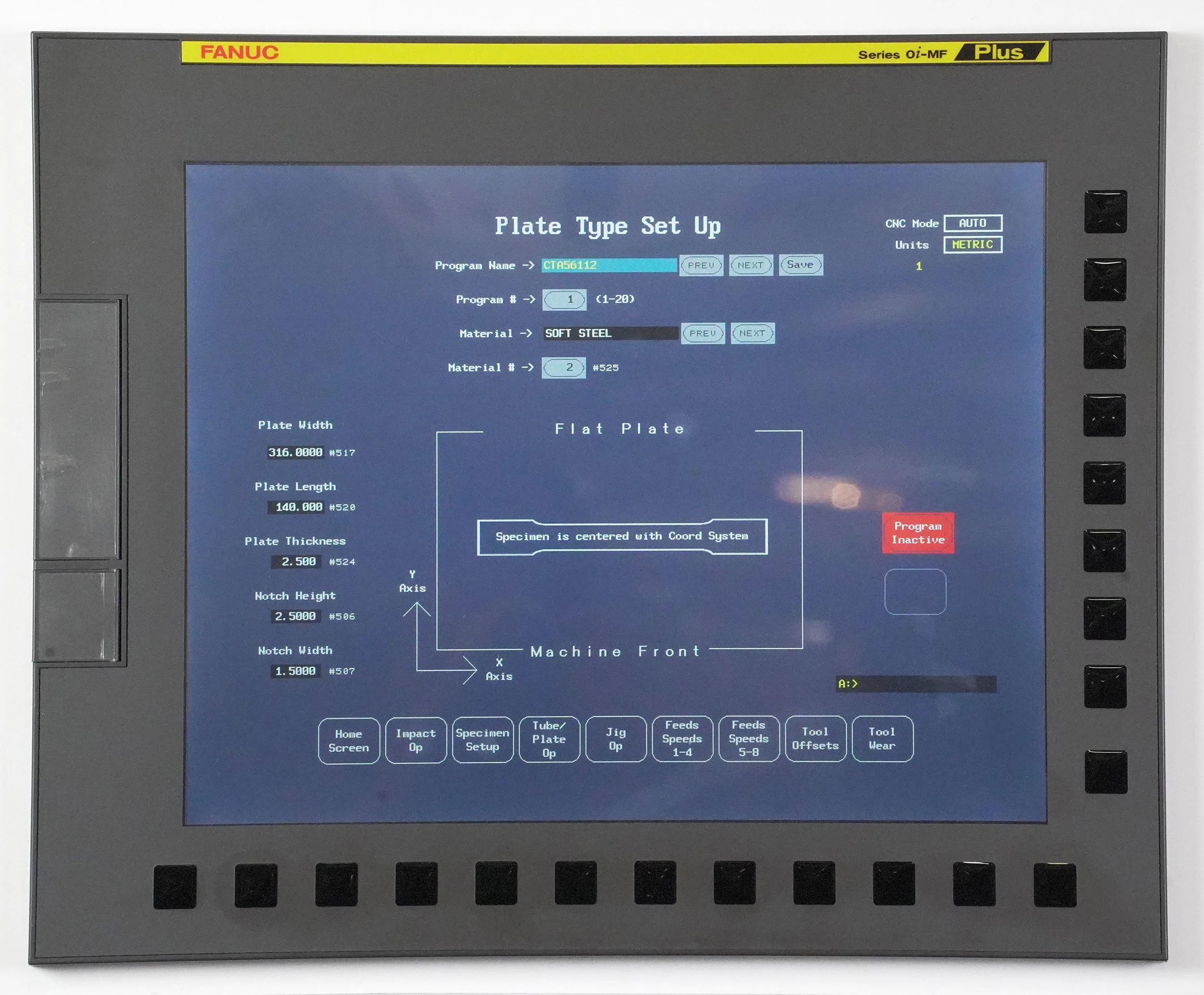
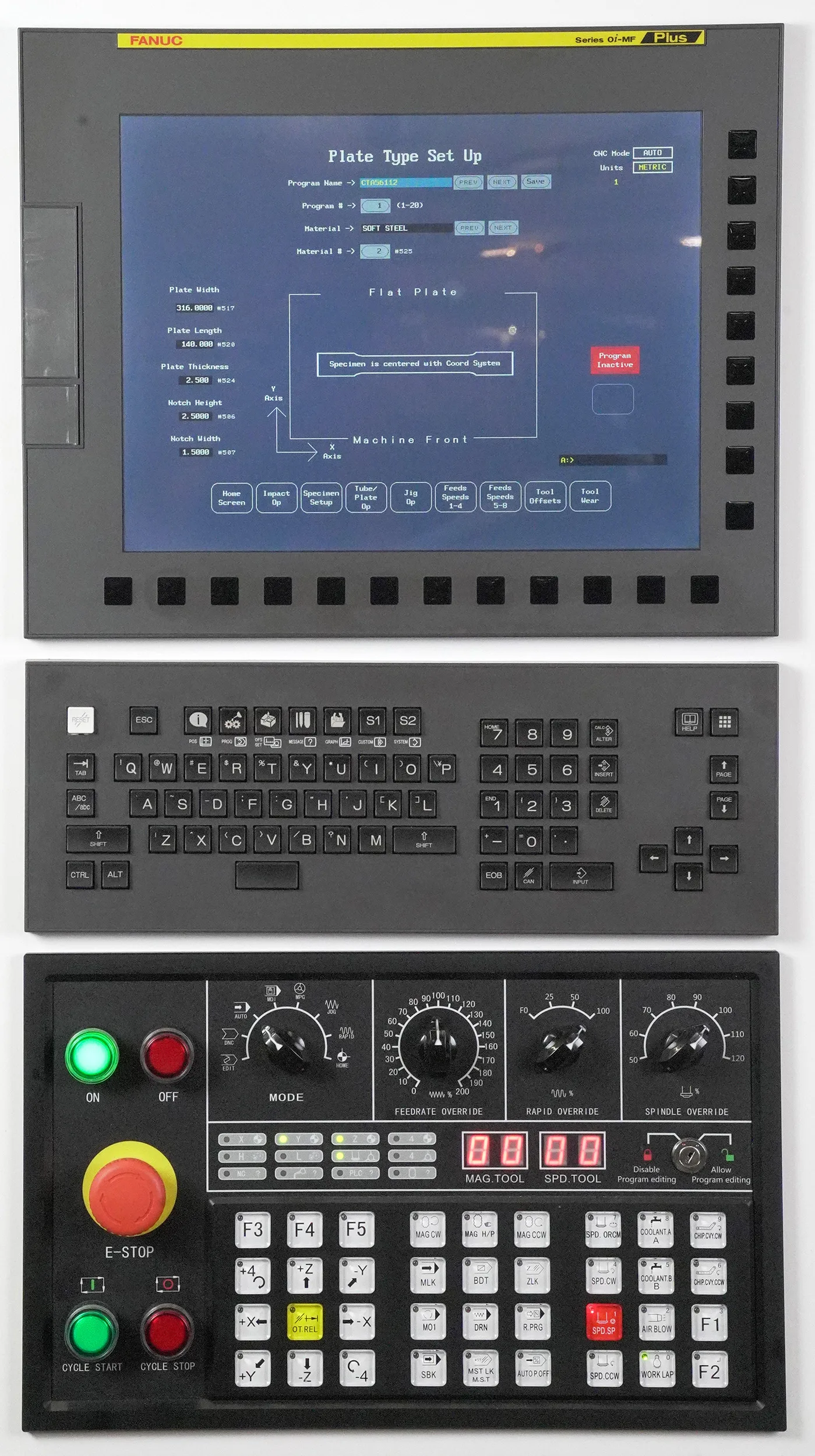
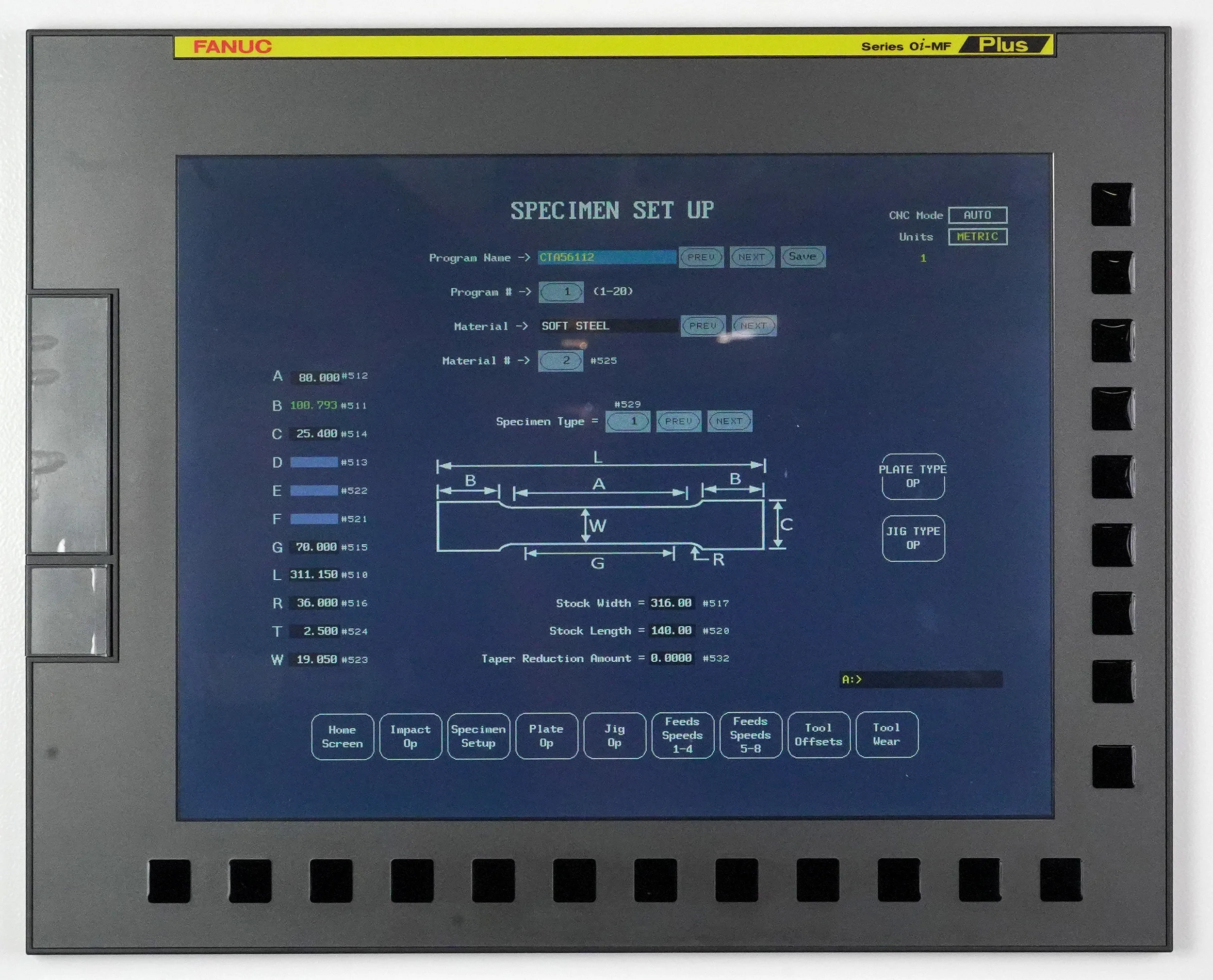
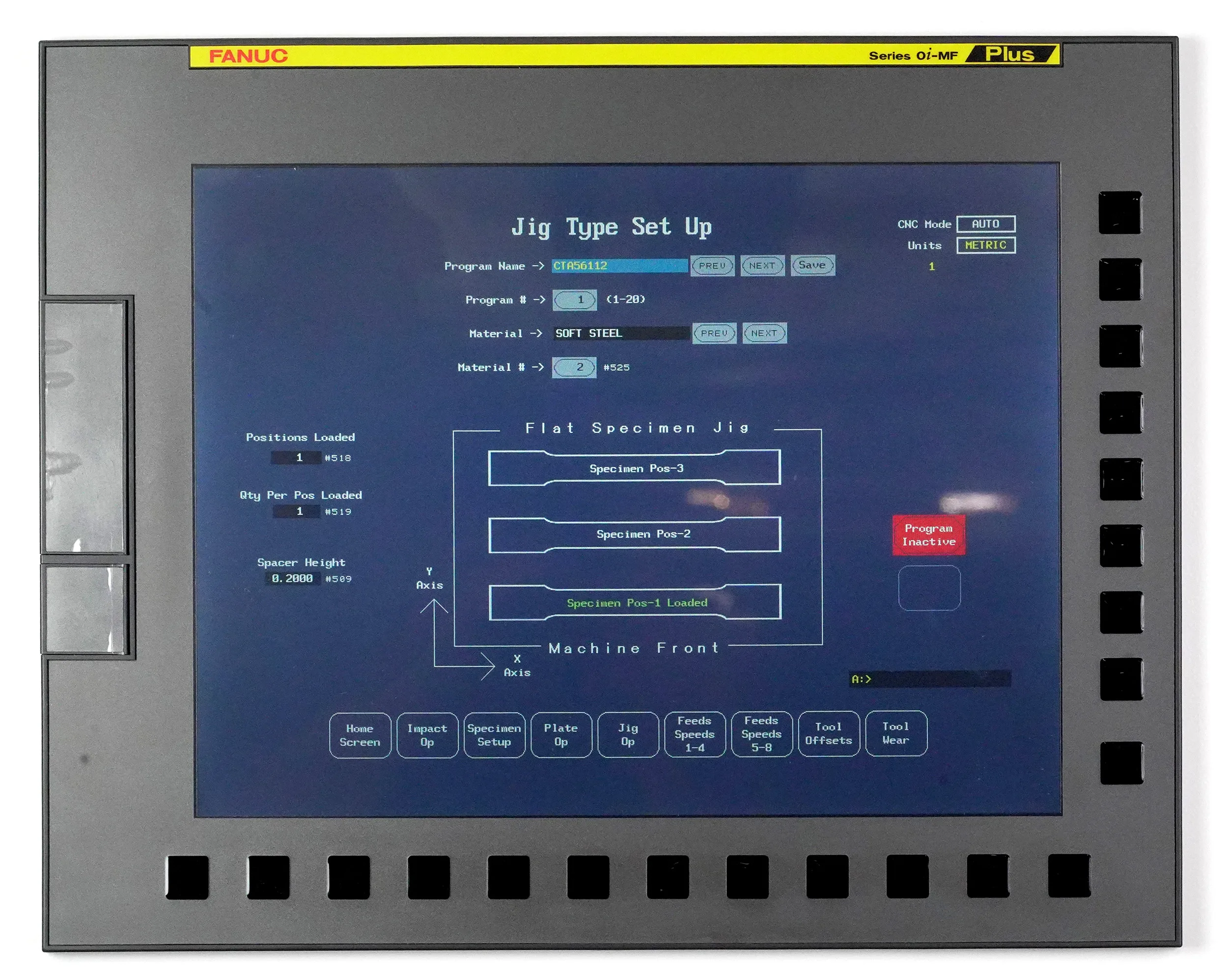
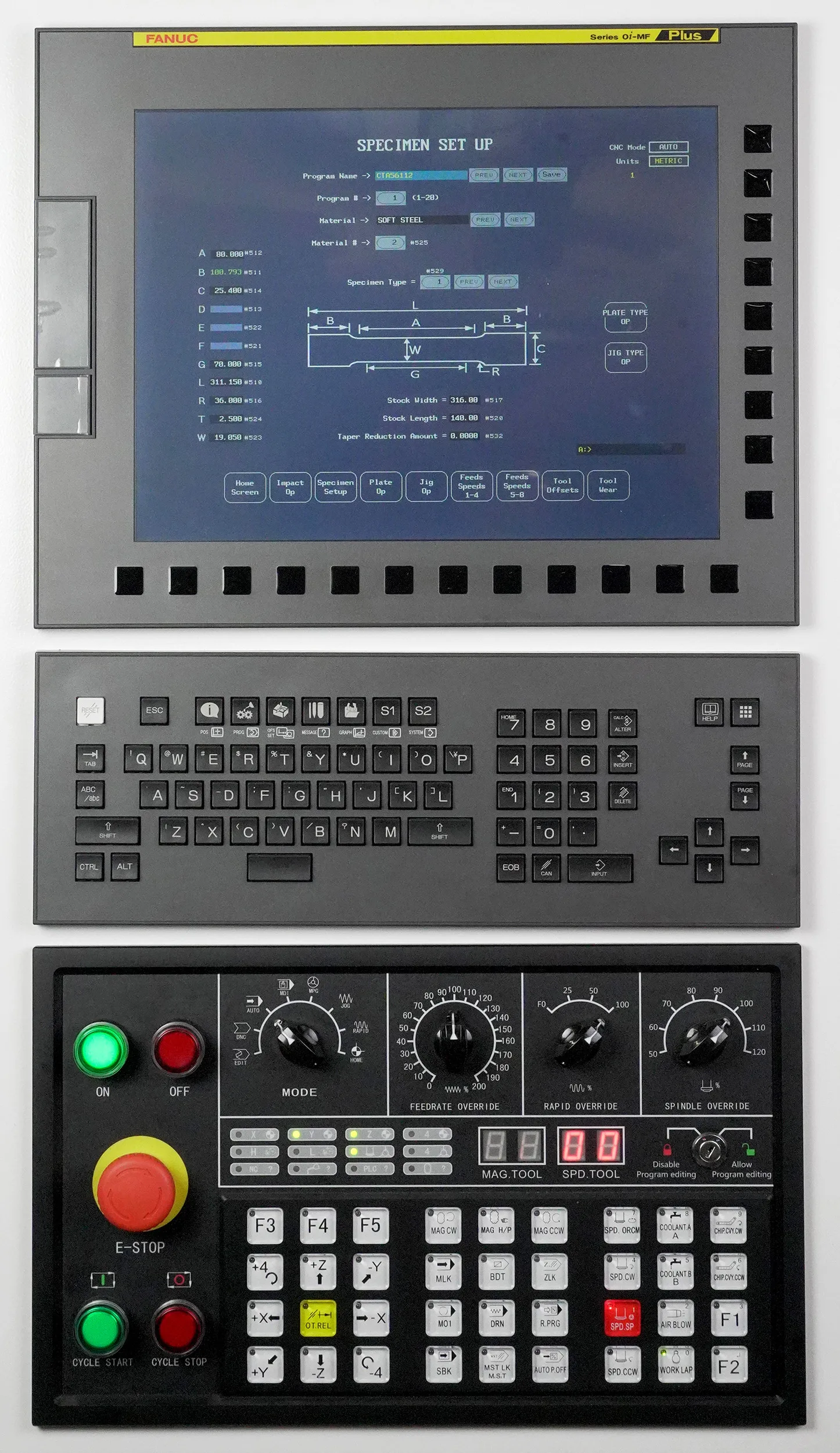
Operators work through a 10.4 in (264 mm) touchscreen that presents guided steps in TensileSoft and the Fanuc control. Preloaded ASTM and ISO templates, editable fields for gauge length and width, and recipe saving reduce keystrokes and help maintain repeatability from shift to shift. The interface highlights fixturing and tooling selections, then walks the user through clamp, probe, and cycle start, which shortens ramp-up for staff without prior CNC experience. Training typically covers safe setup, fixture use, software navigation, tool selection, and basic maintenance, with continued technical guidance available whenever you need a refresher or bring new team members on board.
If you would like a closer look at the controls and onboarding support, you can review details on the
TensileMill CNC Classic Upgrade product page.
Does the TensileMill CNC Classic Upgrade Meet ASTM, ISO, and Other International Tensile Testing Standards?
Yes. The Classic Upgrade is engineered to align with widely adopted flat tensile specimen standards, including ASTM E8, ISO 6892, ASTM A370, and comparable DIN and JIS specifications, when configured with the appropriate tooling, programs, and fixturing.
Compliance in daily operation is achieved through parameter driven geometry templates, consistent datum routines, and a rigid machine structure that limits vibration and deflection for repeatable gauges, radii, and surface finish across batches. Results depend on correct cutter selection, workholding strategy, feed and speed pairing, fillet radius control, gauge length layout, and final polishing practices to remove burrs or heat affected edges. To support audits and submittals, our team provides application setup, process documentation, and optional certification assistance for ASTM, ISO, and NADCAP programs. We can also help validate workflows that include third party devices, so your end to end process tracks the required standard.
If you would like to review capabilities and typical standard templates, you can learn more on the
TensileMill CNC Classic Upgrade product page.
What Are the Maintenance Costs for the TensileMill CNC Classic Upgrade?
Ongoing ownership costs for the Classic Upgrade are low. The system uses durable components and a rigid, low-wear drive train, so routine care is simple and infrequent for most labs.
In typical use, you will budget primarily for lubricants, basic filters, periodic tooling calibration, and normal cutter or end mill wear that depends on material type and throughput. The machine’s preloaded linear guides and ballscrews, balanced spindle tooling, and sealed electrical cabinet help limit friction, protect moving elements, and reduce unscheduled service. Day-to-day tasks usually include wiping down exposed ways, topping up lubrication points, checking belt tension, verifying axis backlash compensation, and confirming spindle runout during scheduled intervals. No proprietary maintenance kits are required, and most preventive work can be completed with standard shop tools.
For higher duty cycles or multi-shift environments, Preventive Maintenance Service Packages are available. A PM visit typically covers mechanical inspection, alignment checks, spindle health review, control diagnostics, firmware backup, and an operator refresher. This approach reduces downtime risk, supports consistent specimen throughput, and extends service life without adding significant annual expense.
If you would like to review ownership details and support options, you can explore features and service offerings on the
TensileMill CNC Classic Upgrade product page.
How Does TensileMill CNC Mitigate Downtime for Flat Tensile Sample Preparation Systems?
A responsive support workflow keeps production interruptions short on our flat-specimen machining systems. For the Classic Upgrade platform, you can reach expert support by phone at 877-672-2622 ext. 3, by email at support1@tensilemillcnc.com, or through our ticket portal. Most requests receive an initial remote assessment within 4 hours, and more involved cases are typically closed within 24 to 48 hours, with replacement part coordination handled during the same window.
When an alarm, surface finish issue, or dimensional drift is reported, specialists guide operators through focused diagnostics: control status capture, toolpath review, probing and work offset checks, cutter inspection, and fixture verification for flat blank alignment. Live screen shares and photos accelerate root-cause isolation so the spindle returns to cutting specimens with minimal delay.
If hardware is implicated, the team arranges the correct serialized components, provides installation guidance, and validates cut parameters on a short test run to confirm geometry and surface finish against your required standard. Proactive tips on maintenance intervals, tooling selection, and a recommended spares list further reduce repeat stops and support consistent throughput.
If you would like to review service options, support contacts, and system capabilities, you may read more on the
TensileMill CNC – Classic Upgrade product page.
What Is the Typical Cost Range Per Flat Tensile Specimen on the Classic Upgrade Machine?
Typical in-house cost to prepare a flat tensile specimen on the Classic Upgrade is usually between $150 and $300 per piece. The figure varies with specimen geometry, material hardness and thickness, tolerance and surface finish targets, and batch size.
Three factors drive the number: operator time, tooling and consumables, and finishing steps. Larger or tighter-tolerance profiles often call for extra roughing and finishing passes, while tougher materials increase cutter wear. If you run short batches with frequent changeovers, costs trend toward the upper end. When you stack blanks, nest multiple coupons, and repeat the same program, setup is amortized and cost moves toward the lower end. If your workflow includes deburring or polishing prior to tensile testing, include that time and media in your estimate. For an exact model matched to your material mix, geometry, and throughput, you may use our flat specimen preparation calculator or request a tailored quotation from our product specialists.
If you would like machine specifics or a cost model aligned to your throughput, you can review technical details on the
TensileMill CNC Classic Upgrade product page.
What Is the Typical Cost Range Per Flat Tensile Specimen With the Classic Upgrade Machine?
For most labs, the typical cost per flat specimen when machining with the Classic Upgrade and completing one tensile test is $150 to $300 per piece. This estimate covers programming or template selection, setup, tool wear, operator time, fixturing, basic edge finishing, and a single pull on a universal testing machine.
Costs trend higher with hard alloys, complex dog-bone geometries, tight tolerances to standards such as ASTM E8 or ISO 6892, extra polishing for surface finish, or expedited changeovers. Per-part rates often drop when specimens are batched, setups and grips are reused, multi-clamp fixtures are used, and standard geometries are selected. Material removal volumes, cutter life, and target throughput also influence pricing. If you are evaluating total ownership, consider recurring items like cutters, clamps, and polishing media alongside expected monthly specimen volume to benchmark your internal rate against outside machining and testing services. A tailored quotation can itemize each driver for your materials and workflows.
If you would like a tailored breakdown for your application, you may review capabilities and request details on the
TensileMill CNC Classic Upgrade product page.
What Additional Maintenance Steps Extend the Life of a Tensile Sample Preparation Machine?
Routine preventive maintenance and a clean workspace go a long way. Keep the lubrication reservoir topped with the recommended oil, wipe down exposed surfaces, and remove chips after each shift to reduce wear on moving components and guarding.
For daily care, vacuum chips instead of blowing them into seals, clear the chip tray, and dry any coolant residue on the table, vises, and fixtures. Confirm that the automatic lubrication system is cycling and that lines are intact. Inspect the spindle taper and tool holders for debris, then lightly clean and re-seat them to protect runout. Keep the coolant or mist system clean by using approved fluids and replacing filters as needed. Periodically check way covers, door interlocks, cable carriers, and the condition of belts, fasteners, and guarding. Verify that the air supply is clean and dry to protect valves and actuators. Back up machine parameters and software, and record service actions in a simple log so you can spot trends. Train operators to run a brief warmup program at start of day, handle specimens and tooling carefully, and report any unusual noise, heat, or vibration immediately.
If you would like maintenance guidance tailored to your setup or a recommended service interval, you can connect with our team on the
Contact Us page.
How Many Tensile Specimens Can Be Prepared Per Cycle?
Throughput per cycle varies by material, specimen geometry, and workholding. On flat CNC tensile systems, you can machine a single coupon in one setup or run a batch using multi-station clamps, fixture plates with nesting, or stacked blanks when thickness and rigidity allow.
The achievable count depends on thickness and hardness, which influence cutter engagement, pass strategy, and allowable stack height. Standards such as ASTM E8 or ISO 6892 define gauge length and width, which dictate part spacing and fixture pocket layout. Tough alloys and thicker stock increase cycle time and often favor one-up machining with separate rough and finish passes, while thinner sheet and softer metals suit nested batches that deliver higher parts per hour. Tool diameter, corner radii, coolant delivery, and changeover method also affect real-world yield. If you share your alloy, initial blank size, thickness, and target standard, our team can provide an application-specific parts-per-cycle and hourly throughput estimate.
If you would like to compare batch fixturing and table sizes, you can review models and options on the
Flat Tensile Test Sample Preparation Machines page to learn more about throughput planning.
What Types of Base Fixtures Are Available for Tensile Sample Preparation Machines?
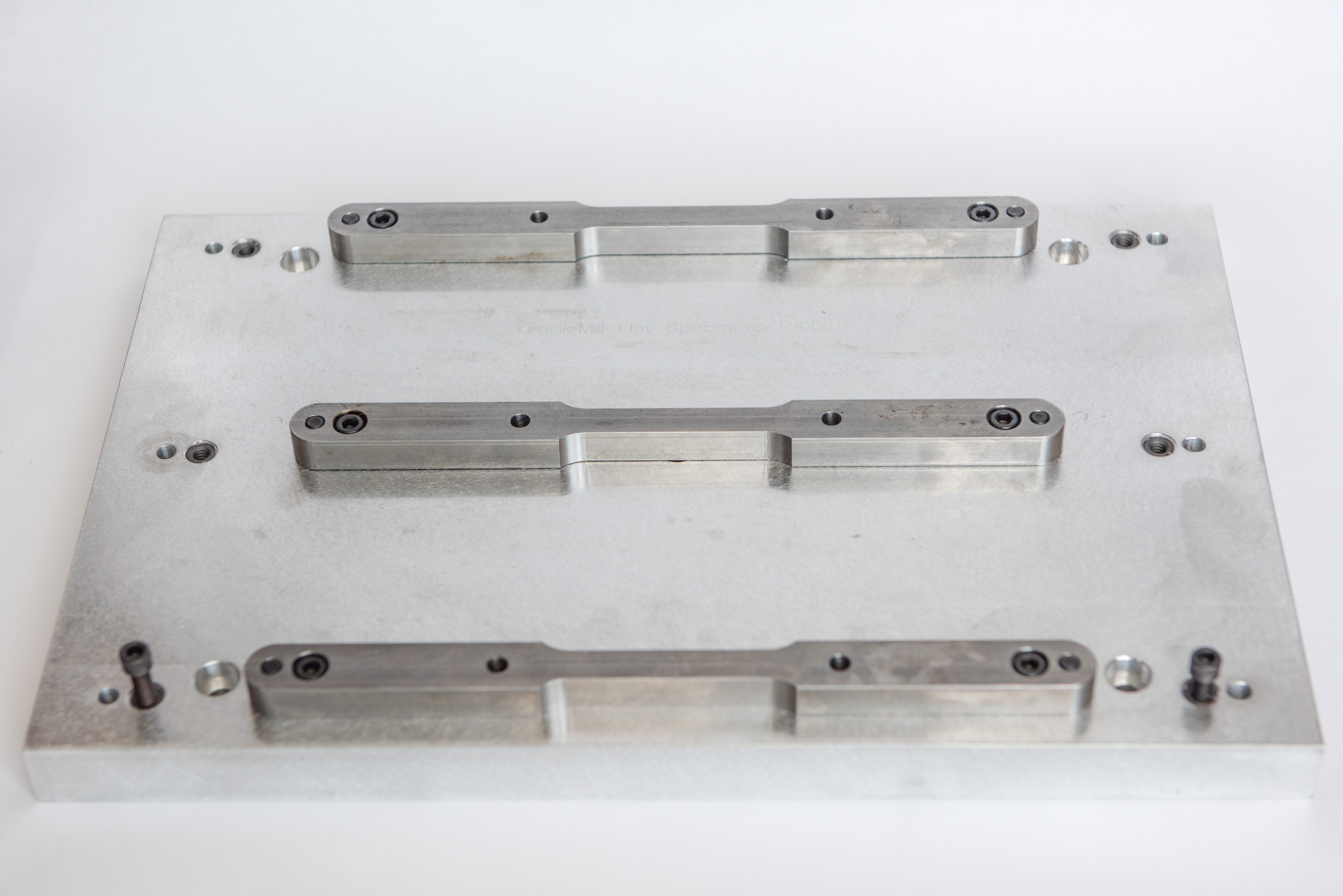
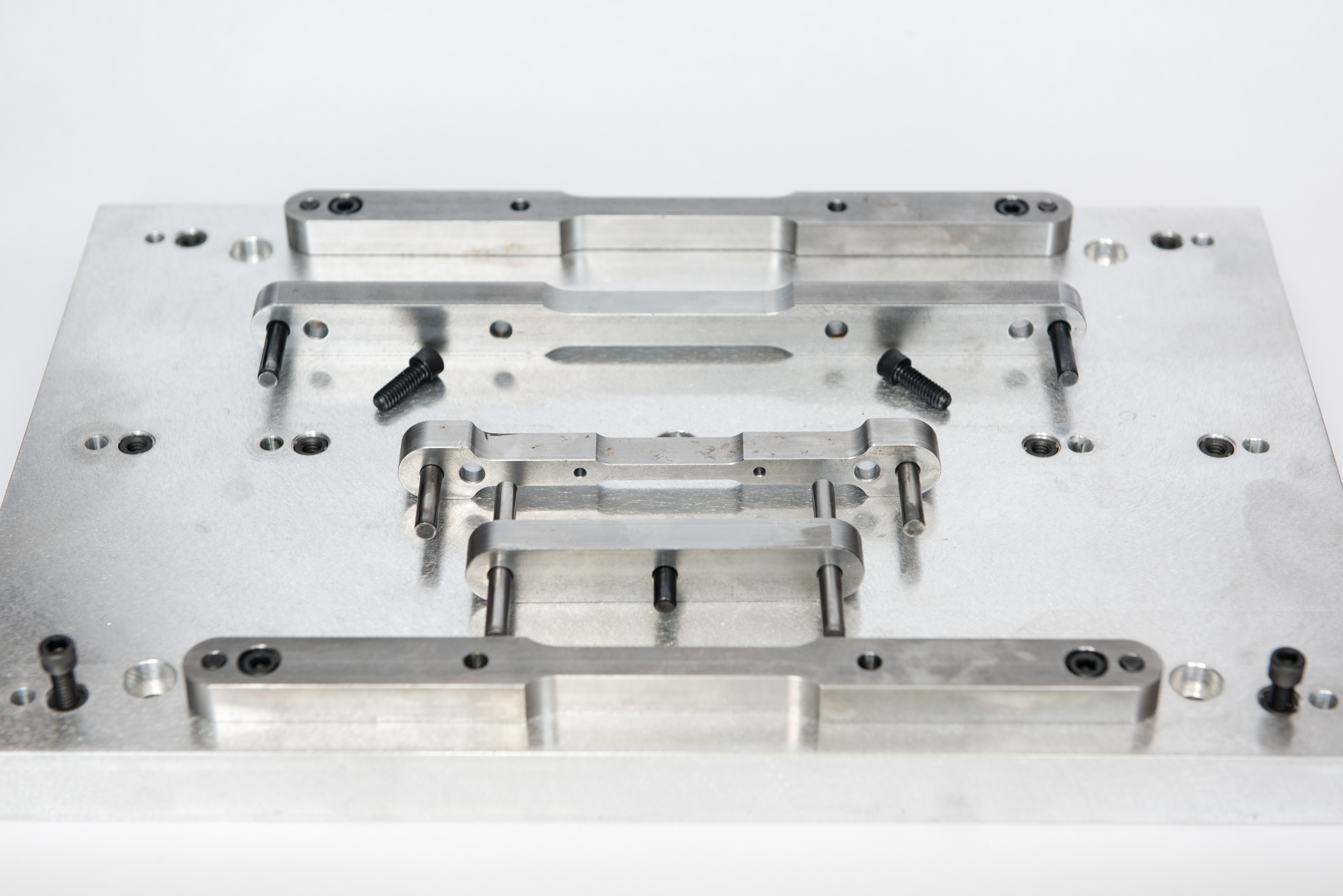
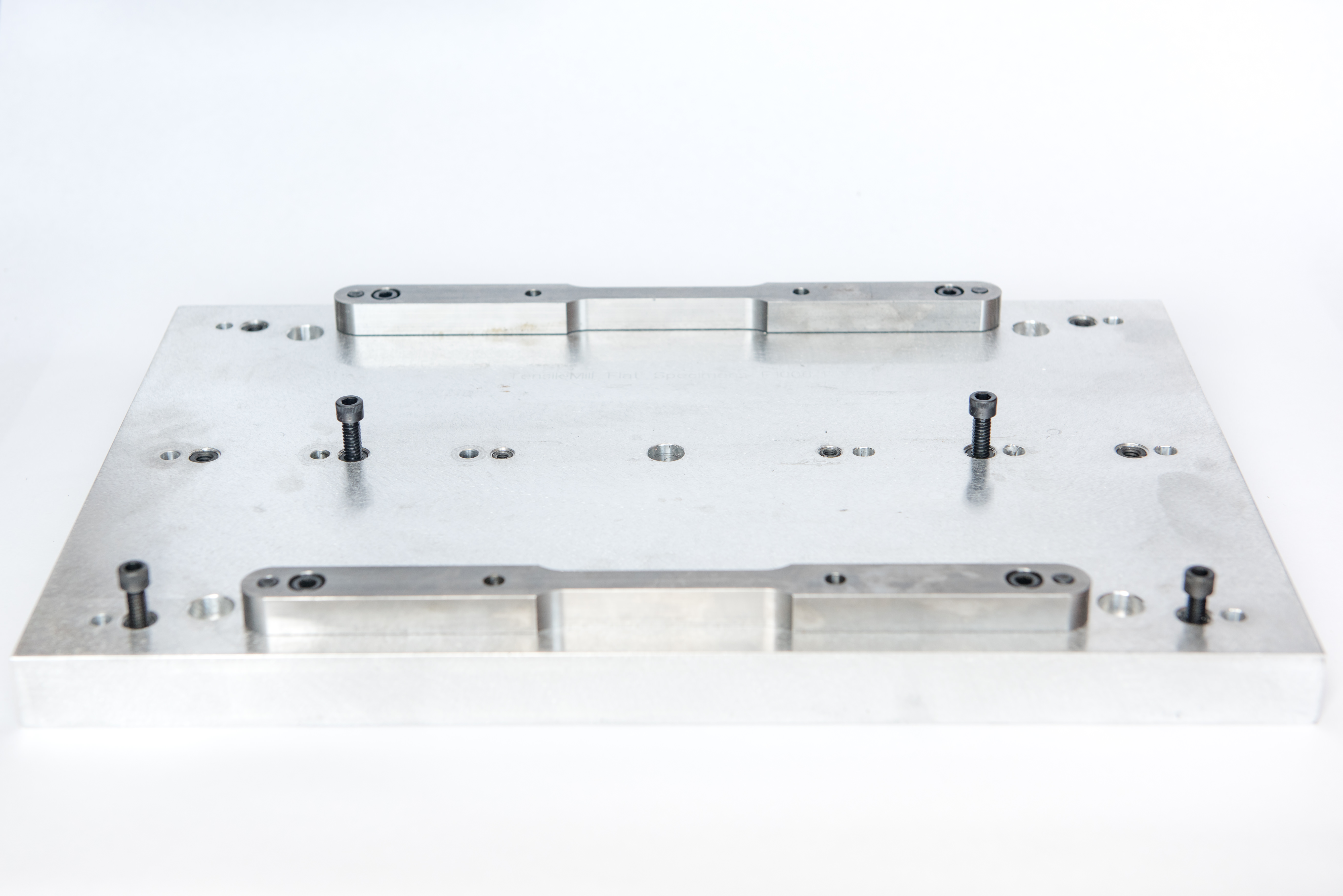
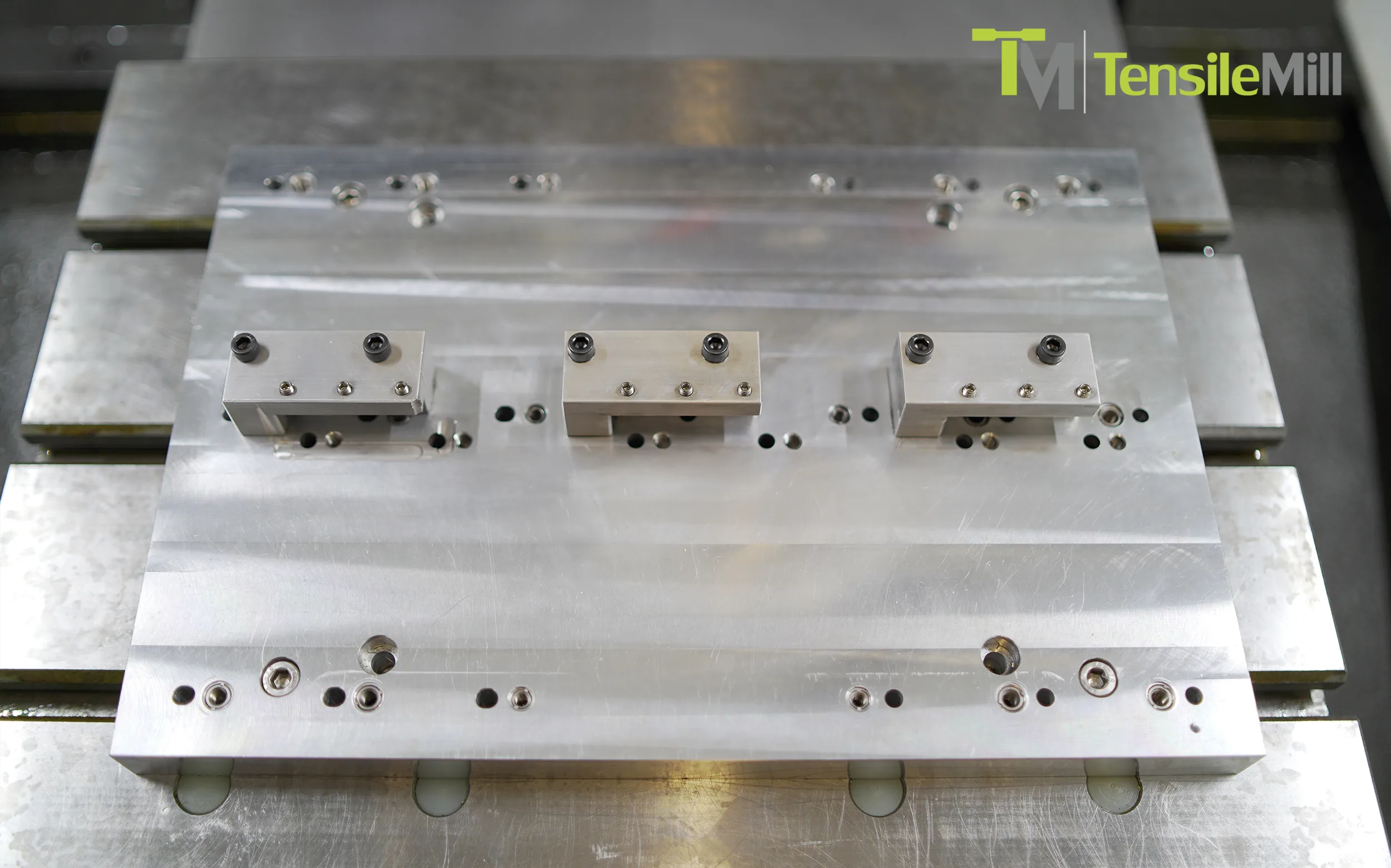
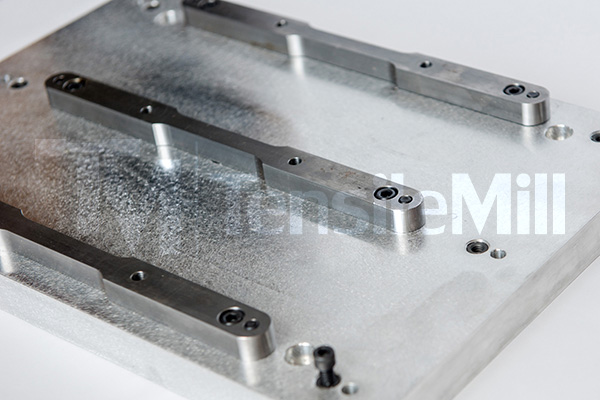
Flat tensile preparation systems from TensileMill CNC are supplied with a stainless steel base fixture tailored to the specimen geometry in your method library. Optional clamping fixtures expand the holding envelope for different blank lengths, covering approximately 15 in down to 4 in (381 mm to 102 mm). Each package also includes an ER collet and carbide end mills, with only the cutters considered routine consumables.
The base fixture is built for long service life and resists wear in high-throughput labs. It is configured to support common flat specimen profiles used in standards such as ASTM E8 for metals, ISO 6892-1, and ASTM D638 for plastics when applicable to your workflow. When your starting blank length changes, selecting the matching clamping fixture maintains full contact and stable clamping, which helps hold gauge-width tolerance and finish quality during milling. End mill life ranges from weeks to months based on part volume, material hardness, and blank thickness, so keeping a small stock of our coated carbide tools helps prevent unplanned downtime.
If you would like to compare fixture options or check current availability, you can review details on the
Tensile Sample Preparation Consumables, Fixtures, and Spare Parts page.
What Is the Typical Lifespan of End Mills for TensileMill CNC Milling Machines?
Tool life varies because it depends on material hardness, blank thickness, toolpath strategy, coolant use, and spindle setup. Our systems ship with specialty carbide end mills in bright finish or Alcrona Pro coating that are engineered for tensile specimen machining. In production labs, these cutters commonly deliver extended service across multiple batches, including high-throughput programs, but there is no single hours-or-parts figure that applies to every application.
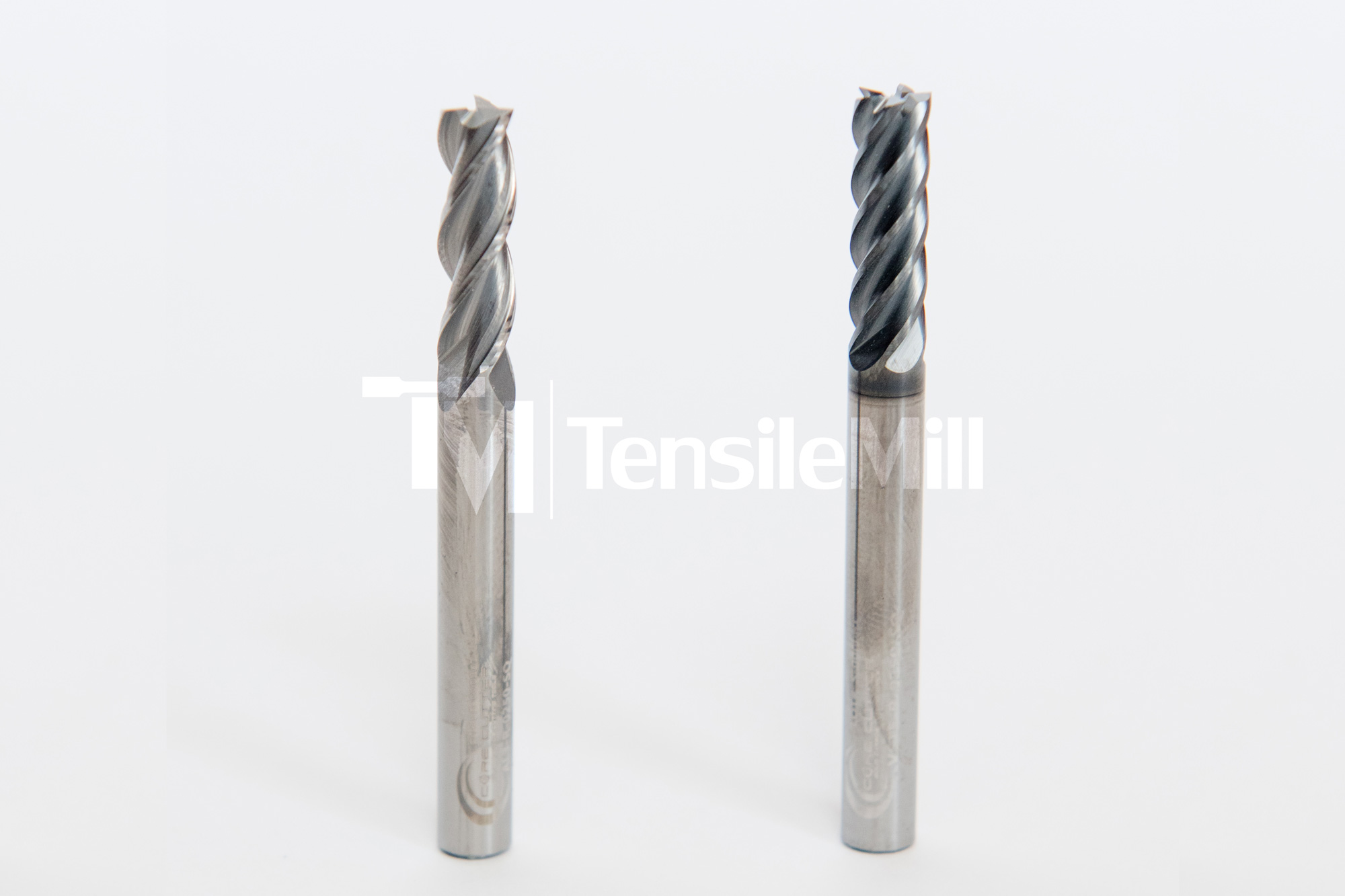
For the longest life, match the geometry and coating to the workpiece: bright finish for aluminum and other nonferrous materials, AlCrN-type coatings such as Alcrona Pro for steels, stainless, and nickel alloys. Use conservative radial engagement, climb milling on profiles, ample coolant, and rigid fixturing. Keep spindle runout at or below 0.001 in (0.025 mm). Replace a cutter when surface finish begins to dull, burrs increase, spindle load trends upward, or edge wear and micro-chipping become visible under magnification. Keeping a spare set of identical tools on hand helps maintain consistent specimen quality and uptime.
If you would like application-specific tooling guidance or to review stocked options, you may explore the
Consumables and Spare Parts page for end mills matched to our sample preparation machines.
How Do Flat Tensile Specimen Machines Keep the Gauge Section Centered During Two-Sided Machining?
Symmetry is achieved with a one-setup flip process that keeps the blank registered to the same clamping faces for both passes. The machine completes the first side, pauses, and the operator rotates the fixture while the work offset and datums remain unchanged. The second operation runs a mirrored toolpath around the same centerline, so the gauge section stays centered and thickness remains uniform.
Dedicated reference surfaces in the fixture control X and Y location, while the clamping stack maintains Z datum, preventing drift that commonly appears when parts are reindicated on manual equipment. Matching step-downs, cutter paths, and feed strategies for both sides keep cutting forces balanced, which helps avoid taper, bow, or offset shoulders. The same workflow applies to multi-part fixtures or stacked blanks, so every coupon in the set carries the same geometry. For labs preparing flat specimens to ASTM E8 or ISO 6892, this approach supports gauge section alignment and parallelism requirements without extra setup time.
If you would like to compare fixturing and workflow options, you can review model details on the
Flat Specimen Preparation Equipment Lineup page.
What Does the Flip-Jig Fixture Do in Two-Sided Tensile Specimen Machining?
The flip-jig is a dedicated workholding fixture that clamps the specimen blank for two-sided milling, keeps the centerline aligned, and preserves the work offset during rotation. By holding the blank in a consistent datum, it allows the part to be rotated when prompted by the software without changing the machining origin.
In practice, you clamp the raw blank, machine the first side, then rotate the part 180 degrees within the same fixture when the program prompts a flip. Because the datum remains constant, the controller continues from the same zero, which reduces thickness mismatch, shoulder radius offset, and gauge-section runout compared with manually re-centering on a general-purpose CNC. The result is tighter correlation between faces, faster changeovers, and stable parallelism across batches.
One flip-jig is supplied with the system and is selected to match expected specimen length. Available sizes include 4 in (101.6 mm), 8 in (203.2 mm), and 12 in (304.8 mm). Selecting the correct size matches the clamping span to the blank, improving stability and surface finish on thin or long samples.
If you would like to compare compatible systems and fixturing options, you can review details on the
Flat Tensile Test Sample Preparation Machines page.
How Many Steps Are Required to Prepare One Flat Tensile Specimen on a TensileMill CNC?
Most users complete one flat tensile specimen in five steps. Select the standard or custom profile on the touchscreen, clamp the blank in the flip fixture against the alignment stop, start the first-side program, rotate the flip fixture when prompted without re-centering, then resume the cycle to machine the second side.
The built-in library covers common profiles such as ASTM E8 or ISO 527, so dimensions are loaded once and stored for repeat runs. Toolpaths, spindle speed, and motion control are automated, which keeps operator involvement to alignment and the single flip. The fixture datum preserves registration between sides, producing consistent gage width and surface finish for reliable tensile results across batches.
If you would like to compare model options for flat specimen machining, you can review capabilities on the
Flat Specimen Preparation Equipment Lineup page.
How Is the Flood Coolant System Maintained and Refilled?
Our flat-specimen machining systems use a recirculating flood coolant housed in the machine base, so all plumbing, filtration, and return flow stay inside the enclosure. Routine care focuses on fluid level, concentration, and chip control to keep cut quality and pump life stable in a lab setting.
To refill, open the sump access inside the enclosure and add premixed water-soluble coolant until the sight gauge or fill mark is reached. Typical lab units hold about 10 gal (37.9 L). After filling, run the pump briefly to verify steady return flow to the tank. For day-to-day operation, top off with the same premix rather than straight water to avoid diluting the blend.
Maintenance includes checking concentration with a refractometer and adjusting with concentrate or water per the coolant manufacturer’s chart, cleaning the intake screen and return tray so chips do not starve the pump, and skimming tramp oil as needed. Plan full tank cleanouts on a usage-based interval, for example every few months, which includes draining, wiping sediment, flushing lines, and replacing disposable filters if fitted. No external coolant supply is required, which keeps service simple for laboratories and small production cells.
If you would like a model-by-model look at coolant features for our flat specimen mills, you can review details on the
Flat Tensile Test Sample Preparation Machines page.
Is In-House Tensile Specimen Preparation More Cost-Effective Than Outsourcing?
For labs with steady testing, in-house preparation typically reduces total cost after the initial equipment purchase, because the marginal cost per specimen becomes far lower than paying per batch externally. For occasional or sporadic testing, outsourcing can be practical since there is no upfront capital spend.
Outsourcing carries variable charges that repeat with every order: setup and machining fees, packaging, two-way shipping, potential rush charges, and idle time while parts are in transit. Those costs scale directly with demand and can rise with tighter tolerances or special profiles for standards such as ASTM E8 or ISO 527. If rework is needed, the cycle repeats.
In-house shifts spending to a fixed asset plus predictable items like cutters, inserts, coolant, and routine maintenance, along with operator time. Once a flat or round specimen system is installed, the next sample mainly reflects tool wear and minutes of machine time, and adjustments happen immediately without courier delays. Facilities running regular production checks, R&D iterations, or academic coursework usually see per-specimen cost drop as throughput increases, especially when using batch cycles or multi-part fixtures to machine multiple blanks in one run.
If you would like to discuss throughput, staffing, and payback for your lab, you can connect with our team on the
Contact Us page.
How Do I Choose Between Flat and Round Tensile Specimen Preparation Systems?
Start with your material form and the target geometry required by your test method. Flat preparation is ideal for sheet, plate, or molded panels, commonly used for ASTM E8 metals or ISO 527 plastics. Typical flat dog-bone sizes include 0.25 to 1.00 in (6 to 25 mm) gauge width with 1.00 to 2.00 in (25 to 50 mm) gauge length and 0.125 in (3.2 mm) fillet radii. Round preparation suits bar, rod, wire, or cast buttons, with frequent sizes of 0.250 to 0.500 in (6 to 13 mm) diameter and 2.00 to 4.00 in (50 to 100 mm) gauge length. Target tolerances often hold ±0.001 in (±0.025 mm) in the gauge section and 0.001 in TIR (0.025 mm) concentricity for round specimens.
Consider throughput and handling. For high coupon volumes across multiple alloys, a fixtured flat CNC system supports repeatable nesting and quick changeovers. For rounds, a programmable lathe-style machine with tailstock support and center drilling maintains straightness on longer pieces, for example 6 to 12 in (152 to 305 mm) overall length, while flood or mist coolant protects both metals and polymers.
Confirm UTM and grip compatibility early. Flats pair well with wedge or pneumatic grips using 1 to 2 in (25 to 50 mm) jaw widths. Rounds may require collets, shoulders, or threaded ends such as 0.500-20 UNF, with shoulder perpendicularity within 0.002 in (0.05 mm). Surface finish affects results, so polish the gauge section longitudinally to Ra ≤ 32 µin (0.8 µm), or to 16 µin (0.4 µm) for notch-sensitive materials, and verify dimensions against the selected standard during first-article inspection.
If you are comparing flat and round preparation solutions, you can explore the
TensileMill CNC Homepage to review product families on the page.
How Do I Choose Between Flat and Round Tensile Specimen Preparation Systems?
Selection depends on your product form, the governing standard, and downstream gripping. For sheet, plate, and extrusions, a milling-based system produces flat coupons to ASTM E8/E8M or ISO 6892-1 for metals, and ASTM D638 or ISO 527 for polymers. For bar, rod, and forged stock, a lathe-style system machines round specimens, typically 0.500 in (12.5 mm) nominal diameter with 2.00 in (50 mm) gauge length for ASTM E8, or subsize options when thickness limits the section.
Consider precision and finish. Flat machining supports tight edge tolerance around ±0.001 in (±0.025 mm) and surface finish near 32 µin Ra (0.8 µm) when tooling is sharp. Turning round specimens makes concentricity and straightness easier to control, often within 0.001 in (0.025 mm) TIR, which reduces bending errors. If your lab needs a mirror finish for strain extensometers, plan on a polishing pass to achieve 16 µin Ra (0.4 µm) or better.
Throughput and fixturing also matter. Flat systems can fixture multiple blanks per cycle, which is efficient for sheet from 0.020 to 0.250 in (0.5 to 6.0 mm) thickness. Round systems suit continuous runs from 0.125 to 1.000 in (3.2 to 25.4 mm) diameter bar. Verify your UTM grip style, wedge grips for flat widths like 0.500 in (12.5 mm) or collet or threaded holders for round shoulders, and confirm overall length, for example 6.0 to 10.0 in (152 to 254 mm), matches the machine and standard.
For additional guidance, you can connect with our team on the
Contact Us page.
How Do I Choose the Right Flat Tensile Sample Preparation Machine for ASTM E8, ASTM D638, or ISO 527 Work?
Start with your material range and blank size. If most coupons come from sheet, a compact work envelope such as 12 in × 12 in (305 mm × 305 mm) is efficient. For plate cutting or multiple-up nesting, consider larger travels, for example 24 in × 36 in (610 mm × 914 mm). Match spindle power and tooling to your thickness, such as 0.020 in to 1.50 in (0.5 mm to 38 mm), and plan for tool diameters from 0.0625 in to 0.375 in (1.6 mm to 9.5 mm).
If you would like to compare sizes, options, and workflows side by side, you can review model details on the
Flat Tensile Test Sample Preparation Machines page.
How Do I Choose the Right Flat Tensile Specimen Preparation System for My Throughput and Materials?
Start by quantifying volume and changeover frequency. If one profile takes about 3 minutes of cut time plus 1 minute of handling, stacking 3 blanks per cycle yields roughly 45 specimens per hour. Look for rigid fixturing that supports stacked thickness targets, for example 0.50 in (12.7 mm) total, and verify chip evacuation so buried layers do not overheat or burr.
Match cutting strategy to material. Typical starting surface speeds are 600–1000 SFM (183–305 m/min) for aluminum, 150–300 SFM (45.7–91.4 m/min) for carbon steel, 100–200 SFM (30.5–61.0 m/min) for stainless, and 80–120 SFM (24.4–36.6 m/min) for hardened alloys with TiAlN-coated carbide. Use 0.0015–0.004 in (0.038–0.102 mm) per-tooth feed and shallow stepdowns of 0.02–0.06 in (0.50–1.50 mm) to control heat and edge quality on the gauge section.
Select software that locks in specimen geometry from a standards library and exports a run record. For metals reference ASTM E8 or ISO 6892-1, and for plastics reference ASTM D638 or ISO 527. Aim for a uniform gauge finish of 63 µin Ra (1.6 µm) or better, and plan a light final pass of about 0.005 in (0.13 mm) to remove tool marks and minimize burrs. For thin sheet, a vacuum table with a sacrificial backup of 0.25 in (6.35 mm) improves flatness and edge integrity.
For labs with frequent size changes, an automatic tool changer and quick-swap jaws reduce cycle losses, while larger work envelopes support multi-up fixtures that increase hourly output without adding operators.
If you want a side-by-side look at compact and full-size options, you can review model details on the
Flat Specimen Preparation Equipment Lineup page.
How Do I Select the Right Flat Tensile Specimen Preparation Machine for Metals, Composites, and Polymers?
Start by matching expected material range and blank size to the work envelope and clamping options. For typical flat coupons, ensure the machine accommodates blank thickness from 0.02 to 0.50 in (0.5 to 12.7 mm) with rigid parallel clamping. If you process hard alloys, confirm cutter stability and spindle torque suitable for up to 60 HRC, plus coolant delivery and effective chip evacuation for stainless and nickel grades. For composites and polymers, prioritize dust extraction and heat control.
Define accuracy targets based on your lab’s method. Many teams aim for gauge width tolerance of ±0.002 in (±0.05 mm), shoulder radius within ±0.005 in (±0.13 mm), and edge burr less than 0.002 in (0.05 mm) to reduce notch effects. When preparing metals to ASTM E8 or ISO 6892, or plastics to ASTM D638 or ISO 527, verify that the software can call standard geometries, edit dimensions, and lock feeds to prevent operator deviation.
Evaluate throughput and automation that actually save minutes per coupon. Look for a probing routine to locate blanks, a tool changer with finishing and roughing tools, and fixtures that allow stacking within the travel area, for example 8 in × 12 in (203 mm × 305 mm). A practical workflow includes a rough pass, a finish pass at reduced step-over, and a light deburr or polish to reach an Ra near 63 µin (1.6 µm) for metals, while using lower surface speeds on polymers to avoid heat-affected edges.
If you would like to compare sizes, controls, and automation options, you can review detailed options on the
Flat Specimen Preparation Equipment Lineup page.
What Dimensional Tolerances And Surface Finish Are Recommended For Flat Tensile Specimens Prepared By CNC Milling?
For metallic coupons prepared to ASTM E8/E8M or ISO 6892-1 geometry, most laboratories target reduced-section width and gauge length within ±0.002 in (±0.05 mm), overall length within ±0.010 in (±0.25 mm), and gauge flatness within 0.002 in (0.05 mm). Aim for a surface finish of 32–63 µin Ra (0.8–1.6 µm) on the gauge section to support stable extensometer contact and consistent strain. Break all edges lightly, about 0.005–0.010 in (0.13–0.25 mm), and remove burrs without narrowing the net width. Shoulder radii should follow the selected standard; where custom, hold radius mismatch under 0.002 in (0.05 mm).
Use stable fixturing on a rigid sacrificial backer, then rough and finish. A typical finishing pass removes 0.010–0.020 in (0.25–0.50 mm) per side with climb milling to minimize recast and burr formation. Keep the work below 150 °F (65 °C) with flood coolant or MQL so temper or residual stresses are not altered. Fresh carbide end mills around 0.250 in (6.35 mm) handle shoulders efficiently, with smaller tools near 0.125 in (3.18 mm) for tight radii.
Verify width at three locations in the gauge using a micrometer with 0.0005 in (0.01 mm) resolution, confirm straightness and parallelism with a granite square or indicator, and document actual dimensions on the traveler before polishing. For plastics per ASTM D638 or polymers to ISO 527, use the same approach, but prioritize lower heat input and gentler edge breaks to avoid notch sensitivity.
If you would like to compare capacities, controls, and footprints, you can review model details on the
Flat Specimen Preparation Equipment Lineup page.
How Do I Choose The Right Flat Tensile Specimen Preparation Machine For ASTM E8 Or ISO 527 Workloads?
Start by matching your material mix and blank thickness to the equipment class. For sheet and thin plate in the 0.020–0.060 in (0.5–1.5 mm) range, a compact system with vacuum workholding and a built-in template library efficiently mills subsize coupons with 2.0 in (50 mm) or 1.0 in (25 mm) gauge lengths. For thicker sections up to 1.00 in (25 mm), a rigid floor machine with higher torque and an automatic tool changer maintains stable cycle times and tool life.
Confirm the machine can hold the tolerances your method requires. Flat tensile coupons for metals and polymers commonly target width and thickness within ±0.002 in (±0.05 mm), straightness within 0.004 in per 6 in (0.10 mm per 150 mm), and a smooth gauge section that avoids notch initiation. A finish of 63 µin Ra (1.6 µm Ra) or better in the gauge length is a practical benchmark. Preloaded libraries for ASTM E8, ISO 527, or ASTM D638 reduce programming risk while still allowing custom geometries.
Evaluate fixturing and process controls. Vacuum or magnetic fixtures excel for thin stock under 0.080 in (2.0 mm); mechanical vises or step clamps suit thicker blanks up to 1.00 in (25 mm). Use appropriate coolant to manage heat and burrs in stainless or nickel alloys, and sequence roughing, semi-finish, then finish passes so final dimensions settle before the contour cut.
If you would like to compare models and review specifications, you can explore options on the
Flat Specimen Preparation Equipment Lineup page.
How Does The Classic Upgrade Improve Throughput And Tolerances For ASTM E8 Flat Specimens?
The machine pairs rigid CNC motion control with probing routines that register each blank before cutting. Parametric programs align the reduced section, grip width, and gauge length for ASTM E8/E8M and ISO 6892-1 geometries, so offsets are corrected at the spindle, not at the bench. With a verified tool length setter and in-process measurement, dimensional variation is minimized from part to part.
Use stable workholding, such as a vacuum fixture or precision clamps over a sacrificial plate about 0.25 in (6 mm) thick, to prevent breakthrough burrs. Run a two-step strategy, rough then finish, and climb mill the reduced section with a sharp 0.25 in (6.35 mm) carbide end mill or size appropriate to the template. This approach commonly achieves width tolerance to ±0.002 in (±0.05 mm), parallelism within 0.001 in (0.025 mm), and surface finish near 63 µin Ra (1.6 µm Ra) without inducing edge nicks that could influence results.
Throughput gains come from templated programs, automatic probing, and consistent feeds that reduce hand-fitting. After initial setup, labs often see 20 to 40 percent shorter cycle times per specimen, along with lower scrap. When cutters are maintained and calibration checks are performed, repeatability around ±0.001 in (±0.025 mm) across batches is typical, and switching between full-size and sub-size coupons is handled by adjusting parameters rather than rewriting code.
If you would like to review capabilities in detail, you can learn more on the
TensileMill CNC - Classic Upgrade equipment page.
What Facility Requirements Are Needed To Install The Classic Upgrade Machine?
Allocate a clear footprint of at least 72 × 72 in (1829 × 1829 mm) for safe access and service. The enclosure measures about 59 × 53 × 79 in (1500 × 1350 × 2000 mm) and the machine weight is approximately 2,640 lb (1,200 kg). Provide a dedicated 220 V, 50/60 Hz, 3-phase supply with proper grounding per your site’s electrical code.
Plan for coolant handling and chip control. The system’s flood coolant pump delivers at least 5.3 gpm (20 L/min), so include a containment tray and a convenient drain or filtration path. The spindle is water cooled, so reserve space for the integrated or external chiller that accompanies your configuration. For rigging, use a forklift rated at 4,000 lb (1,814 kg) or higher and verify door and hallway clearances prior to delivery.
Maintain stable lab conditions around 68–77°F (20–25°C) with low airborne dust to protect electronics and finishes. A level industrial floor, ideally 4 in (100 mm) reinforced concrete, improves vibration damping and dimensional consistency. Provide a network drop for remote software updates and support, and consider a mist collector with roughly 200–300 cfm (340–510 m³/h) airflow if your coolant strategy benefits from additional air handling. If you intend to use the multi-specimen fixture, confirm your raw stock and clamping plan within the working envelope for pieces up to 14 × 2 × 0.5 in (356 × 50 × 12.5 mm).
If you would like a complete checklist and detailed specs, you can review them on the
TensileMill CNC - Classic Upgrade equipment page.
What Setup And Tooling Practices Help The Classic Upgrade Produce ASTM E8 Flat Tensile Specimens With Consistent Tolerances?
Start with rigid, parallel workholding and verify blank thickness at several points with a 0.0001 in (0.0025 mm) micrometer. Indicate the fixture or reference edge to within 0.001 in (0.025 mm), then face or skim as needed so both sides are flat and parallel. Program shoulder radii and reduced section per ASTM E8 or ISO 6892, and load a verified template in the control to prevent manual entry errors.
Use sharp, coated carbide end mills sized to the gauge width, for example 0.375 in (9.5 mm). For steels, target 150 to 300 SFM (46 to 91 m/min) with 0.0015 to 0.0025 in/tooth (0.038 to 0.064 mm/tooth). Rough at about 0.050 in (1.27 mm) axial depth with 30 percent radial step-over, leave 0.010 in (0.25 mm) stock, then finish at 120 to 180 SFM (37 to 55 m/min) and lighter chip load. For aluminum, 600 SFM (183 m/min) and higher is appropriate with similar rough and finish strategy.
After machining, break edges minimally at 0.005 in (0.13 mm) and confirm surface finish of 63 µin Ra (1.6 µm) or better where required. Check width, thickness, and gauge length with 0.0005 in (0.013 mm) resolution calipers, confirm radii with go or no-go templates, and verify parallelism by comparing opposite sides to within 0.001 in (0.025 mm). Document offsets, tools, and coolant settings so repeated batches run identically.
If you would like configuration details and fixture options, you can explore the
TensileMill CNC – Classic Upgrade equipment page for additional information and specifications.
What Throughput And Tolerance Capabilities Does The Classic Upgrade Offer For ASTM E8 Flat Specimens?
The Classic Upgrade machine is engineered for precise flat tensile specimen machining with positional accuracy down to 0.0003 in (0.008 mm), supporting routine preparation of ASTM E8 and ISO 6892-1 geometries when paired with correct tooling and parameters. Operators can program gauge length, reduced section width, and shoulder radii directly in the tensile interface, then verify critical dimensions using calibrated gauges or a CMM to maintain repeatability across batches.
For throughput, the workholding includes a triple-clamp fixture that supports multi-part stacking to multiply output per cycle. Typical blank capacity fits envelopes up to 14 in × 2 in × 0.5 in (356 mm × 51 mm × 12.7 mm). Stacks can be built up to about 1.0 in (25.4 mm) total height per clamp, subject to material and cutter engagement limits, so multiple coupons can be machined in one program while maintaining stability.
Consistent results come from combining rigid fixturing with finishing toolpaths that leave a small stock allowance for a final contour pass, followed by a light deburr. Align cutter paths with the loading axis where practical, manage heat with flood or mist coolant, and verify that shoulders and fillets are free of nicks before testing. This workflow helps deliver parallel sides, clean transitions, and burr-free edges that support ASTM E8 dimensional conformity.
If you would like more details on capacities and fixturing, you can review technical information on the
TensileMill CNC - Classic Upgrade product page.
What Tolerances And Surface Finish Are Realistic With The Classic Upgrade When Preparing ASTM E8 And ISO 6892-1 Flat Specimens?
With a dialed-in process, operators typically hold ±0.001 in (±0.025 mm) on gauge width and ±0.002 in (±0.05 mm) on fillet radii using the Classic Upgrade system. Edge quality suitable for testing is 32 µin Ra (0.8 µm) or better on the cut surfaces before polishing, and 16 µin Ra (0.4 µm) or better on the gauge length after light polish. These results align with ASTM E8 and ISO 6892-1 expectations for smooth, burr-free specimens without tool marks in the gauge section.
To repeat these numbers, use a rigid clamp or vacuum fixture that supports at least 1.0 in (25 mm) beyond the gauge length, verify spindle runout under 0.0004 in (0.010 mm), and leave a 0.005 in (0.13 mm) radial finish allowance. Finish with a light climb pass of 0.002 to 0.003 in (0.05 to 0.08 mm) per side at consistent feed, and program an arc blend at the shoulder radii to remove step lines. Keep tool overhang below 1.5 in (38 mm), and probe the blank to correct work offsets before each batch.
After machining, break the edge with a 0.005 in (0.13 mm) chamfer or 0.010 in (0.25 mm) radius, then polish the gauge length with 600 to 1200 grit media to reach the target finish. For plastics per ASTM D638 or ISO 527, reduce cutting heat, use sharper tools, and consider a larger finish allowance of 0.008 in (0.20 mm) to avoid melting or smearing.
If you would like to review capacities and options, you can explore details on the
TensileMill CNC - Classic Upgrade product page.
How Should Labs Choose Between Flat-Specimen and Round-Specimen CNC Equipment For ASTM E8 and ISO 6892 Programs?
Start with your incoming material and governing standard. Sheet, strip, and plate typically drive a milling-type system for dog-bone coupons, while bar, rod, and machined components favor a lathe-style system for round bars. If the specification calls for a proportional round sample or threaded ends, a round-specimen machine is the efficient path. When standards permit either form, choose the geometry that best represents the product form and simplifies measurement for your team.
Match machine capability to tolerances and finish targets. A good benchmark for flat coupons is ±0.002 in (±0.05 mm) on width and thickness with smooth fillet transitions. For round bars, plan for diameter control within ±0.0015 in (±0.04 mm) and concentricity near 0.001 in (0.025 mm). Many labs target Ra 32–63 µin (0.8–1.6 µm) in the gauge, achieved with sharp tooling, proper coolant, and light finishing passes. Common dimensions include 2.00 in (50 mm) gauge length for flat sub-size coupons and 0.505 in (12.83 mm) diameter round specimens where allowed by ASTM E8/E8M.
Consider throughput and features. If you produce many round bars, a rigid lathe with tailstock support, threading cycles, and optional bar feed improves cadence. For varied flat work, look for travels around 12 in × 6 in × 6 in (305 mm × 152 mm × 152 mm), fast workholding, and an automatic tool changer. Labs that routinely test both sheets and bars often deploy one of each style to keep schedules predictable and results consistent.
If you would like to review configuration options for both flat and round systems, feel free to connect with our team on the
Contact Us page.
How Should Labs Choose Between Flat-Specimen CNC Mills and Round-Specimen CNC Lathes?
Start with incoming stock and the governing standard. Sheet, strip, and plate are most efficiently machined as flat dog-bones on a milling platform, while rods and bars are best prepared as round specimens on a lathe. For metals, ASTM E8/E8M and ISO 6892 outline proportional geometries, so select the machine that matches the required coupon form. If thickness is limited, flat coupons are often the practical path. When both are allowed, round bars can simplify stress calculations and reduction-of-area measurements.
Build your quality targets into the program and inspection plan. Common lab goals are diameter within ±0.001 in (±0.025 mm) for round gauges, width and thickness within ±0.0015 in (±0.04 mm) for flat gauges, and fillet radii within ±0.002 in (±0.05 mm). Aim for 32 to 63 µin Ra (0.8 to 1.6 µm) on the gauge section. Leave finish stock of 0.030 to 0.060 in (0.8 to 1.5 mm) for final passes, use sharp tooling, and apply coolant to avoid altering the surface layer. Deburr lightly, then polish only as needed to remove tool marks without changing dimensions.
Match the machine to throughput and workflow. A benchtop mill can produce a flat coupon in a few minutes, while a lathe with a tailstock and proper centers keeps TIR under 0.002 in (0.05 mm) across the gauge. For mixed workloads, many labs pair a flat system from the TensileMill CNC line with a round-prep TensileTurn unit to cover all materials efficiently.
If you would like to discuss selection criteria for your materials and standards, feel free to connect with our team on the
Request a Quote page.
How Should I Set Up CNC Tooling, Fixturing, And Tolerances For Flat Versus Round Tensile Specimen Preparation?
For flat coupons, use a rigid vise or dedicated plate fixture that supports the gauge and fillet regions, and verify parallelism of the work surface within 0.001 in (0.025 mm). Keep clamp pressure low near the gauge to avoid distortion. For round bars, hold in a precision collet or soft-jaw chuck with a live tailstock center, and keep total indicated runout at or below 0.001 in (0.025 mm). Add 60° center holes with an entrance diameter near 0.10 in (2.5 mm) to maintain concentric support, and limit unsupported overhang to 3–4 in (75–100 mm).
Tooling differs by geometry. Flat specimens respond well to carbide end mills, 3/8–1/2 in (10–12 mm) diameter, with a light finishing pass of about 0.010 in (0.25 mm) per side using climb milling. Deburr edges minimally, about 0.005 in (0.13 mm). For round specimens, use finishing inserts with 0.016–0.032 in (0.4–0.8 mm) nose radius, depth of cut 0.004–0.008 in (0.10–0.20 mm), and feed 0.003–0.006 in/rev (0.08–0.15 mm/rev). Face ends square and add a 0.010 in × 45° (0.25 mm × 45°) chamfer. In both cases, apply flood coolant at 5–10 percent concentration to control temperature.
As practical targets, hold width or diameter within ±0.002 in (±0.05 mm), straightness within 0.002 in per 6 in (0.05 mm per 150 mm), and surface finish in the gauge section between 32–63 μin Ra (0.8–1.6 μm). Verify geometry against the selected standard, such as ASTM E8/E8M or ISO 6892 for metals and ASTM D638 or ISO 527 for plastics. Measure round diameters at three axial locations, and for flat coupons measure width and thickness in the necked region. Avoid cold work by keeping the part under 120°F (50°C), then, if needed, apply a light longitudinal polish to remove tool marks.
If you would like to review equipment options and sizing for your lab, you can connect with our team on the
Contact Us page.
What Tolerance, Concentricity, and Surface Finish Targets Should We Use for Flat vs Round Tensile Specimens?
For flat coupons prepared to ASTM E8/E8M or ISO 6892, labs commonly hold width and thickness within ±0.002 in (±0.05 mm) and keep fillet radii within ±0.005 in (±0.13 mm). Cut edges should be smooth, typically 63–125 µin Ra (1.6–3.2 µm), with machined faces, if required, at about 32–63 µin Ra (0.8–1.6 µm). Break sharp edges lightly, about 0.005–0.015 in (0.13–0.38 mm), and ensure the gauge section is uniform through thickness. Verify at multiple points across the reduced section, not just at mid-length.
For round bars, diameter control drives data quality. A practical target is ±0.001 to ±0.002 in (±0.025 to ±0.05 mm) on the gauge, total indicated runout at or below 0.001 in (0.025 mm), and straightness within about 0.002 in over 6 in (0.05 mm over 150 mm). Surface finish on the gauge is typically 32–63 µin Ra (0.8–1.6 µm). If threaded grips are specified by the standard, cut threads after finishing the gauge to avoid distortion, and use 60° center holes to support the work during turning.
Process tips help you achieve these targets. On flat systems, use full-face fixturing, finish with a light climb-mill pass around 0.005 in (0.13 mm) radial, apply coolant, then deburr without rounding the gauge. On round systems, use a collet or soft jaws with a live center, finish in multiple light passes of 0.002–0.004 in (0.05–0.10 mm), and polish longitudinally. Preloaded templates in TensileMill CNC and TensileTurn CNC equipment help enforce geometry and compliance checks.
If you would like to discuss your testing requirements, feel free to connect with our team on the
Contact page.
How Do I Choose Between Flat and Round Tensile Specimen CNC Systems for ASTM E8 and ISO 6892 Work?
Start with material form and the governing standard. Sheet, strip, and plate, typically 0.04–0.50 in (1.0–12.7 mm) thick, are prepared on a flat-specimen CNC mill per ASTM E8/E8M or ISO 527. Bars and rods, often 0.25–1.00 in (6.4–25.4 mm) diameter, are turned on a round-specimen CNC lathe for ASTM E8 or ISO 6892 work. When a material could be tested either way, follow the product form specified by the standard to keep results comparable.
For flat coupons, hold width and thickness uniformly, probe stock before cutting to minimize taper to under 0.0008 in (0.02 mm), and program the correct shoulder radii from the selected method. Use sharp carbide end mills, climb milling, and flood coolant to avoid cold work. Many labs target edge quality that deburrs to a smooth finish near 32–63 µin Ra (0.8–1.6 µm).
For round bars, center-drill each end, support with a live center, and limit total indicated runout to 0.001 in (0.025 mm) across the gauge length. A 0.015 in (0.40 mm) insert nose radius and light finishing passes help achieve a uniform surface and stable diameter. If your workload regularly includes both sheets and bars, the most efficient path is one dedicated machine of each type. If you must pick one first, select the platform that covers at least 80 percent of your daily specimens.
If you would like to compare round-specimen options, you can explore details on the
All Round Sample Preparation Products product page.
What Tolerances And Surface Finish Should Flat Tensile Specimens Meet Before UTM Testing?
For metallic dog-bone coupons per ASTM E8/E8M or ISO 6892-1, hold gauge width and thickness within about ±0.001 to ±0.002 in (±0.025 to ±0.05 mm). Keep shoulder transitions smooth to the specified radius, and target a gauge-section roughness of 32 micro-in Ra or better (0.8 µm). For plastics under ASTM D638 or ISO 527, dimensional limits are typically wider, yet edge quality and uniform thickness across the gauge length, often 2 in (50 mm), remain critical.
On a flat CNC mill, leave 0.020 to 0.040 in (0.5 to 1.0 mm) stock for finishing. Use a sharp 2 or 3-flute carbide tool, climb-mill the final contour with a light step-over near 0.010 in (0.25 mm), and apply ample coolant to cap heat. Deburr mechanically, then polish along the loading axis through progressively finer abrasives until the target Ra is reached. Remove any longitudinal tool marks that could seed cracks.
Verify thickness and width with calibrated micrometers, confirm gauge length with a template, check shoulder radii with radius gauges, and measure Ra on the gauge section with a profilometer. Mark IDs outside the gauge, clean off coolant residues, and condition specimens to the temperature and humidity required by the selected standard.
If you want to review machine options for flat-specimen preparation, you can explore details on the
Flat Tensile Test Sample Preparation Machines equipment page.
How Do You Prepare Forged Tensile Specimens For ASTM E8 Testing?
Start by selecting the sampling direction specified on the drawing, usually parallel to the primary grain flow of the forging. Remove surface scale and decarburized layers before laying out the blank. For common ASTM E8 subsize flats, target a 2.00 in (50 mm) gage length with about 0.50 in (12.5 mm) gage width, or apply the 4D rule for round bars. Keep the reduced section centered and coplanar with the forging’s working direction to avoid mixed microstructures.
Machine the profile on a dedicated specimen preparation system. Use flood coolant and conservative finishing parameters to avoid work hardening, for example 0.010 in (0.25 mm) radial depth of cut with 0.002–0.006 in/rev (0.05–0.15 mm/rev) feed on steels. Finish the gage length longitudinally and aim for Ra ≤ 32 µin (0.8 µm). Break edges lightly, about 0.010 in (0.25 mm), to prevent nicks that can trigger early fracture.
Before testing, mark two punch or scribe marks 2.00 in (50 mm) apart, verify straightness within roughly 0.002 in per 6 in (0.03 mm per 150 mm), and confirm grip sections match the selected ASTM E8 specimen type. During mounting, align the shoulders in the grips and tighten evenly to minimize bending from off-axis loading.
If you want repeatable, standards-based coupon machining with built-in specimen libraries, you can review
Flat Tensile Test Sample Preparation Machines on the product page.
How Should Forging Labs Size a UTM and Specimen Preparation Setup for Tensile QA?
Start with load. Multiply the highest expected ultimate tensile strength by the largest test cross-section you plan to machine, then add a safety margin for strain hardening and grip friction. Example: a 0.505 in (12.83 mm) round per ASTM E8 has about 0.200 in² (129 mm²) area. At 150 ksi (1,034 MPa), peak load is roughly 30,000 lbf (133 kN). A 50 kip (222 kN) frame handles most steels. For oversized coupons or subcomponent pulls, plan for 135 kip (600 kN) to 225 kip (1,000 kN) hydraulic frames.
Specimen preparation drives repeatability. A CNC system that holds dimensional tolerance to ±0.0003 in (±0.008 mm) and machines up to 60 HRC cuts down rework and out-of-spec blanks. For surface integrity, a longitudinal polisher set for length, speed, and pressure removes circumferential tool marks and helps maintain finishes near 32 µin Ra (0.8 µm) before testing.
During testing, follow ASTM E8 or ISO 6892-1 for gauge length, speed or strain-rate control, and extensometer use, commonly 2 in (50 mm). Record heat number, orientation, and heat-treat batch with every pull so outliers can be traced to forging or thermal variables, not preparation artifacts.
You can review frame capacities and control options on the
Tensile Testing Equipment equipment page.
Which Pre-Test Checks Catch Hidden Preparation Errors In Flat Tensile Specimens?
Start with geometry. Measure gauge width and thickness at multiple points with micrometers, then verify fillet radii with radius gauges or an optical comparator against ASTM E8/E8M or ISO 6892-1 drawings. Mark and confirm the gauge length, commonly 2.0 in (50 mm), and record the exact values on the traveler for traceability.
Review surface and edges. Target a gauge-section roughness at or below 80 µin Ra (2.0 µm). Under 10× magnification, look for burrs, EDM recast, waterjet striations, laser HAZ tint, or grinder chatter. Reject parts with nicks at the radius or gauge margins; light, uniform deburring is acceptable if it does not change profile.
Do a quick alignment and handling check before mounting. Clean gauge faces with acetone or isopropyl alcohol, then load a dummy to verify even grip contact. If bending strain is monitored per ASTM E1012, keep it within accepted limits such as below 5%. Until testing, store specimens at 68–73 °F (20–23 °C) and below 50% RH to reduce oxidation and residue transfer.
If you would like a closer look at system capabilities, you can explore details on the
TensileMill CNC – Flat Specimen Preparation product page.
How Should Surface Finish and Edge Quality Be Controlled for Reliable ASTM E8 and ISO 6892 Tensile Results?
Target a gauge-section roughness of 80 µin Ra (2 µm) or finer for most metals. For high-strength or brittle alloys, work toward 32–63 µin Ra (0.8–1.6 µm). Create a dedicated finish pass of about 0.005 in (0.13 mm) with climb milling and coolant, then clean the gauge section with acetone. Extensometer contact pads should be flat within about 0.001 in (0.025 mm) over the contact length.
Protect the profile. Break sharp edges lightly, about 0.005–0.010 in (0.13–0.25 mm), avoiding a large chamfer that reduces area. Inspect the entire perimeter at 10× to catch nicks and micro-notches. If blanks are cut by waterjet or EDM, leave 0.020–0.040 in (0.5–1.0 mm) stock and remove striations or recast with a final mill or grind. After laser cutting, remove the heat-affected layer by grinding 0.004–0.008 in (0.10–0.20 mm) from the gauge walls.
Record finish, edge break, and inspection magnification with each lot. Verify final dimensions per ASTM E8 or ISO 6892 drawings, and keep grip faces clean to prevent slip that masks surface-related problems.
If you want controlled Ra and scratch direction without changing geometry, you can explore details on the
Automatic Longitudinal Polisher System equipment page.
Which CNC Features Help Produce ASTM E8 or ISO 6892-Compliant Flat Tensile Specimens?
For metals qualified to ASTM E8 or ISO 6892, select a CNC mill with standards-ready templates and precise axis control. Program gauge width and fillet radii per the selected specimen type, then hold gauge width within ±0.002 in (±0.05 mm) and radii within ±0.010 in (±0.25 mm). A rigid table, low spindle runout under 0.0004 in (0.01 mm), and consistent clamping keep the gauge section centered and repeatable from part to part.
Use climb milling with a light finish pass around 0.005 in (0.13 mm) to clean edges. Target a smooth edge and surface roughness near Ra 32 to 63 µin (0.8 to 1.6 µm). Apply flood or mist coolant and keep part temperature below 140 F (60 C) to avoid unwanted thermal effects. Deburr with a small 0.005 to 0.010 in (0.13 to 0.25 mm) edge break and confirm smooth fillet blending into the gauge.
In-process probing helps verify blank alignment, compensate tool wear, and confirm gauge width before release. For ISO/IEC 17025 workflows, log tool IDs, offsets, and CMM checks of width, thickness, and radius, then archive programs and inspection data for audits. If cutting thicker plate, confirm torque at low rpm and fixture reach for blanks up to 12 in × 24 in (305 mm × 610 mm).
If you want to compare platform sizes and control packages, you can explore details on the
Flat Tensile Test Sample Preparation Machines equipment page.
How Do I Choose a CNC Tensile Specimen Preparation Machine for ASTM E8 or ISO 6892 Work?
Start with sample types, materials, and volume. For typical ASTM E8 flat coupons near 0.25 in thick (6.35 mm), target rigid fixturing, travel around 12 in × 12 in (305 mm × 305 mm), and a 3 hp spindle (2.2 kW). Repeatability near ±0.0005 in (±0.013 mm) helps keep gauge width and fillet transitions inside tolerance. For batch work, use a vise or vacuum fixture that holds 6 to 12 blanks.
Program tooling around standards radii. A common subsize radius is 0.5 in (12.5 mm). Rough with a 3/8 in (9.5 mm) end mill, leave 0.005 in (0.13 mm), then finish using climb cuts to clean edges. On 0.25 in thick (6.35 mm) steel, feeds of 15 to 30 in/min (380 to 760 mm/min) with mist or flood cooling limit burrs and heat. Use ASTM E8 or ISO 6892 templates to shorten setup.
Before releasing parts, check gauge width, thickness, and radii with calibrated tools and record values. Ask for ISO/IEC 17025 traceable alignment assistance aligned with ASTM E1012, and verify your UTM per ASTM E4 or ISO 7500-1. Add quick weekly checks with a 6 in (152 mm) ground bar and keep offset notes so the next operator starts from a known reference.
For model comparisons and specifications, you can review options on the
Flat Specimen Preparation Equipment Lineup equipment page.
Which CNC Machining Parameters Matter Most For ASTM E8 And ISO 6892 Flat Tensile Specimens?
Specimen geometry drives data quality before the UTM ever loads the part. For a common ASTM E8/E8M flat specimen, hold width to 0.500 in ±0.010 in (12.5 mm ±0.25 mm), use a 0.50 in (12.5 mm) fillet radius, and keep gauge length at 2.00 in (50 mm). ISO 6892 workflows often use 1.97 in or 3.15 in (50 mm or 80 mm) gauge lengths. Any burr, scratch, or asymmetry near the shoulders shifts stress away from the gauge and can trigger invalid fracture outside the test section.
During CNC milling, use a cutter that matches the programmed radius, then leave a small stock for a contour finishing pass to stabilize edge quality. Aim for surface roughness near 63 µin Ra (1.6 µm) or better and keep burr height under 0.002 in (0.05 mm). Maintain shoulder symmetry within a few thousandths, for example ±0.002 in (±0.05 mm), to limit bending.
Practical checks include a quick CMM or template verification of width and radius, a 10× visual edge inspection, and a light deburr that does not roll material into the gauge. Thermal control with coolant helps maintain size when cutting long blanks.
If you would like to review machine options and specifications for flat specimens, you can explore details on the
Flat Tensile Test Sample Preparation Machines equipment page.
How Do I Qualify a CNC Milling Workflow for ASTM E8 and ISO 6892 Specimens?
Start with the target drawing. Program the CNC and cut a pilot lot of 10 flats from typical stock. Measure width, thickness, gauge length, and fillet radius with calibrated tools. Record surface roughness and aim for Ra ≤ 63 µin (1.6 µm). Fix the cutting recipe, for example a 0.250 in (6.35 mm) end mill, 8,000 rpm, 20 ipm (508 mm/min), climb milling on the finish pass with coolant.
Control the setup. Set vise or fixture torque to 15 ft-lb (20 N·m). Check edge condition on a bench microscope and verify radii with gauges, for example 0.50 in (12.7 mm) if that matches the drawing. Target dimensional repeatability of ±0.001 in (0.025 mm). Establish a wear limit, then replace the tool after 300 in (7.6 m) of cut path or when Ra drifts above 63 µin (1.6 µm). Run a gage R&R on width and thickness with 3 operators.
Connect machining to the test system. Verify force per ASTM E4 and alignment per ASTM E1012. Confirm the extensometer at 2.00 in (50.0 mm) under ASTM E83 or ISO 9513. Keep a traveler linking each specimen ID to CNC program revision, tool lot, and measurements. Re-do the study if blank thickness changes by over 0.040 in (1.0 mm) or the end mill diameter shifts by 0.010 in (0.25 mm).
If you would like to review flat-specimen machining options, you can explore details on the
Flat Tensile Test Sample Preparation Machines product page.
How Should I Specify a CNC Machine for Flat Tensile Specimen Preparation?
Start with the standards you run and the specimen geometry. The machine should hold gauge length and fillet radii for ASTM E8 and ISO 6892 templates, for example 2 in (50 mm) gauge length with radius accuracy within ±0.005 in (±0.13 mm). Look for controlled toolpaths that create burr free edges and consistent width and thickness, with a typical edge break near 0.010 in (0.25 mm) and surface finish around 32 to 63 µin Ra (0.8 to 1.6 µm).
Match capacity to your blanks. Verify travel and Z clearance against your largest coupons, for example a table that accepts 12 in × 24 in (305 mm × 610 mm) stock and about 4 in (100 mm) vertical space. Rigid workholding that clamps the sheet along the neutral axis reduces chatter and taper. A spindle that can hold steady feed at low chip loads, roughly 10 to 60 ipm (0.25 to 1.5 m/min) for thin alloys, with flood or mist cooling, helps protect edge quality.
Check workflow items. Touchscreen programs with preloaded specimen families cut setup time and limit operator variability. Ask for alignment and calibration support to ISO/IEC 17025, plus ASTM E4 force verification and ASTM E1012 frame alignment, so the machine and the test results track together. For high volume, options such as automatic clamping, tool length probing, and multi part nesting can shorten cycle time without sacrificing dimensional control.
If you want to compare capacities and controls side by side, you can review model details on the
Flat Tensile Test Sample Preparation Machines equipment page.
How Does the TensileMill CNC MINI Speed ASTM E8 Flat Specimen Preparation?
Operators load blanks, zero the stock, and select an ASTM E8 template in TensileSoft. The software preloads gauge length options, shoulder radii, and grip widths, then posts toolpaths without manual G-code. For stacked blanks, use parallel shims and clamp evenly so the top plane stays within 0.002 in (0.05 mm) across the vise span.
With the 24,000 RPM spindle, a 3-flute 0.375 in (9.5 mm) carbide end mill works well. For 6061-T6, set chip load around 0.0015–0.0025 in/tooth (0.038–0.064 mm/tooth), which produces roughly 108–180 ipm (2740–4570 mm/min). For alloy steel, drop to 0.0008–0.0012 in/tooth (0.020–0.030 mm/tooth), about 38–52 ipm (965–1320 mm/min). Leave a finish allowance near 0.005 in (0.13 mm) and take a full-profile climb pass to hit width tolerance. Target surface finish in the 32–63 µin Ra range (0.8–1.6 µm).
Verify gauge section width and overall length with a calibrated rule and micrometer or a profile template. Hold dimensional variation within ±0.002 in (±0.05 mm) or per drawing. If required by your method, light edge break near 0.005 in (0.13 mm) and a quick polish to P400 grit support repeatable results prior to testing under ASTM E8.
If you would like to review specifications and workflow examples, you can explore details on the
TensileMill CNC MINI product page.
How Do Labs Plan An In-House Tensile Specimen Preparation Setup That Meets ASTM And ISO Requirements?
Start with your standards and geometry library. For metals, ASTM E8 subsize and full-size choices often use 2.0 in (50 mm) or 1.0 in (25 mm) gage lengths; plastics commonly follow ISO 527 geometries. A software-driven workflow that lets operators pick a template, then locks critical dimensions and shoulder radii, reduces programming mistakes and shortens onboarding for new staff.
Match equipment to stock. Use a flat-specimen milling system for dog-bone blanks from plate or sheet, and a round-specimen CNC lathe for bars and rods. For consistent finish, leave about 0.020 in (0.50 mm) per side for a final pass near 0.008 in (0.20 mm). Target a surface roughness near 63 µin (1.6 µm) or better; if tool marks remain, a longitudinal polisher helps clean the gauge section without rounding edges.
Plan the workflow details. Keep dedicated fixtures that center the blank on the machine axis and prevent tilt. Stage duplicate cutters and inserts, and track tool life by part count instead of time. Use workholding that clamps outside the shoulder region so the gage section is untouched. Maintain a small kit of consumables, including end mills, lathe inserts, jaw pads, and polishing media, to avoid stoppages.
If you would like to review sample-prep options for your lab, you can connect with our team on the
Contact Us page.
How Should Labs Plan Service and Calibration for Tensile Specimen Preparation and UTM Systems?
Plan annual force verification for UTMs to ASTM E4 or ISO 7500-1, with a maximum interval of 18 months. Reverify after relocation, repairs, or any out-of-tolerance result. In daily use, warm electronics 20 to 30 minutes, check zero, and confirm load-train seating and grip face condition. Log rate control and encoder checks. For alignment, follow ASTM E1012 when required by method or customer, or after grip or fixture changes.
For tensile sample preparation machines, set a practical PM rhythm. Monthly, check spindle runout and toolholders, aiming for ≤ 0.001 in (≤ 0.025 mm). Verify vise or chuck runout and, on lathes, tailstock center height. Cut a verification coupon and confirm critical dimensions to ± 0.001 in (± 0.025 mm) against a calibrated reference.
Budget for consumables and spares that wear, such as end mills, inserts, collets, jaw inserts, and belts. Schedule remote software updates on a set cadence, for example quarterly. Maintain one log that ties calibrations, PM tasks, certificates, and operator training to specific serial numbers. This documentation keeps audits predictable under ISO/IEC 17025, ASTM E4, and ISO 7500-1.
If you would like to review accredited methods and scheduling options, you can read the
Certification for Testing Equipment page to explore details on the information page.
How Does a Single-Vendor Tensile Testing Workflow Improve Compliance and Throughput?
A single-vendor workflow ties specimen preparation, polishing, and tensile testing into one chain. Operators work from standard libraries aligned to ASTM and ISO geometries, which cuts programming steps and reduces mismatches between machined dimensions and test fixtures. Lead time drops because blanks move directly from the mill or lathe to the tester, while one support group handles installation, calibration, and training.
Typical chain: flat milling or round turning to the specified gauge and fillet radii, optional longitudinal polish, then testing on a UTM with matched grips and an extensometer. For metals per ASTM E8, a common gauge length is 2 in (50 mm). For plastics per ASTM D638 or ISO 527, Type I and 1A specimens use 2.0 in (50 mm) gauge length. Size the frame to at least twice the predicted failure load, for example 22 kip (100 kN) for many steels.
On the floor, watch details that affect repeatability. Keep gauge length temperature under 150 F (65 C) during machining to avoid local property changes. Inspect cutters every 25 to 50 parts and adjust feed to prevent chatter that raises surface stress. Use wedge or pneumatic grips with serrations matched to hardness, verify alignment per ASTM E1012, and keep spare jaws and sharp inserts on hand to avoid mid-run delays.
If you would like to discuss your workflow, you can connect with our team on the
Contact Us page.
Which CNC Features Should Operators Prioritize For Flat Tensile Specimen Preparation?
Pick a machine that repeats accurately and guides setup. Look for probing or clear zeroing routines, saved work offsets, and fixtures that hold multiple blanks without clamping the gauge section. For throughput, a plate that nests 4 to 8 blanks helps standardize toolpaths and inspection steps.
Aim for dimensional repeatability within ±0.001 in (±0.025 mm). A gauge section finish at or below 63 µin Ra (1.6 µm) keeps machining marks from biasing tensile results under ASTM E8 and E8M. Size the work envelope for common blanks, for example 14 in × 2 in × 0.5 in (356 mm × 51 mm × 12.7 mm), and use soft jaws with relief so contact occurs outside the gauge length and fillet radii.
For stable cutting, a rigid cast-iron frame with a 3 to 5 hp spindle (2.2 to 3.7 kW) and dependable flood coolant is practical. As a starting point in low-carbon steel with a 0.375 in (9.5 mm) end mill, try about 20 in/min (508 mm/min) and 2,500 rpm, then adjust based on tool wear and finish. Deburr and, when needed for fracture sensitivity, polish to roughly 32 µin Ra (0.8 µm). Systems designed for tensile blanks, such as the TensileMill CNC - Classic Upgrade, streamline these steps and support ASTM E23 Charpy profiles as well.
If you want system details and typical setups, you can review the
TensileMill CNC - Classic Upgrade product page.
Which CNC Features Should Operators Prioritize For Flat Tensile Specimen Preparation?
Pick a machine that repeats accurately and guides setup. Look for probing or clear zeroing routines, saved work offsets, and fixtures that hold multiple blanks without clamping the gauge section. For throughput, a plate that nests 4 to 8 blanks helps standardize toolpaths and inspection steps.
Aim for dimensional repeatability within ±0.001 in (±0.025 mm). A gauge section finish at or below 63 µin Ra (1.6 µm) keeps machining marks from biasing tensile results under ASTM E8 and E8M. Size the work envelope for common blanks, for example 14 in × 2 in × 0.5 in (356 mm × 51 mm × 12.7 mm), and use soft jaws with relief so contact occurs outside the gauge length and fillet radii.
For stable cutting, a rigid cast-iron frame with a 3 to 5 hp spindle (2.2 to 3.7 kW) and dependable flood coolant is practical. As a starting point in low-carbon steel with a 0.375 in (9.5 mm) end mill, try about 20 in/min (508 mm/min) and 2,500 rpm, then adjust based on tool wear and finish. Deburr and, when needed for fracture sensitivity, polish to roughly 32 µin Ra (0.8 µm). Systems designed for tensile blanks, such as the TensileMill CNC - Classic Upgrade, streamline these steps and support ASTM E23 Charpy profiles as well.
If you want system details and typical setups, you can review the
TensileMill CNC - Classic Upgrade product page.
How Does A CNC Operator Machine Tensile Specimens To ASTM E8 And ISO 6892 Requirements?
Work begins with the print. The operator confirms stock thickness, references the datum scheme, and aligns the blank so the gauge section cuts parallel to the load axis. Workholding is tightened uniformly, then indicated to within about 0.001 in (0.025 mm). A dry run verifies toolpaths against a 2.0 in (50 mm) gauge length or the metric equivalent in ISO 6892.
Roughing removes most material while keeping heat low. For the final contour, many labs leave 0.005 to 0.010 in (0.13 to 0.25 mm), switch to a sharp end mill, and use a light climb-milling pass with lead-in and lead-out kept outside the gauge section. Edges are broken lightly, not rounded, and the surface is finished along the loading direction to about 125 µin Ra (3.2 µm) or finer to avoid stress risers.
Inspection documents the gauge width and thickness to about ±0.001 in (±0.025 mm), verifies gauge length, and checks parallelism. Measurements are taken with calibrated micrometers, height gauges, or a CMM. A brief longitudinal hand polish with 320 to 600 grit media removes residual burrs, and all IDs and lot numbers are recorded for traceability under ASTM E8 or ISO 6892.
If you would like to review flat-specimen equipment options, you can explore details on the
Flat Tensile Test Sample Preparation Machines equipment page.
What Room Conditions Should Be Maintained During CNC Tensile Specimen Preparation?
Hold the prep room near 68 to 74 F (20 to 23 C) with 40 to 55% relative humidity. For moisture-sensitive plastics, condition material per ASTM D618 at 73.4 ± 3.6 F (23 ± 2 C) and 50 ± 5% RH before machining and testing. Keep fixtures, machine table, and blanks at the same temperature; a 10 F (5.6 C) swing can move aluminum by about 0.0004 in (0.011 mm) across a 6 in (152 mm) gauge length.
Control moisture and contaminants at the machine. Use an enclosed CNC with HEPA extraction to limit dust and oil mist. For metals, remove water-based coolant promptly and dry with clean air; for polymers and composites, avoid water exposure, wipe with isopropyl alcohol, and store in sealed bags with desiccant. Limit air exposure on corrosion-prone alloys, and clean oxide with a light polish that does not change thickness.
Process behavior that improves repeatability: allow raw stock to thermally soak in the lab for at least 30 minutes, machine and measure in the same room, target final dimensional checks at 68 F (20 C), and handle the gauge section with gloves to prevent residue. If a polisher is used, finish and measure within the same environmental window.
For additional guidance, you can contact us through the
Contact Us page.
What ROI Thresholds Indicate It Is Time To Bring Tensile Testing In-House?
Start by comparing the calculator’s 12-month outsourcing total to a realistic equipment package. If yearly spend for sample preparation and tensile tests, including shipping, approaches the quoted price of a UTM with grips plus a flat or round specimen machine, payback often falls within 12 to 18 months. Using the default values, 8 flat specimens per week at $240 each with weekly shipping at $50 equals roughly $102,000 per year, which can justify an internal lab for many operations.
Check schedule risk and growth next. A 14-day turnaround holds WIP and pushes lot release. If results routinely gate production or PPAP timing, shorter internal cycles can outweigh a lower annual spend. Apply your expected volume increase, for example 10 percent per year, and review where the in-house curve overtakes outsourcing.
Right-size the equipment to your blanks since dimensions affect price and throughput. Flat blanks under 0.5 in (12.5 mm) thickness and round stock under 4.0 in (100 mm) diameter and 8.0 in (200 mm) length generally fit compact sample-prep systems. Larger inputs may require higher-capacity machines and a different ROI. For ASTM E8 metals or ISO 527 plastics, include proper grips and extensometry in the capital model.
If you would like to review frame capacities, grips, and software options, you can explore details on the
All Tensile Testing Equipment page.
How Do Automated Flat-Specimen CNC Systems Improve Accuracy, Throughput, and Compliance Over Manual Router Tables?
Closed-loop CNC control removes operator variability, so gage width, shoulder radii, and thickness land within tight limits. Systems in this class routinely hold ±0.0003 in (±0.008 mm), which reduces stress concentrators at the shoulder and along the gage. Traceable programs and automatic logging support audits and make it easier to demonstrate alignment with ASTM E8 and ISO 6892 geometry requirements.
Throughput improves because blanks can be fixtured in batches and cut in a single cycle. An 8-up fixture allows multiple specimens to be produced simultaneously, cutting overall prep time by roughly 70 to 90 percent compared to one-at-a-time router work. Typical flat capacities reach about 14 in × 2 in × 0.5 in (356 mm × 50 mm × 12.7 mm), so subsize and standard coupons can be programmed from the same setup with consistent entry and exit paths that protect edges.
Operator safety and surface quality also improve. Fully enclosed cutting, interlocks, and automated tool changes limit exposure to rotating tools. With the right cutter and feeds, edge finish commonly reaches Ra 16 to 32 µin (0.4 to 0.8 µm), which helps minimize post-processing before polishing. Tool life monitoring and standardized toolpaths further reduce scrap and rework, keeping specimen geometry consistent across lots and materials, from aluminum to high-strength steels and nickel alloys.
If you want to see fixture options and cycle-time examples, you can explore details on the
TensileMill CNC Classic Upgrade product page.
How Do Automated Flat-Specimen CNC Systems Improve Accuracy, Throughput, and Compliance Over Manual Router Tables?
Closed-loop CNC control removes operator variability, so gage width, shoulder radii, and thickness land within tight limits. Systems in this class routinely hold ±0.0003 in (±0.008 mm), which reduces stress concentrators at the shoulder and along the gage. Traceable programs and automatic logging support audits and make it easier to demonstrate alignment with ASTM E8 and ISO 6892 geometry requirements.
Throughput improves because blanks can be fixtured in batches and cut in a single cycle. An 8-up fixture allows multiple specimens to be produced simultaneously, cutting overall prep time by roughly 70 to 90 percent compared to one-at-a-time router work. Typical flat capacities reach about 14 in × 2 in × 0.5 in (356 mm × 50 mm × 12.7 mm), so subsize and standard coupons can be programmed from the same setup with consistent entry and exit paths that protect edges.
Operator safety and surface quality also improve. Fully enclosed cutting, interlocks, and automated tool changes limit exposure to rotating tools. With the right cutter and feeds, edge finish commonly reaches Ra 16 to 32 µin (0.4 to 0.8 µm), which helps minimize post-processing before polishing. Tool life monitoring and standardized toolpaths further reduce scrap and rework, keeping specimen geometry consistent across lots and materials, from aluminum to high-strength steels and nickel alloys.
If you want to see fixture options and cycle-time examples, you can explore details on the
TensileMill CNC Classic Upgrade product page.
How Do Automated Flat-Tensile CNC Systems Improve ASTM E8 and ISO 6892 Compliance Versus Manual Routers?
Automated CNC preparation holds gauge width, thickness, and shoulder radii within tight tolerances, typically about ±0.001 in (±0.025 mm) across a batch, which supports ASTM E8 and ISO 6892 dimensional limits. Consistent toolpaths and fixturing produce smooth edges around 32–63 µin Ra (0.8–1.6 µm Ra), lowering stress risers that can cause early fracture. Manual router tables depend on hand-guiding, so burrs, taper, and nicked fillets are more common, which increases variability in elongation and ultimate tensile strength results.
Throughput improves because multi-part fixtures and canned programs machine several coupons in one cycle. For example, operators can fixture up to eight blanks at once, then cut the gauge sections and apply light chamfers in a single program. Typical work envelopes accommodate flat specimens up to about 14 in × 2 in × 0.5 in (356 mm × 50.8 mm × 12.7 mm). Libraries of standard geometries reduce setup, while tool-life monitoring keeps cutter condition steady on materials ranging from aluminum to alloy steels near 60 HRC.
Safety and traceability are stronger with enclosed cutting, interlocks, and automatic coolant and chip evacuation. Digital logs capture program IDs, offsets, and cycle times, so each batch can be tied to a preparation record for audits. This combination of dimensional control, repeatable surface finish, and documented process quality is difficult to achieve with manual routers.
If you would like to review specifications and see example workflows, you can explore details on the
TensileMill CNC Classic Upgrade product page.
How Do Automated Flat-Tensile CNC Systems Improve ASTM E8 and ISO 6892 Compliance Versus Manual Routers?
Automated CNC preparation holds gauge width, thickness, and shoulder radii within tight tolerances, typically about ±0.001 in (±0.025 mm) across a batch, which supports ASTM E8 and ISO 6892 dimensional limits. Consistent toolpaths and fixturing produce smooth edges around 32–63 µin Ra (0.8–1.6 µm Ra), lowering stress risers that can cause early fracture. Manual router tables depend on hand-guiding, so burrs, taper, and nicked fillets are more common, which increases variability in elongation and ultimate tensile strength results.
Throughput improves because multi-part fixtures and canned programs machine several coupons in one cycle. For example, operators can fixture up to eight blanks at once, then cut the gauge sections and apply light chamfers in a single program. Typical work envelopes accommodate flat specimens up to about 14 in × 2 in × 0.5 in (356 mm × 50.8 mm × 12.7 mm). Libraries of standard geometries reduce setup, while tool-life monitoring keeps cutter condition steady on materials ranging from aluminum to alloy steels near 60 HRC.
Safety and traceability are stronger with enclosed cutting, interlocks, and automatic coolant and chip evacuation. Digital logs capture program IDs, offsets, and cycle times, so each batch can be tied to a preparation record for audits. This combination of dimensional control, repeatable surface finish, and documented process quality is difficult to achieve with manual routers.
If you would like to review specifications and see example workflows, you can explore details on the
TensileMill CNC Classic Upgrade product page.
How Do CNC Flat Tensile Specimen Systems Improve Tolerance, Throughput, and Safety Compared With Manual Routers?
Programmable CNC preparation removes operator variability, so gauge widths and shoulder radii are cut to repeatable tolerances, often down to ±0.0003 in (±0.008 mm) when the machine, tooling, and fixturing are set correctly. Software libraries for common specimen geometries help match ASTM E8 and ISO 6892 dimensions, while rigid frames and controlled feeds maintain uniform edges that resist stress risers. Typical flat capacities cover about 14 in (356 mm) in length, 2.00 in (50.8 mm) in width, and 0.50 in (12.7 mm) in thickness, which covers most sub-size and standard coupons.
Batch processing and repeatable toolpaths raise throughput. Multi-part fixtures routinely cut up to 8 blanks in one cycle, and integrated roughing and finishing strategies reduce secondary deburr steps, cutting total prep time by up to 90 percent. Because geometry is stored in the control, re-runs and cross-shift work produce the same result, which reduces re-prep and schedule slips.
Safety and material range improve as well. Enclosed work zones, interlocked doors, and chip evacuation help separate operators from rotating cutters, which reduces exposure compared with open router tables. With correct cutters and feeds, hardened steels near 60 HRC, titanium alloys, and nickel-based superalloys are machined with stable surface quality, where manual routers often stall, chatter, or burnish. The net result is fewer test interruptions, cleaner fracture behavior, and a higher likelihood that your lab work supports standards conformance and audit traceability.
If you would like a closer look at system capabilities, you can explore details on the
TensileMill CNC Classic Upgrade product page.
How Do CNC Flat Tensile Specimen Systems Improve Tolerance, Throughput, and Safety Compared With Manual Routers?
Programmable CNC preparation removes operator variability, so gauge widths and shoulder radii are cut to repeatable tolerances, often down to ±0.0003 in (±0.008 mm) when the machine, tooling, and fixturing are set correctly. Software libraries for common specimen geometries help match ASTM E8 and ISO 6892 dimensions, while rigid frames and controlled feeds maintain uniform edges that resist stress risers. Typical flat capacities cover about 14 in (356 mm) in length, 2.00 in (50.8 mm) in width, and 0.50 in (12.7 mm) in thickness, which covers most sub-size and standard coupons.
Batch processing and repeatable toolpaths raise throughput. Multi-part fixtures routinely cut up to 8 blanks in one cycle, and integrated roughing and finishing strategies reduce secondary deburr steps, cutting total prep time by up to 90 percent. Because geometry is stored in the control, re-runs and cross-shift work produce the same result, which reduces re-prep and schedule slips.
Safety and material range improve as well. Enclosed work zones, interlocked doors, and chip evacuation help separate operators from rotating cutters, which reduces exposure compared with open router tables. With correct cutters and feeds, hardened steels near 60 HRC, titanium alloys, and nickel-based superalloys are machined with stable surface quality, where manual routers often stall, chatter, or burnish. The net result is fewer test interruptions, cleaner fracture behavior, and a higher likelihood that your lab work supports standards conformance and audit traceability.
If you would like a closer look at system capabilities, you can explore details on the
TensileMill CNC Classic Upgrade product page.
What Measurable Gains Do Automated CNC Flat Specimen Systems Deliver Over Manual Router Tables?
Automated CNC preparation keeps tensile blanks within tight gauge and width tolerances, commonly ±0.0003 in (±0.008 mm), and holds shoulder radii and fillets consistently. Toolpaths, probing, and fixed work offsets reduce operator variability, which helps specimens meet the dimensional intent of ASTM E8 and ISO 6892. Smooth edges and controlled chamfers minimize stress risers, and typical surface finishes of 32–63 µin Ra (0.8–1.6 µm) reduce premature failures during testing.
Throughput increases because the machine batches multiple blanks in one cycle. For example, preparing up to 8 flat specimens at once, each as large as 14.0 in × 2.0 in × 0.50 in (356 mm × 51 mm × 12.7 mm), cuts changeovers and handling. Libraries of standard geometries and canned cycles for rough, finish, and deburr operations shorten setup and reduce rework, so labs move from queuing parts to loading, pressing start, and recording results.
Safety and traceability also improve. Fully enclosed cutting, interlocked doors, and automated chip evacuation limit exposure to sharp tools and airborne debris. The controller logs programs, revisions, and offsets, so you can document each lot’s preparation parameters for audits and investigations. Together, these gains translate to higher compliance, lower scrap, and more reliable tensile data.
If you would like to review capabilities and specifications, you can explore details on the
TensileMill CNC – Classic Upgrade product page.
What Measurable Gains Do Automated CNC Flat Specimen Systems Deliver Over Manual Router Tables?
Automated CNC preparation keeps tensile blanks within tight gauge and width tolerances, commonly ±0.0003 in (±0.008 mm), and holds shoulder radii and fillets consistently. Toolpaths, probing, and fixed work offsets reduce operator variability, which helps specimens meet the dimensional intent of ASTM E8 and ISO 6892. Smooth edges and controlled chamfers minimize stress risers, and typical surface finishes of 32–63 µin Ra (0.8–1.6 µm) reduce premature failures during testing.
Throughput increases because the machine batches multiple blanks in one cycle. For example, preparing up to 8 flat specimens at once, each as large as 14.0 in × 2.0 in × 0.50 in (356 mm × 51 mm × 12.7 mm), cuts changeovers and handling. Libraries of standard geometries and canned cycles for rough, finish, and deburr operations shorten setup and reduce rework, so labs move from queuing parts to loading, pressing start, and recording results.
Safety and traceability also improve. Fully enclosed cutting, interlocked doors, and automated chip evacuation limit exposure to sharp tools and airborne debris. The controller logs programs, revisions, and offsets, so you can document each lot’s preparation parameters for audits and investigations. Together, these gains translate to higher compliance, lower scrap, and more reliable tensile data.
If you would like to review capabilities and specifications, you can explore details on the
TensileMill CNC – Classic Upgrade product page.
How Do CNC Flat Tensile Specimen Systems Improve Accuracy and Throughput Compared With Manual Router Tables?
Automated CNC preparation holds tight dimensional control and repeatability, which directly improves test validity. Systems maintain tolerances as fine as ±0.0003 in (±0.008 mm) on gauge width and shoulder radii, and produce uniform fillets and edge quality that minimize stress raisers. Standard libraries and probing help align every blank consistently, supporting compliance with ASTM E8 and ISO 6892-1 without constant operator adjustments.
Throughput improves because multiple blanks can be fixtured and machined in one cycle. For example, a compact flat-specimen machine can process up to 14.00 in (355.6 mm) long, 2.00 in (50.8 mm) wide, and 0.50 in (12.7 mm) thick specimens, with fixtures that allow 6 to 8 parts per run. The operator loads and clamps the stack, selects the required profile from the library, closes the enclosure, and starts the program. The toolpath repeats identically on every part, which reduces rework and scrap and can cut total preparation time by as much as 90 percent.
Safety and traceability also improve. Enclosed work zones, interlocks, and automated tool changes limit exposure to rotating cutters and chips, while integrated job recipes and logs record the preparation parameters for audits. The combination of consistent geometry and smooth finishes helps keep fractures within the gauge section, which reduces invalid tests and repeat machining.
If you would like to review capabilities and standard libraries, you can explore details on the
TensileMill CNC - Classic Upgrade product page.
How Do CNC Flat Tensile Specimen Systems Improve Accuracy and Throughput Compared With Manual Router Tables?
Automated CNC preparation holds tight dimensional control and repeatability, which directly improves test validity. Systems maintain tolerances as fine as ±0.0003 in (±0.008 mm) on gauge width and shoulder radii, and produce uniform fillets and edge quality that minimize stress raisers. Standard libraries and probing help align every blank consistently, supporting compliance with ASTM E8 and ISO 6892-1 without constant operator adjustments.
Throughput improves because multiple blanks can be fixtured and machined in one cycle. For example, a compact flat-specimen machine can process up to 14.00 in (355.6 mm) long, 2.00 in (50.8 mm) wide, and 0.50 in (12.7 mm) thick specimens, with fixtures that allow 6 to 8 parts per run. The operator loads and clamps the stack, selects the required profile from the library, closes the enclosure, and starts the program. The toolpath repeats identically on every part, which reduces rework and scrap and can cut total preparation time by as much as 90 percent.
Safety and traceability also improve. Enclosed work zones, interlocks, and automated tool changes limit exposure to rotating cutters and chips, while integrated job recipes and logs record the preparation parameters for audits. The combination of consistent geometry and smooth finishes helps keep fractures within the gauge section, which reduces invalid tests and repeat machining.
If you would like to review capabilities and standard libraries, you can explore details on the
TensileMill CNC - Classic Upgrade product page.
How Should Labs Plan Tensile Tests For Recycled And Upcycled Materials?
Recycled feedstock varies by source, melt history, and contamination, so test planning starts with defining the property set needed for use. Typical targets are yield and ultimate strength, modulus, and elongation. Batch variability makes lot tracking and consistent geometry essential, otherwise small shifts in section or surface act as unintended stress raisers.
For plastics, machine dog-bone coupons to ASTM D638 Type I, 0.125 in (3.2 mm) thick with 2.0 in (50 mm) gauge length, and finish edges to about 32 µin Ra (0.8 µm). For metals, ASTM E8 subsize round at 0.25 in (6.0 mm) diameter with 1.0 in (25 mm) gauge length works well. Hold flow direction or rolling direction consistent across lots.
Set conditioning at 73.4 F (23 C) and 50 percent RH. Use 0.2 in/min (5 mm/min) crosshead speed for many plastics per D638 materials, and about 0.05 to 0.5 in/min (1 to 13 mm/min) for metals per E8 targets. Apply a small preload, 5 to 20 lbf (22 to 89 N). Use a 1.0 to 2.0 in (25 to 50 mm) extensometer and test at least five specimens per lot.
If you would like to discuss your testing requirements, you can reach our team on the
Contact Us page.
Manual Router Mills vs CNC For ASTM E8 Flat Tensile Specimens: What Accuracy And Throughput Should Labs Expect?
Manual router milling can produce flat coupons, but accuracy rides on the operator. Typical outcomes are around ±0.020 in (±0.50 mm) on width and radii, with 30 to 45 minutes per specimen. Errors stem from collet runout, template wear, chatter, and heat. To tighten results, use rigid clamping with a sacrificial backer, shallow passes near 0.040 in (1.0 mm), a climb-cut finish, and sharp carbide. Plan on extra time for deburring.
A CNC tensile system removes most human variation. A flat-specimen machine such as the TensileMill CNC MINI routinely holds about ±0.0004 in (±0.01 mm) on the gauge section and completes a part in under 5 minutes. Ten ASTM E8 specimens that might occupy 6 to 7 hours by hand are finished in less than 60 minutes. The 3.0 hp (2.2 kW) spindle, programmed toolpaths, and dedicated fixtures keep geometry consistent across aluminum, steel, and Inconel.
Manual routing fits one-off R&D or unusual geometries. For production or any program audited to ASTM E8 or ISO 6892-1, CNC preparation delivers repeatable dimensions and traceable setups that support reliable tensile data.
If you would like cycle time and tolerance details, you can review specifications for the
TensileMill CNC MINI on the product page.
Can Manual Router Mills Produce ASTM E8 Flat Tensile Specimens With Consistent Accuracy?
Manual router mills can shape flat blanks, but hand feed, tool deflection, and template wear often shift gauge width and shoulder radii. In practice, variation of 0.005 to 0.020 in (0.13 to 0.50 mm) across the reduced section is common, which affects parallelism and the radius blend. ASTM E8 and ISO 527 call for controlled geometry and smooth transitions, so even small taper or chatter marks can bias measured strength.
A dedicated flat-specimen CNC machine uses fixed fixturing, programmed paths, and stable spindle control. Typical repeatability near 0.0004 in (0.01 mm) and cycle times under five minutes are achievable on compact systems such as a 3.0 hp (2.2 kW) unit. A light finishing pass can deliver surfaces near 32–63 µin (0.8–1.6 µm) Ra, and radii match the programmed value without hand blending.
If a manual router must be used, reduce variability with a hardened template and positive stops, rigid clamping on a sacrificial plate, a sharp carbide cutter, and a climb-mill finish pass of about 0.005 in (0.13 mm) radial step. Deburr along the gauge axis only, verify radii with gauges, and record bit wear and feed direction every few parts. Confirm dimensions on a surface plate before testing.
You can review cycle times, dimensional capabilities, and software features on the
TensileMill CNC MINI product page.
Are Manual Router Mills Appropriate For Preparing ASTM E8 Flat Tensile Specimens?
Manual router mills can work for low-volume or R&D jobs where geometry changes often and budgets are tight. An operator typically sets a template, locks the blank, follows guide fences, and deburrs the edges before gage marking. This approach can produce valid metallic specimens for ASTM E8 or ISO 6892-1 when the operator controls heat, feed, and tool wear carefully.
The limitations show up in repeatability. Width tolerance around ±0.005 in (±0.13 mm) and a burr height target under 0.002 in (0.05 mm) are realistic for consistent tensile results. Chatter or taper from an overhung setup can bias failure location. Keep overhang below 0.25 in (6 mm), use a light finishing pass of about 0.010 in (0.25 mm), and verify width every 0.50 in (12.7 mm) along the reduced section. For aluminum, a practical starting point is a 0.25 in cutter at about 30 ipm (760 mm/min) with climb finishing to improve edge quality.
For production runs or when you need repeatability tighter than ±0.001 in (±0.025 mm) across many parts, CNC flat systems are the better path. They hold dimensions, log settings, and simplify compliance checks such as 2.0 in (50 mm) gage length and shoulder transitions.
If you would like to review CNC alternatives for flat specimens, you can explore details on the
Flat Tensile Test Sample Preparation Machines equipment page.
How Do Manual Router Mills Compare With CNC Machines for ASTM E8 Flat Tensile Specimen Preparation?
Manual router mills depend on hand control, templates, and fences. Expect part-to-part drift and small edge nicks that change section area. In practice, dimensional scatter can reach about 0.020 in (0.5 mm) on gauge width or radius, which risks out-of-tolerance ASTM E8 specimens. A CNC flat-sample system clamps the blank, applies a programmed toolpath, and holds about 0.0004 in (0.01 mm) accuracy across a batch, so gauge width and fillet geometry repeat.
Cycle time also shifts sharply. A manual setup typically needs 30 to 45 minutes per flat specimen including layout, roughing, finish passes, and deburring, which limits output to 5 to 6 pieces in a workday. A compact CNC, such as the TensileMill CNC MINI, machines a specimen in under 5 minutes and can complete a 10-piece ASTM E8 run in less than an hour with consistent edges ready for test.
Material choice matters. Hard alloys like Inconel tend to chatter under a handheld router. A CNC spindle around 3.0 hp (2.2 kW) with controlled feed, coolant, and proper tooling maintains chip load and edge quality on steels, aluminum, and plastics alike. For labs moving from one-off work to routine compliance, the CNC route reduces operator dependence and supports reliable tensile data.
If you would like to review cycle times, tolerances, and material capability, you can explore details on the
TensileMill CNC MINI product page.
Are Manual Router Mills Suitable For Flat Tensile Specimen Preparation In Modern Labs?
Manual router mills can work for short runs, prototypes, and non-standard blanks. The operator controls toolpath and feed by hand, often against a template and hard stops. Without rigid fixturing, hand pressure or vibration can taper a gauge section by 0.002 to 0.008 in (0.05 to 0.20 mm) across 2 in (50 mm), and burrs or chatter may appear near the radius transitions.
For metallic specimens governed by ASTM E8 or ISO 6892-1, geometry and surface condition drive result scatter. Many labs target width within ±0.002 in (±0.05 mm), thickness within ±0.001 in (±0.025 mm), end radii within ±0.010 in (±0.25 mm), and 32 to 63 µin Ra (0.8 to 1.6 µm). With a sharp 0.25 in (6.35 mm) carbide cutter, light step downs of 0.010 to 0.020 in (0.25 to 0.50 mm), and chip load near 0.001 to 0.003 in/tooth (0.025 to 0.075 mm), these targets are achievable on aluminum or mild steel. Throughput remains modest at roughly 30 to 45 minutes per part, and cross-operator repeatability can drift. For recurring batches or tighter Cpk, a CNC flat specimen system holds variation tighter and shortens cycle time.
If you are weighing manual setups against dedicated machines, you can review flat system options on the
Flat Tensile Test Sample Preparation Machines product page.
How Do I Plan an In-House Tensile Testing Setup to Reduce Lab Fees?
Start by scoping loads, throughput, and specimen types. Pair a flat-specimen CNC, such as the TensileMill CNC MINI, with a UTM sized to your peak force. Many metals labs work well at 50 kip (222 kN), while lighter programs run at 10 to 30 kip (44 to 133 kN). Above 100 kip (445 kN), a hydraulic frame is practical. Reserve about 48 in × 36 in (1219 mm × 914 mm) for the UTM, 30 in × 35 in (762 mm × 889 mm) for the CNC, plus 24 in (610 mm) of operator clearance.
Batch work drives savings. Rough cut blanks in lots, then machine in stacks when geometry allows. Typical aluminum feeds are 60 to 120 ipm (1.5 to 3.0 m/min); for steels, 20 to 60 ipm (0.5 to 1.5 m/min). Verify gage length and width to ASTM E8 or ISO 6892 before the UTM queue. Where finish affects strain uniformity, polish to Ra ≤ 32 µin (0.8 µm) and break edges to below 0.005 in (0.13 mm).
Retests drain budgets. Keep the load train calibrated per ASTM E4 and check alignment per ASTM E1012. Log grip face condition and clamp settings by material, then batch UTM runs by alloy and thickness to reduce jaw changes and heat build-up. This reduces stoppages and lowers per-specimen cost.
If you would like to size a frame and plan accessories, you can explore details on the
Tensile Testing Equipment equipment page.
What Test Volume Justifies Bringing Tensile Specimen Preparation In House?
Use a simple crossover check. Tally your current external spend per month, including test fee, per-specimen prep, shipping, and any rush charges. Compare that to in-house variable cost, which includes operator time per specimen, consumables, and machine financing or depreciation. For many operations the crossover appears when monthly volume reaches roughly 25 to 50 specimens, especially when geometries repeat across jobs and schedules are tight.
Technical signals help the decision. If you routinely send flats with a 2 in (50 mm) gauge length at about 0.125 in (3.2 mm) thickness or rounds at about 0.25 in (6.4 mm) diameter, batch machining yields consistent parts with short setups. Stacking 2 to 4 blanks reduces part-to-part handling, and typical cycle times of 3 to 6 minutes per specimen are achievable on aluminum and common steels. A gauge finish near 32 µin Ra (0.8 µm) supports repeatable strain measurement and reduces retest risk.
Start with a pilot lot. Dial feeds and speeds until edges break cleanly, then validate dimensions against your chosen standard. Check gauge width and thickness at three locations with a 0.0005 in (0.013 mm) resolution instrument and record heat numbers to keep traceability intact.
If you would like to compare system options, you can review details on the
Flat Tensile Sample Preparation Machines equipment page.
How Can In-House Specimen Preparation Cut Tensile Testing Lab Fees?
Third-party labs often add charges for specimen machining, surface finishing, rework, rush handling, and shipping. Moving specimen preparation in house with a flat or round CNC and a simple polisher reduces those add-ons. Operators can stack two or three blanks 0.125 in (3.2 mm) thick with a spacer and cut multiple coupons in one cycle. Grouping jobs by alloy and thickness reduces tool changes and repeated metrology setups, which lowers per-coupon labor time.
Run a consistent workflow. Saw stock slightly oversize, then leave 0.020 in (0.50 mm) per side for finishing. Use a final pass of about 0.005 in (0.13 mm) to stabilize edges and limit cold work. Deburr lightly with 0.010 in (0.25 mm) edge breaks. If the lab requests a smooth gauge section, target around 32 µin Ra (0.8 µm). Match geometry to ASTM E8 for metals with a 2.00 in (50 mm) gauge length, or use the applicable ISO 527 type for plastics to avoid rejection and retests.
Before shipment, verify width and thickness at three locations across the gauge length, check parallelism on a surface plate, and record heat lot and program ID. Keep a spare end mill ready and replace at the first sign of burnishing. Ship in larger batches to one lab to reduce per-sample pricing and freight.
If you are planning an in-house lab, you can explore details on the
All Flat products equipment page.
What Maintenance and Calibration Routine Keeps CNC Sample-Prep Machines Within ASTM E8 and E23 Tolerances?
Start with daily and per shift checks. Clean chips and coolant residue from fixtures, then check tool runout with a dial indicator, target ≤ 0.0005 in (0.013 mm). Verify clamp or vise parallelism within 0.001 in (0.025 mm). Hold coolant between 68 to 77 F (20 to 25 C) to control thermal drift. For tensile blanks, aim for a gauge-region surface finish of 32 to 63 µin Ra (0.8 to 1.6 µm Ra). Replace cutters when flank wear approaches 0.005 in (0.13 mm).
On a weekly cycle, confirm machine geometry. Run a ballbar circularity check on a 12 in (305 mm) circle, keep backlash below 0.0015 in (0.038 mm), and hold X-Y squareness within 0.0008 in per 10 in (0.02 mm/250 mm). Inspect the lube system and service reservoirs every 160 h. For triple-clamping setups such as the Classic Upgrade, compare all stations and keep dimensional spread within ±0.001 in (±0.025 mm).
Quarterly to annual tasks include calibrating linear positioning with 1 in and 4 in (25.4 mm and 101.6 mm) traceable artifacts, re-teaching work offsets, and validating standard toolpaths used for ASTM E8 geometries. For impact work, verify V and U notch tooling before each batch against ASTM E23 templates. Export prep logs and the TensileSoft library weekly for audit traceability.
If you would like to review technical specifications and fixture options, you can explore details on the
TensileMill CNC – Classic Upgrade product page.
How Do Adaptive CNC Controls Improve Flat Tensile Specimen Accuracy?
Adaptive CNC controls watch spindle load, vibration, and coolant temperature while cutting. If load spikes or heat climbs, the program trims feed by 5–15%, or reduces surface speed, to keep cutting temperature near 95 F (35 C) or below. That helps hold gauge width and shoulder geometry within tight bands, often around ±0.0005 in (±0.013 mm), and reduces burr formation on thin or heat-sensitive sections.
A practical recipe is to rough at about 0.010 in (0.25 mm) per pass, then finish at 0.002 in (0.05 mm) with climb milling around the shoulder radii. A light spring pass along the gauge section, oriented parallel to the loading axis, minimizes transverse tool marks that can act as stress starters. For ASTM E8 flat dog-bone layouts, adaptive feeds help maintain transition radii and parallelism across 2–14 in (50–350 mm) lengths.
Operators often add probing between parts. The probe confirms blank zero, checks gauge width, and applies tool-wear offsets as small as 0.0002 in (0.005 mm). The control logs speeds, feeds, lot ID, and cycle time for traceability. Paired with stable fixturing and sharp tooling, these behaviors support repeatable machining that aligns with ASTM E8 and ISO 6892 practices.
For workflow examples and specifications, you can explore details on the
Flat Tensile Test Sample Preparation Machines equipment page.
How Do Modern CNC Sample Prep Systems Hold ASTM E8 And E23 Tolerances During Automated Runs?
Tight geometry starts with fixturing. Use solid parallels, short overhang on clamps, and a probing routine to locate the blank, then apply work offsets. In-process probing can correct drift by a few tenths, keeping width and thickness within ±0.001 in (±0.025 mm). For flat tensile blanks to ASTM E8, target a finishing allowance of 0.005 to 0.010 in (0.13 to 0.25 mm) to clean up heat or tool marks.
Run a three-step toolpath: rough, semi, and finish. Use climb milling on shoulders, a small corner radius cutter for the fillet, and coolant to keep part temperature under 120 °F (49 °C) so thermal growth does not shift dimensions. Apply tool-wear offsets in 0.0002 in (0.005 mm) steps based on measured cross section. For ASTM E23 notches, program the certified broach or form tool and verify root profile with a radius gage under a 10x loupe.
Surface quality matters. Aim for Ra 16 to 32 microinch (0.4 to 0.8 µm) on gauge sections. Systems like the Classic Upgrade record feeds, speeds, and offsets per lot, so an operator can repeat a validated recipe and run multi-part fixtures without chasing variability.
If you would like to review capabilities and common setups, you can explore details on the
TensileMill CNC – Classic Upgrade product page.
How Do Modern CNC Sample Prep Systems Hold ASTM E8 And E23 Tolerances During Automated Runs?
Tight geometry starts with fixturing. Use solid parallels, short overhang on clamps, and a probing routine to locate the blank, then apply work offsets. In-process probing can correct drift by a few tenths, keeping width and thickness within ±0.001 in (±0.025 mm). For flat tensile blanks to ASTM E8, target a finishing allowance of 0.005 to 0.010 in (0.13 to 0.25 mm) to clean up heat or tool marks.
Run a three-step toolpath: rough, semi, and finish. Use climb milling on shoulders, a small corner radius cutter for the fillet, and coolant to keep part temperature under 120 °F (49 °C) so thermal growth does not shift dimensions. Apply tool-wear offsets in 0.0002 in (0.005 mm) steps based on measured cross section. For ASTM E23 notches, program the certified broach or form tool and verify root profile with a radius gage under a 10x loupe.
Surface quality matters. Aim for Ra 16 to 32 microinch (0.4 to 0.8 µm) on gauge sections. Systems like the Classic Upgrade record feeds, speeds, and offsets per lot, so an operator can repeat a validated recipe and run multi-part fixtures without chasing variability.
If you would like to review capabilities and common setups, you can explore details on the
TensileMill CNC – Classic Upgrade product page.
How Does CNC Automation Improve Repeatability In Flat Tensile Specimen Preparation Under ASTM E8?
Repeatability starts with a controlled setup. Use fixed hard stops or an in-cycle probe to establish a single X0/Y0 and Z reference, then lock tool length and wear offsets to a saved library. Program the dogbone geometry from a standard template that matches your ASTM E8 drawing, including gauge radius and transitions, so every lot begins from the same code and offsets.
Workholding drives stability. Clamp outside the gauge section by at least 0.5 in (13 mm) to avoid distortion, and keep the blank flat on parallels or a vacuum plate. Rough leaving 0.010–0.020 in (0.25–0.50 mm) per side, then finish with a 0.002–0.004 in (0.05–0.10 mm) radial skim using climb milling. Use gentle lead-ins, for example a 0.10 in (2.5 mm) arc, and a balanced cutter, such as a 0.250 in (6.35 mm) carbide end mill for typical radii.
Control heat and verify dimensions on a schedule. Maintain chip load near 0.0015–0.003 in/tooth (0.038–0.076 mm/tooth) for low alloy steels, apply flood coolant to keep parts below 140 °F (60 °C), and check width and thickness every 10 pieces with a 0.0001 in (0.0025 mm) micrometer. Target 32–63 µin Ra (0.8–1.6 µm), break edges to about 0.005 in (0.13 mm), and confirm gauge length and radii against ASTM E8.
If you need model comparisons or specs, you can review options on the
All Flat products equipment page.
What Setup Steps Improve ASTM E8 Compliance In Automated CNC Tensile Specimen Preparation?
Start with workholding and alignment. Tram the fixture or vise so the jaw face runs within 0.0005 in (0.013 mm) over 4.0 in (102 mm). Probe the blank’s centerline for X–Y, then set Z with an automatic tool setter to ±0.0002 in (±0.005 mm). Use a dedicated coupon fixture or dowel-pinned soft jaws to keep the gauge section square to the spindle. Verify spindle warm-up and backlash compensation before the first article.
Program a two-stage strategy. Rough, leaving 0.010 in (0.25 mm) per side. Finish with a climb pass along the gauge length using a 0.003 in (0.08 mm) radial step at 12–20 ipm (305–508 mm/min) and 0.10–0.20 in (2.5–5.0 mm) axial depth, adjusted to material hardness. Maintain coolant flow near 0.5–1.0 gal/min (1.9–3.8 L/min) to limit heat that can distort width. Blend shoulder radii to the print, and break edges lightly to avoid burrs that affect gauge length marking.
Close the loop with metrology. Many labs hold gauge width to ±0.001 in (±0.025 mm) for process control, parallelism within 0.0008 in (0.020 mm), and surface roughness near Ra 32–63 µin (0.8–1.6 µm). Mark a 2.0 in (50 mm) gauge length for common subsize per ASTM E8, record tool wear, and replace small end mills once width drift exceeds 0.0005 in (0.013 mm) or after 25–35 coupons.
If you would like to review fixtures, software options, and capacities, you can explore details on the
Flat Tensile Test Sample Preparation Machines product page.
How Do CNC Settings and Finishing Steps Reduce Tensile Specimen Defects?
Defect control starts at the machine. Use a roughing pass, then a light finishing pass around the gauge with climb milling and sharp tooling. Keep the finish allowance small, about 0.005 to 0.010 in (0.13 to 0.25 mm). Feed gently through shoulders to avoid chatter marks. Maintain coolant near 0.5 to 1.0 gal/min (1.9 to 3.8 L/min) to limit heat and preserve microstructure. Replace tools before a visible wear land, around 0.004 in (0.10 mm), to reduce burrs and taper.
Target a uniform surface. For metals, a finish of Ra ≤ 32 µin (0.8 µm) suits general tensile work; high-strength or fatigue-sensitive lots benefit from Ra ≤ 16 µin (0.4 µm). Break edges with a 0.010 to 0.015 in radius (0.25 to 0.38 mm) or a 45° × 0.010 in chamfer (0.25 mm) so edges do not act as stress raisers. Polish lengthwise with 600, 800, 1200 grit, then, if required, a 120 µin (3 µm) diamond compound. Avoid transverse scratches across the gauge.
Verify geometry per the drawing and the applicable standard. Check width and thickness within ±0.001 in (±0.025 mm) where practical. Confirm gauge length and shoulder radii per ASTM E8 or ISO 6892-1 for metals, or ASTM D638 for plastics. A quick straightness check over 4 in (100 mm) helps prevent off-axis loading in the UTM.
If you would like to review machine options for flat specimens, you can explore details on the
Flat Tensile Test Sample Preparation Machines equipment page.
Which CNC Practices Reduce Machining Defects in Tensile Specimens?
Set the finishing strategy to limit stress risers. Use climb milling for the final pass with a light radial depth, about 0.005 in (0.13 mm), and a feed near 0.002 in/tooth (0.05 mm/tooth). Keep the tool sharp to prevent chatter. After machining, break edges with a light 0.010 to 0.020 in (0.25 to 0.50 mm) chamfer or radius, then deburr. Target burr height under 0.002 in (0.05 mm).
Verify geometry before polishing. Measure width and thickness at three locations with a micrometer, and check grip parallelism within 0.001 in (0.025 mm) and gauge flatness within 0.002 in (0.05 mm). Conform dimensions to ASTM E8 or ISO 6892-1 for metals, and ASTM D638 or ISO 527 for plastics.
Finish the gauge section to 32 to 63 µin Ra (0.8 to 1.6 µm) for routine tensile tests. For high strength or fatigue-sensitive alloys, refine to 16 µin Ra (0.4 µm) and keep scratch direction along the load axis. If heat tint or work hardening is suspected, follow with a light longitudinal polish to restore a uniform surface without changing section size.
If you would like to review machining options for flat specimens, you can explore details on the
Flat Tensile Test Sample Preparation Machines equipment page.