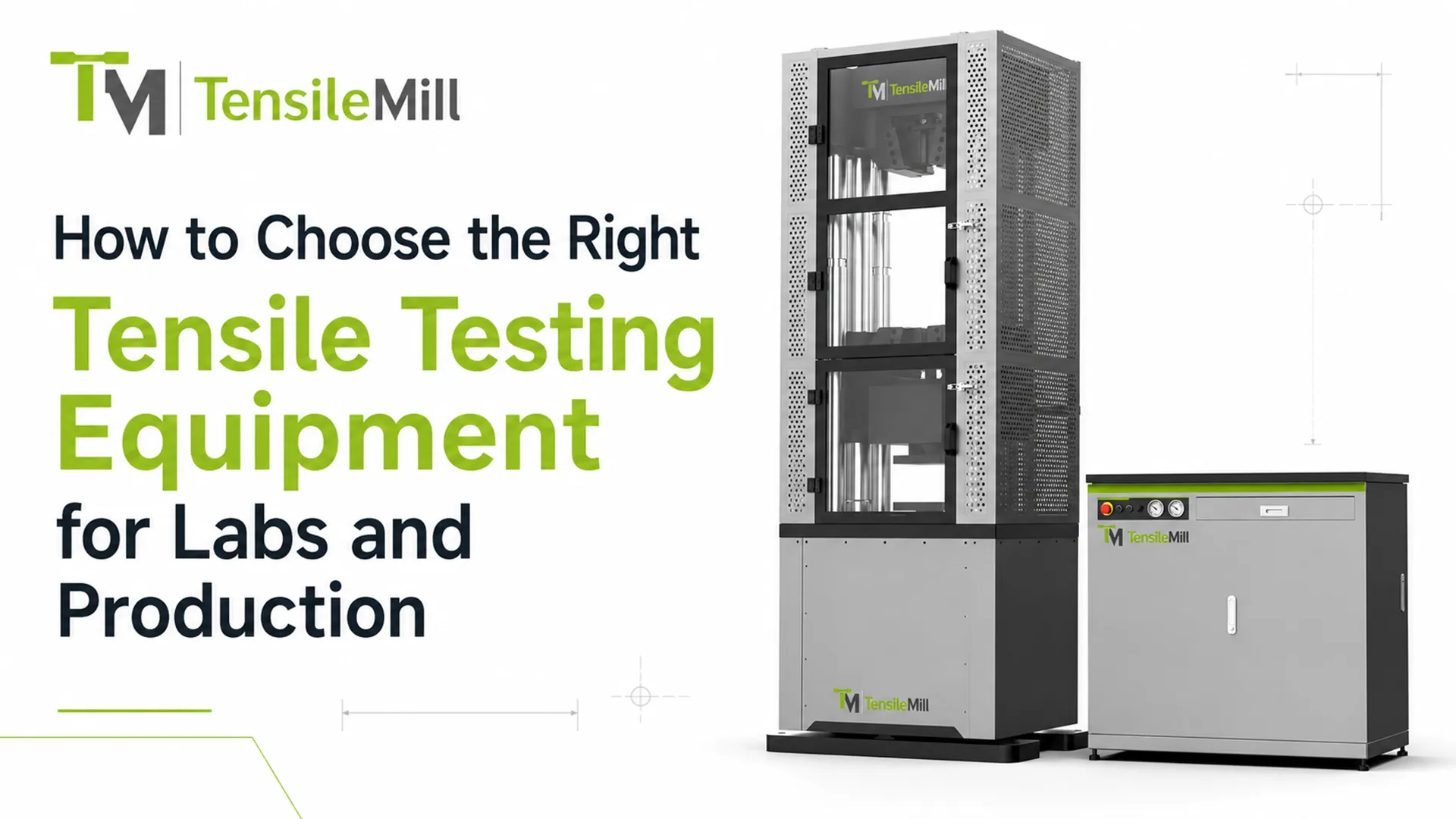
The right tensile testing equipment is not defined by the highest force rating alone. A tensile setup has to match the test program, which means the frame is only part of the decision. Load range, load cell selection, grips, strain measurement, software, and method control all influence whether the results are reliable, repeatable, and useful in practice.
A better starting point is the application itself. The material being tested, the governing standard, specimen geometry, and the required strain data all shape the right configuration. Metals, plastics, elastomers, films, and composites do not place the same demands on a tensile system. Even closely related standards may require different specimen forms, measurement approaches, and test conditions, so the equipment has to be matched to the method rather than chosen in broad terms.
Day-to-day use also changes the decision. Some systems need to support multiple methods and detailed reporting, while others are chosen for routine checks, simpler operation, and repeatable setup. These differences are often where selection mistakes begin, especially when frame capacity is treated as the main decision instead of one part of the full testing process.
For labs that also prepare their own tensile specimens, equipment selection should also be considered alongside sample preparation. A well-matched testing system can only produce reliable results when specimens are machined, gripped, and measured according to the required method. That is why tensile testing equipment and tensile sample preparation should be viewed as connected parts of the same quality workflow.
Why Tensile Equipment Selection Often Goes Wrong
Many equipment selection problems start with an overly narrow question. Instead of asking what kind of testing system the application actually requires, buyers often jump straight to frame capacity. That may seem like a practical starting point, but it leaves out the factors that usually determine whether a tensile setup performs well in real use. A machine can have enough force capacity on paper and still be the wrong fit once sample format, holding method, measurement needs, and test control come into play.
Another common problem is treating the test standard as something to check later rather than something that should shape the setup from the beginning. In tensile testing, the governing method affects more than the final report. It can influence specimen dimensions, gauge length logic, strain measurement requirements, and how the test is controlled. The risk increases when teams assume ASTM and ISO methods are interchangeable or switch between them without reviewing specimen and reporting requirements. In practice, those differences can change what the system needs to do.
Selection errors also appear when grips and strain measurement are treated as secondary decisions. Grip choice is not a minor detail because specimen holding, slippage control, and load transfer all affect the quality of the test. Strain measurement needs the same level of attention. When crosshead movement is used in place of direct strain measurement for applications that require more accurate modulus, yield, or elongation data, the results may be less reliable than expected.
Start With the Application, Not the Machine
A better equipment decision starts with the test itself. Before comparing frame types or force ratings, it is more useful to define what is actually being tested, how the specimen is shaped, and which standard governs the method. Tensile systems are not selected in the abstract. They are selected around actual materials, specimen requirements, and measurement needs. The same machine configuration will not suit every metals lab, plastics program, or mixed-material testing workflow.
Material family is one of the first things that changes the equipment requirement. Metals, rigid plastics, elastomers, thin films, and composites do not behave the same way under load, and they do not place the same demands on grips, strain measurement, or force range. A setup that works well for routine rigid plastic specimens may be poorly suited for thin films, soft elastomers, or higher-force metallic work. The material is not just a testing variable. It helps define the configuration itself.
The governing test standard should shape the setup early. ASTM E8 / E8M, ISO 6892-1, ASTM D638, and ISO 527 can affect specimen form, gauge-length logic, strain measurement, and how the test is controlled. Equipment should be matched to the method from the outset, not selected first and justified later.
Plastics testing shows this clearly. ASTM D638 is commonly used for tensile testing of rigid and semi-rigid plastic specimens, while ASTM D882 is used for thin plastic sheeting and film. ASTM D638 and ISO 527 are similar in purpose, but they are not fully interchangeable because specimen shapes, procedures, and result determination can differ. That means specimen geometry is not a small secondary detail. It helps define the practical limits of the setup.
How to Size the System Correctly
Force capacity matters, but it is not the whole decision. A tensile system has to be sized around the expected workload, not around the largest number on a specification sheet. In practice, that means looking at the frame, the load cell, and the working force range together. A system that is too small can limit headroom, fixture choice, and future testing flexibility. A system that is too large can be a poor practical match for lower-force work, especially when the real testing program does not come close to using its range.
Start with the expected peak load and the load cell you plan to use. The frame, load cell, and grips should all support the forces your specimens will actually reach, with enough margin for fixtures, method requirements, and future work. That keeps the setup practical without drifting into unnecessary oversizing.
The system category also becomes part of the sizing decision. Smaller benchtop systems can make sense for lower-force materials and lighter routine work, while broader mixed-material programs often need larger electromechanical systems with more room for accessories. At higher force levels, floor-standing electromechanical systems may become the more realistic option, especially when larger fixtures, longer travel, or broader industrial workflows are involved. This is where the selection starts moving from basic capacity planning into workflow, space, and accessory requirements.
Lab and Production Floor Priorities Differ
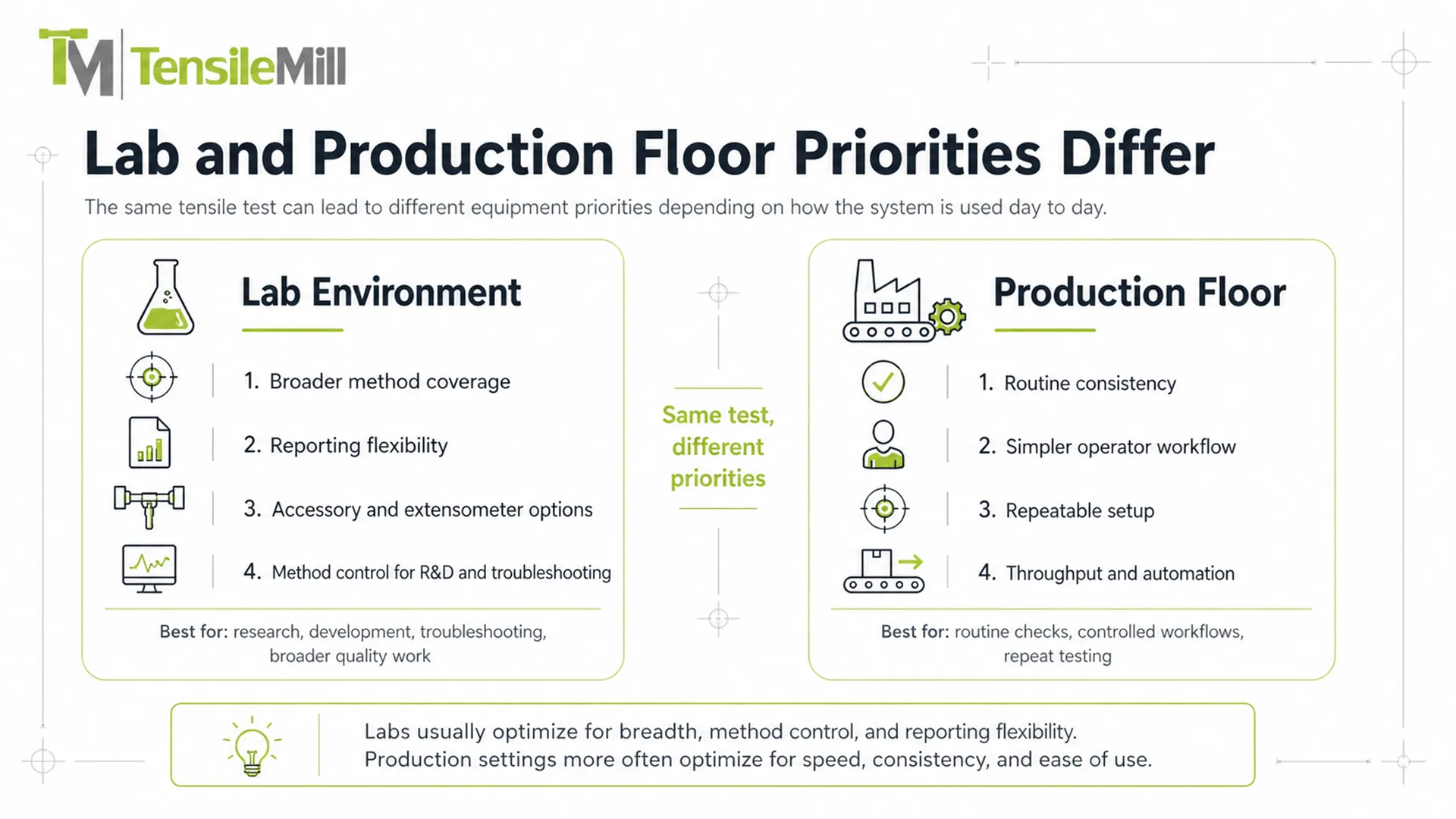
The same tensile test does not always lead to the same equipment priorities. A system that works well in one setting may be less suitable in another, even when the material and test type appear similar. The difference usually comes from how the system is expected to be used day to day. Some environments need broader method coverage, more reporting flexibility, and easier adaptation across materials. Others place more value on repeatable routine use, simpler handling, and smoother testing over many similar cycles.
In a lab environment, flexibility often carries more weight. A lab may need to work across multiple standards, specimen types, and material families without narrowing the system too early. That usually makes software options, accessory compatibility, strain measurement choices, and method control more important. Richer reporting and easier adjustment between test programs can matter just as much as raw force capability, especially when the system supports research, development, troubleshooting, or broader quality work.
On the production floor, the priorities often shift. The system may be used for routine checks on a narrower range of materials or parts, where consistency, operator simplicity, and repeatable setup become more important than broad experimental flexibility. In that kind of workflow, automation and software are valuable not because they sound advanced, but because they help reduce operator burden, support throughput, and make repeated testing easier to run in a controlled way.
Labs usually optimize for breadth, method control, and reporting flexibility, while production settings more often optimize for speed, consistency, and ease of use. Once those workflow priorities are clear, it becomes easier to compare the main system categories and avoid treating every tensile tester as the same type of investment.
Comparing Tensile Testing System Categories
Not every tensile testing system is built for the same range of work. The comparison below shows how common system categories differ by force range, specimen demands, accessory needs, working environment, and long-term flexibility.
|
System category |
Best fit |
Typical strengths |
Common limitations |
Best environment |
|
Compact benchtop systems |
Lower-force materials and routine testing programs |
Space-saving, practical for lighter materials, good for routine QC |
Limited force range, less suitable for larger specimens or heavier accessories |
Small labs, routine QC, lighter-duty workflows |
|
Mid-range electromechanical systems |
Mixed-material testing and broader general-purpose work |
More flexibility, wider accessory support, suitable for a broader range of specimens |
May provide more capacity and flexibility than narrow, low-force work requires |
General labs, mixed testing programs, broader QC work |
|
Floor-standing high-force electromechanical systems |
Higher-force testing with larger specimens and heavier fixtures |
Greater load capacity, more room for demanding setups, broader industrial coverage |
Larger footprint and may be excessive for smaller routine programs |
Industrial labs, broader metals testing, heavier-duty applications |
|
Servo-hydraulic systems |
Very high-force and more demanding industrial applications |
Strong fit for thick sections, high-force metals, and heavy-duty work |
Higher complexity and not necessary for many standard lower-force programs |
Heavy industrial testing, advanced high-force applications |
Accessories and Measurement Tools Can Make or Break the Test
A tensile system is only as effective as the accessories and measurement tools that support it. Even when the frame and force range are appropriate, the test can still be compromised if the specimen is not held correctly or if strain is not measured in a way that matches the method. Proper gripping supports specimen geometry, load transfer, and standards-based execution, which is why grips and fixtures should be treated as core parts of the system rather than afterthoughts.
The clearest example is grip selection. Different materials and specimen forms call for different holding methods, and a poor match can affect stability, slippage control, and repeatability during the test. In practice, that often means choosing among:
- Wedge grips for firmer holding in higher-force applications
- Pneumatic grips for faster, repeatable routine testing
- Hydraulic grips for more demanding high-force work
- Material-specific fixtures for flexural or specialized specimen types
Accessory choice should stay tied to the specimen and method. The right grip or fixture helps the machine apply load consistently, control slippage, and produce more repeatable data.
Strain measurement deserves the same level of attention. Crosshead travel can be useful in some situations, but it also includes system effects such as compliance and grip movement, so it is not always enough when more precise strain data is needed. Extensometers are commonly used when the test requires more accurate strain data, such as modulus, yield, elongation, or standards-based tensile results. ASTM E83 classifies extensometer systems by defined performance requirements, so they should be treated as measurement devices, not secondary accessories.
Strain measurement also raises the question of contact versus non-contact methods. Video extensometers are especially relevant when specimen sensitivity, test method, temperature conditions, or marking effort make physical contact less desirable. In these situations, the strain-measurement method is more than a convenience feature. It affects whether the system can meet the specimen and standard requirements in practice.
Grips, fixtures, and extensometers should be treated as core parts of the tensile testing setup, not secondary accessories. The wrong grip can cause slippage, poor load transfer, and less repeatable results, even if the test frame itself is appropriate. Strain measurement is just as important, especially when standards require accurate modulus, yield, or elongation data. Choosing the right accessories helps the tensile tester produce reliable, repeatable, standards-aligned results.
Common Equipment Selection Mistakes to Avoid
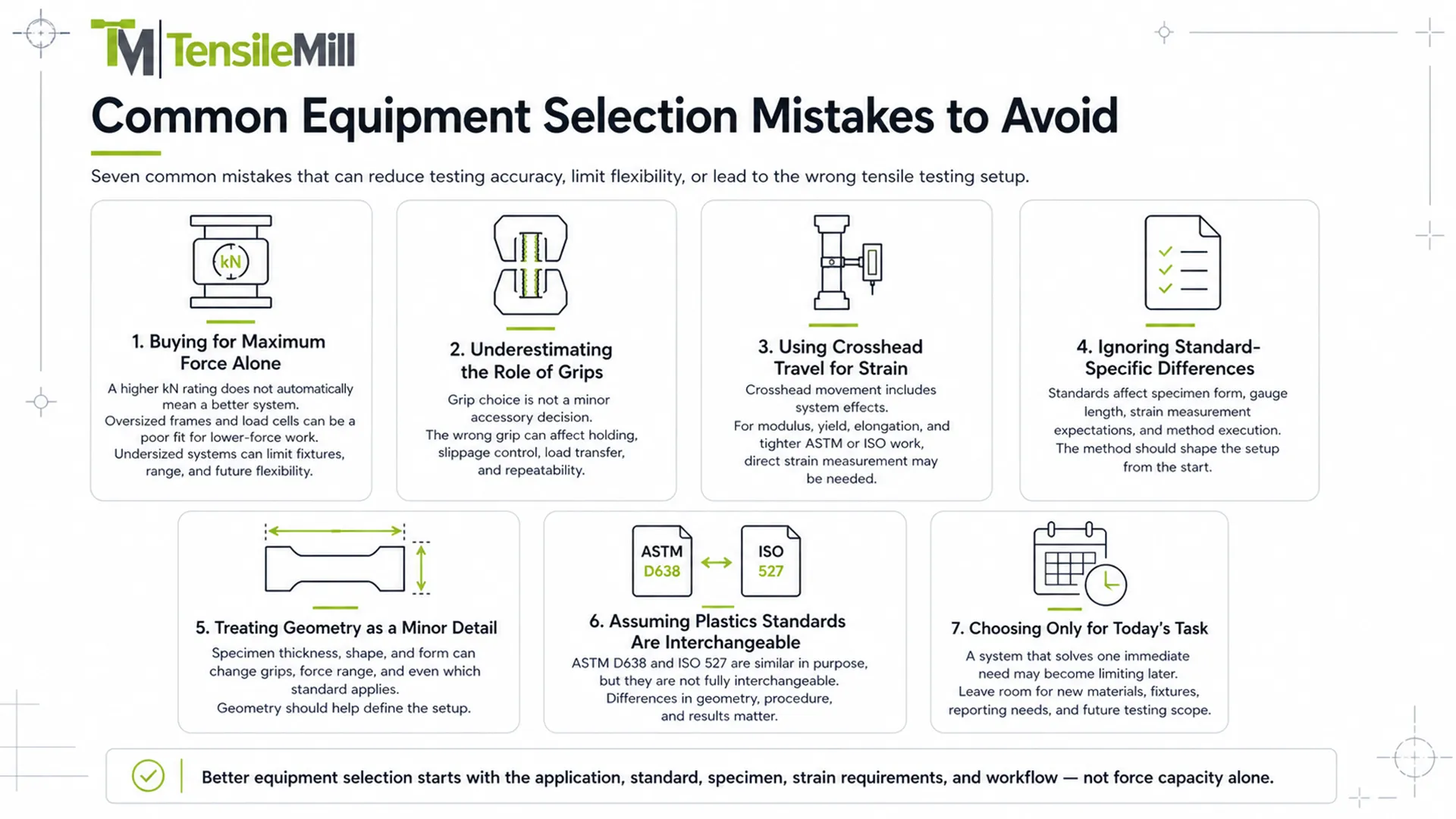
Some of the most common mistakes include:
- Buying for Maximum Force Alone: a higher kN rating does not automatically mean a better system. If the frame and load cell are oversized for the actual work, the setup may be a poor practical match for lower-force testing. If the system is too small, it can limit fixture options, working range, and future flexibility.
- Underestimating the role of grips: grip selection is not a minor accessory decision. The wrong grip can affect specimen holding, slippage control, load transfer, and repeatability, which means an otherwise capable machine can still produce weak test performance if the holding method is poorly matched to the specimen.
- Using crosshead travel where direct strain measurement is needed: crosshead movement includes system effects and is not always suitable when the method requires more accurate strain data. In work involving modulus, yield, elongation, or tighter ASTM and ISO expectations, direct strain measurement may be necessary to avoid less reliable results.
- Ignoring standard-specific differences: standards do more than shape the final report. They can affect specimen form, gauge-length logic, strain measurement expectations, and method execution. Treating the standard as something to check after the machine is chosen can lead to a setup that does not truly match the test method.
- Treating specimen geometry as a minor detail: specimen thickness, shape, and form can change the equipment requirement more than many buyers expect. These details can influence grips, strain measurement, force range, and even which standard applies in the first place.
- Assuming plastics standards are interchangeable: ASTM D638 and ISO 527 are similar in purpose, but they are not fully interchangeable in results. Differences in specimen geometry, procedure, and result determination can change what the system needs to handle and how the data should be interpreted.
- Choosing only for today’s task: a system that fits one immediate testing need may become limiting if the lab or production program expands into new specimen types, materials, accessories, or reporting requirements. Selection is stronger when it leaves practical room for future testing scope instead of solving only the nearest problem.
A Practical Framework for Choosing the Right Tensile Testing Setup
A useful selection process usually works best in this order:
- Define the material family: start with what is actually being tested. Metals, rigid plastics, elastomers, films, and composites do not behave the same way under load, and they do not place the same demands on force range, grips, or strain measurement.
- Identify the governing standard: the method should shape the setup from the beginning. Standards such as ASTM E8 / E8M, ISO 6892-1, ASTM D638, and ISO 527 influence specimen form, measurement expectations, and method execution, so they should guide configuration rather than be checked only after the machine is chosen.
- Confirm specimen geometry and expected force range: specimen thickness, shape, and form are not minor details. They help determine which grips are suitable, what force range is realistic, and whether the system is being sized appropriately for actual testing work.
- Decide what strain must be measured directly: not every test can rely on crosshead movement alone. If the work involves modulus, yield, elongation, or higher strain-accuracy requirements under ASTM or ISO methods, direct strain measurement may be needed.
- Choose grips and fixtures around the specimen: grip selection should follow the specimen and the method, not come later as a secondary decision. Proper holding, slippage control, and load transfer all affect repeatability and test quality.
- Match the system to the real workflow: a lab may need more flexibility across methods, materials, and reporting requirements, while a production floor may place more value on routine consistency, simpler operation, and repeatable setup. The same test type does not always lead to the same equipment priorities.
- Check software, reporting, and repeatability needs: saved methods, guided workflows, reporting options, and day-to-day setup consistency can make a major difference in how well the system performs outside a spec sheet. These factors are especially important when multiple operators, repeated testing, or standardized workflows are involved.
- Leave room for future testing scope: the best choice is rarely the system that solves only the immediate task. A stronger decision leaves practical room for additional materials, specimen types, accessories, and broader testing needs without forcing an unnecessary jump into oversizing.
How Our Tensile Testing Systems Fit Different Testing Needs
Once the selection criteria are clear, the next step is matching the system to the real testing workload. Some labs need a compact frame for lower-force materials, routine quality checks, and frequent method changes. Others need a higher-capacity system for metals, larger fixtures, broader standards coverage, or production-floor use.
Our tensile testing systems cover both paths, so the right choice depends on the workload the lab needs to support over time.
TM-EML Series B Dual-Column Benchtop Universal Testing Machine
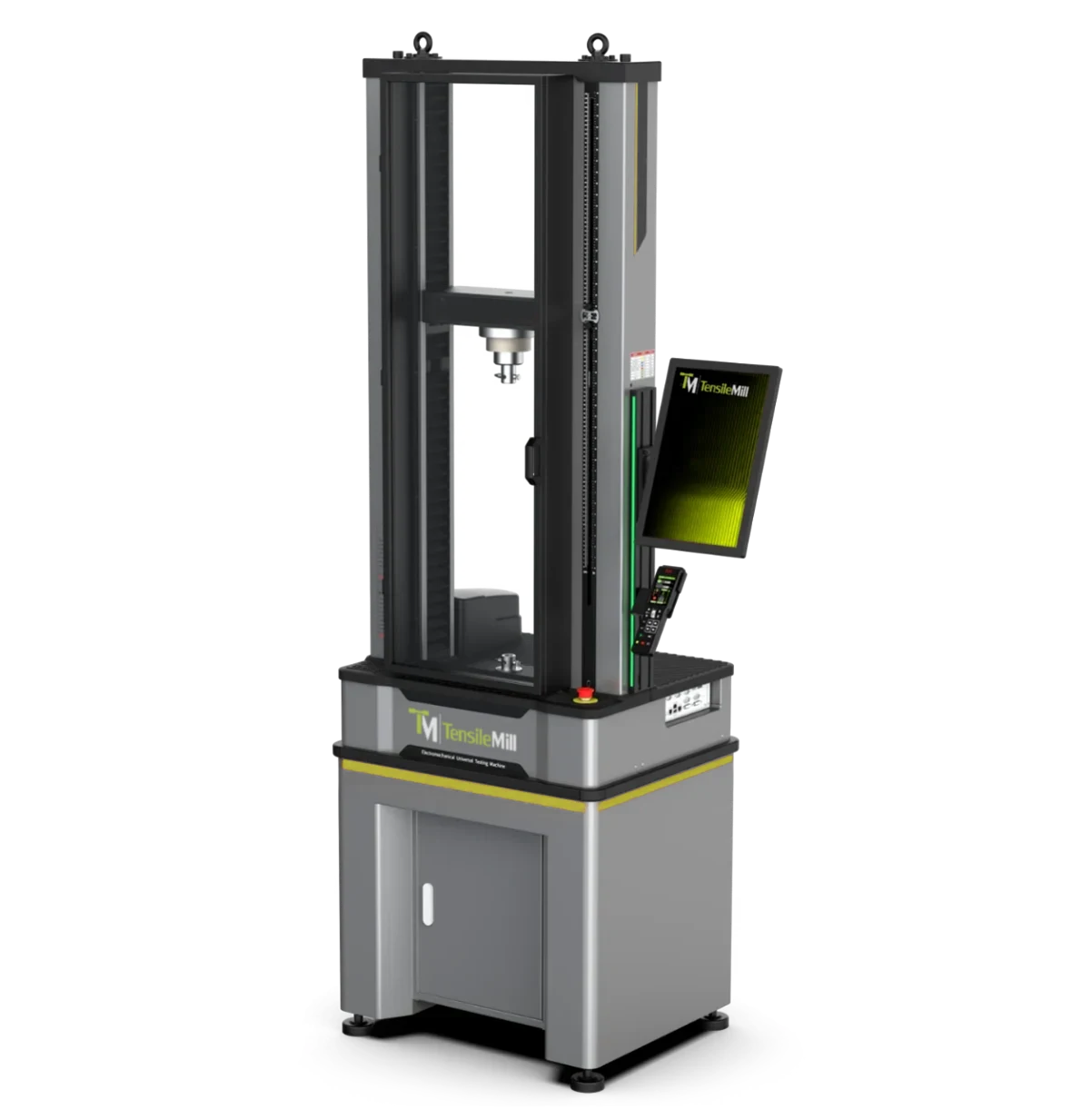
The TM-EML Series B Dual-Column Benchtop Universal Testing Machine is a practical fit for lower- and mid-force tensile testing where space, repeatability, and method flexibility matter. Its 100 N to 10 kN capacity range supports routine lab and QC applications involving plastics, elastomers, composites, thin films, foams, adhesives, wires, and other lower-force specimens.
It gives labs one compact platform for several common test types without moving into a larger floor-standing machine too early.
Key details include:
- Force range: 100 N to 10 kN
- Best fit: plastics, elastomers, composites, films, foams, adhesives, wires, and other lower-force specimens
- Common methods: tensile, compression, flexural, peel, shear, and puncture testing
- Useful options: interchangeable grips, fixtures, load cells, and extensometry
- Best environment: R&D labs, routine QC, teaching labs, and mixed lower-force workflows
The Series B is strongest when the main challenge is repeatable setup, stable control, and switching between different materials and specimen forms.
TM-EML Series D Dual-Column Floor-Standing Universal Testing System
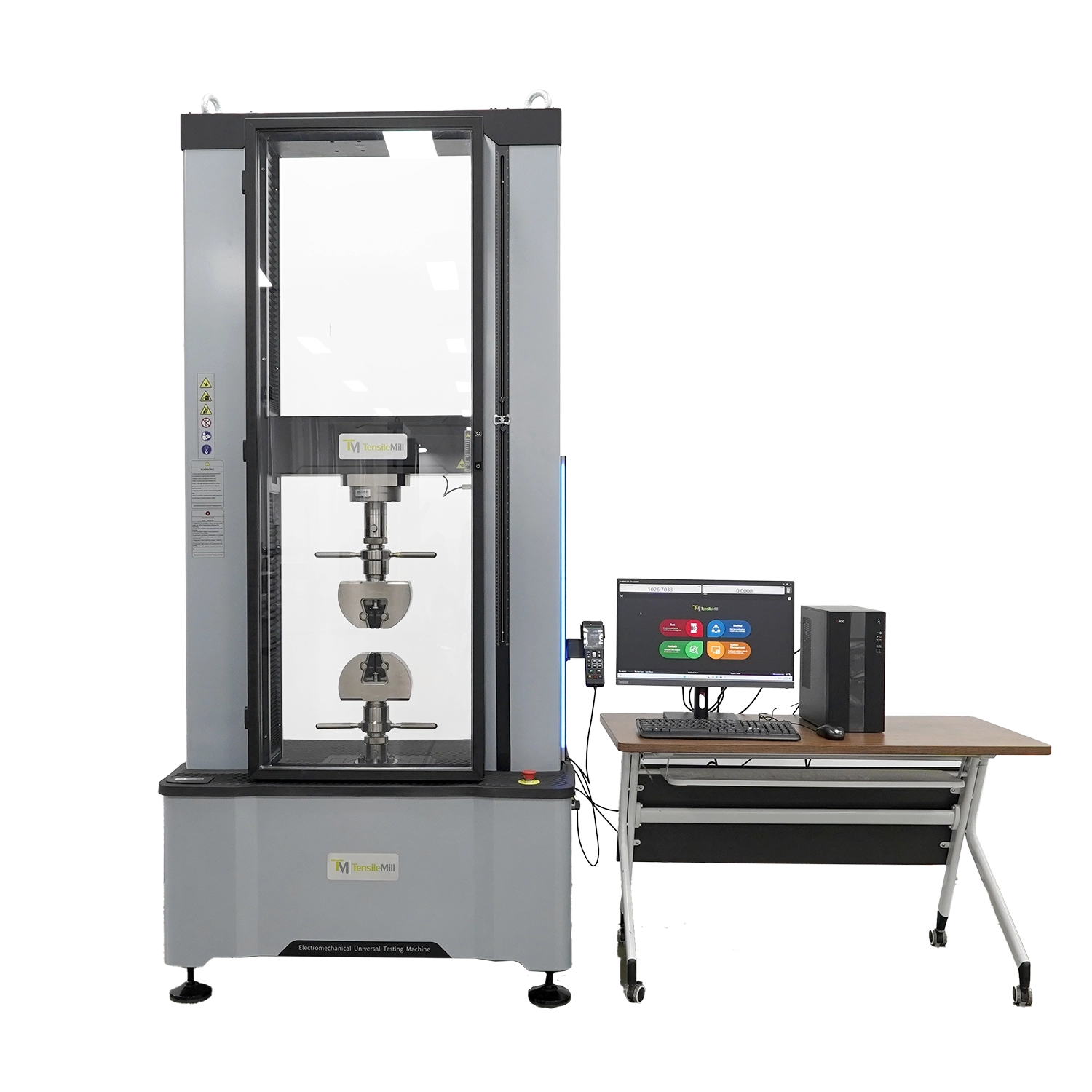
For higher-force work, broader lab programs, or production-floor testing, the TM-EML Series D Dual-Column Floor-Standing Universal Testing System gives labs more capacity, more working space, and more room for demanding accessories. It is a stronger fit when the testing program includes metals, structural components, larger specimens, or applications where future scope may grow.
It fits programs that have moved beyond compact benchtop capacity.
Main configuration points include:
- Force range: 50 kN to 1000 kN
- Best fit: metals, larger components, higher-force specimens, and broader industrial testing
- Common test types: tensile, compression, bending, and shearing
- Useful options: alignment device, extensometers, grips, fixtures, and extended frame configurations
- Best environment: materials labs, production floors, metals testing programs, and higher-capacity QC workflows
This option works best when the lab needs more headroom for force, fixtures, travel, and standards-driven testing, especially if the program may expand into larger specimens or more demanding methods.
How to Decide Between the Two
Choose the TM-EML Series B when the main work involves lower-force specimens, compact lab space, routine QC, plastics, elastomers, films, composites, or frequent setup changes.
Choose the TM-EML Series D when the program needs higher force capacity, larger grips or fixtures, more working space, metals testing, or broader production-floor coverage. The choice should follow the workload rather than the largest available capacity.
Choose the System Around the Work
The right tensile setup is not defined by one headline specification. It is defined by how well the full system matches the real testing task. Material, standard, specimen geometry, force range, grips, strain measurement, and daily workflow all shape whether the system will produce reliable, repeatable results in practice.
TensileMill CNC can help match tensile testing equipment, grips, fixtures, and related system components to your materials, standards, and daily testing workflow. Explore our available systems or contact us to discuss a setup that fits your testing requirements.