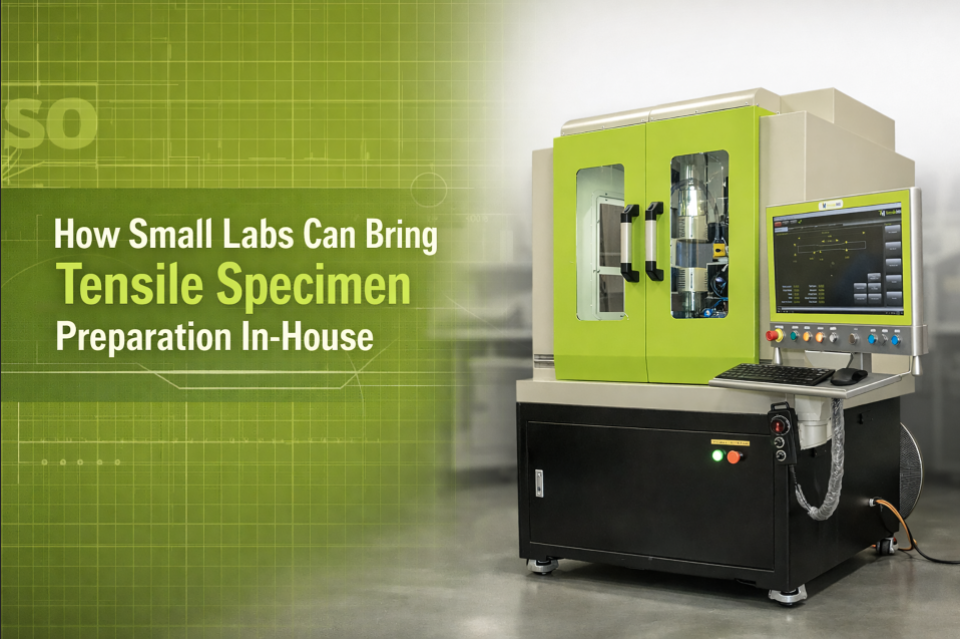
Not every tensile-testing program operates inside a full machining environment. Many smaller labs, QA teams, and R&D groups still need specimens prepared to a controlled standard, but they do not always have the floor space, staffing structure, or internal workflow to support traditional machining capacity. The technical expectation remains high even when the operation itself is compact.
For these teams, specimen preparation is rarely a minor side task. It sits directly upstream of the test itself, which means delays, inconsistencies, or machining-related defects can affect both turnaround time and confidence in the result. ASTM E8/E8M makes that point clearly by warning that improperly prepared specimens can lead to unsatisfactory or incorrect test results. Even a low-to-moderate volume program still has to treat preparation as a controlled part of the testing workflow.
That creates a familiar operational bind. A lab may not run enough daily volume to justify a full machine-shop setup, yet outsourcing specimen preparation introduces its own cost in time, logistics, and process control. Public machining schedules show that ASTM E8 specimen preparation is billed per specimen and can increase further depending on material and added operations, while standard ground shipping across the contiguous United States commonly takes one to five business days each way before vendor queue time is even considered.
The challenge is practical. Smaller programs still need repeatable, standards-aligned coupon preparation, but they often need it without the overhead of a larger machining workflow or the delays of sending work out.
Why Specimen Preparation Matters In Tensile Testing
ASTM E8/E8M warns that improperly prepared specimens can produce unsatisfactory or incorrect results. In tensile testing, that makes preparation quality part of the data-quality problem, not just a machining step.
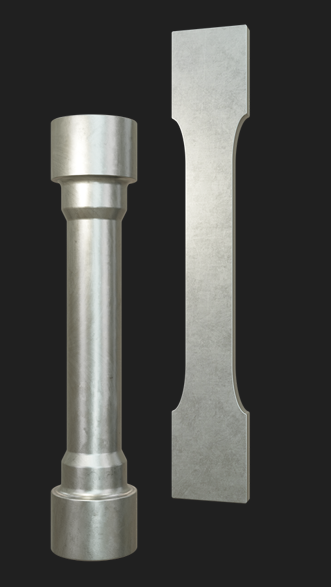
ASTM E8/E8M also identifies the defects that must be avoided in the reduced section: notches, chatter marks, burrs, grooves, gouges, rough edges, rough surfaces, overheating, and cold work. Each of these can affect measured tensile properties. The standard also warns against preparation methods that change the actual cross-sectional area from the calculated one.
That point matters because tensile stress is calculated from force divided by cross-sectional area. If specimen width or thickness is wrong, the reported stress is wrong with it. ASTM reflects that relationship in its dimensional requirements. For a 12.5 mm (0.500 in) sheet-type specimen, the nominal width tolerance is 12.5 ± 0.2 mm. Within the reduced section, the ends should not differ in width by more than 0.05 mm, and the width at each end should not be more than 1% larger than the width at the center.
ASTM also notes that dimensional measurement becomes more critical as specimen size decreases. Small errors take a larger share of the final value. Preparation control and measurement control both limit the same source of error.
The same logic appears in the ISO 527 series for plastics. ISO 527-1 defines the general principles. ISO 527-2 sets test conditions for moulding and extrusion plastics and links result comparability to consistent specimen types, preparation, and test setup.
The Hidden Cost Of Outsourcing Small-Batch Specimen Preparation
Outsourcing specimen preparation adds more than a machining charge. The visible line item is only part of the cost. One U.S. lab pricing schedule for ASTM E8 machining lists standard flat tensile specimen preparation at $50 per specimen for aluminum, copper, and magnesium, $60 per specimen for carbon, low-alloy, and stainless steels, and $85 per specimen for cobalt-, nickel-, and titanium-base alloys, as well as alloys above 40 HRC. The same schedule adds $25 per specimen for sub-size tensile specimens and bills sectioning separately at $80 per hour.
That matters because outsourced preparation usually starts before the machining step itself. Blank extraction may be billed separately. Sub-size work may carry a surcharge. Material class changes the per-specimen rate. Round specimens can bring extra operations such as threading. A nominal coupon price can grow quickly once the job moves beyond the simplest case.
The timing issue is just as important. Standard ground shipping across the contiguous United States commonly takes 1 to 5 business days each way. In a two-leg workflow, transit alone can consume several business days before vendor queue time, machining, inspection, and return handling are even counted. For labs working through material deviations, supplier checks, or short production decisions, that delay affects the speed of the whole testing loop.
A small batch makes the math easy to see. Twenty steel flat tensile specimens at $60 each already total $1,200 in machining alone. If sub-size preparation applies, that adds another $500. If one hour of sectioning is needed, that adds $80 more. None of that includes shipping charges, packaging, internal coordination, or the cost of waiting for the batch to come back.
Outsourcing can still make sense for infrequent work. Not every lab needs in-house preparation capacity. The trade-off changes when small batches become routine. At that point, specimen preparation becomes an ongoing external dependency with added cost, slower feedback, and less direct control over turnaround.
Why A General-Purpose CNC Is Often The Wrong Fit For A Small Lab
For a small lab, the problem is usually not machining capability. The problem is fit between the workflow and the machine:
- A general-purpose CNC can produce tensile specimens, but tensile standards focus on controlled preparation, dimensional integrity, and defect avoidance, not on using the largest or most flexible machine category.
- Small labs usually work with a narrow family of recurring specimen geometries, not a wide mix of parts that justifies broad machining flexibility.
- In that setting, extra machine capability often brings extra footprint, setup depth, training burden, and maintenance scope without solving a more important specimen-preparation problem.
- The main requirement is usually simpler: hold specimen geometry within tolerance, keep the reduced section free from burrs, chatter marks, overheating, and other preparation defects, and repeat that process consistently from batch to batch.
- For a low-to-moderate throughput lab, broad machining flexibility is not always the main source of value. Repeatability, workflow control, and lower process overhead often matter more.
For many small labs, the decision comes down to overhead. The question is not whether a full-size CNC can machine tensile coupons. It can. The question is whether the lab should carry that level of complexity, infrastructure, and setup burden for a much narrower preparation task.
What To Look For In A Compact CNC For Tensile Specimen Preparation
When a lab evaluates a compact CNC for tensile specimen preparation, the useful criteria are usually practical first:
- Footprint and lab integration: The machine should fit a lab-adjacent environment without forcing a full machine-shop expansion. Floor space, enclosure layout, access clearance, and installation requirements all affect how easily the system fits into daily lab work.
- Dimensional repeatability: Specimen width and cross-sectional area directly affect calculated tensile properties. ASTM E8/E8M makes that clear through both nominal tolerances and reduced-section uniformity requirements. For a 12.5 mm (0.500 in) sheet-type specimen, the nominal width tolerance is 12.5 ± 0.2 mm, and the reduced section has tighter width-uniformity limits.
- Fixturing and alignment: Secure, repeatable positioning is part of geometry control. If the blank is not held and located consistently, tolerance control becomes harder from one cycle to the next.
- Ease of use: For recurring standard geometries, the workflow should reduce programming burden and operator variability. A specimen-preparation system should support repeatable execution rather than depend on constant manual intervention.
- Throughput matched to demand: The right machine size depends on how many coupons the lab actually prepares, not on the largest machine it could buy. Published cycle times can be useful as workflow examples, but they should not be treated as universal output guarantees.
- Utilities and overhead: Power requirements, service needs, and daily operating complexity affect installation and long-term usability. Installation friction is part of total overhead.
- Workflow fit: The machine should support controlled geometry, repeatable preparation, and a scale of operation that matches the lab. In this type of workflow, those factors usually matter more than maximum machining range.
For small labs, the right compact CNC is usually defined less by maximum machining range and more by fit: controlled geometry, repeatable fixturing, manageable footprint, simpler daily operation, and throughput that matches actual demand. In tensile specimen preparation, the best system is rarely the biggest one. It is the one that holds tolerance, supports consistent setup, and fits the operating scale of the lab.
Affordable Does Not Have To Mean Compromised
In tensile specimen preparation, “affordable” should describe fit, not lower standards. ASTM E8/E8M and ISO 527 do not require the largest machine category. They require controlled preparation, dimensional integrity, and comparable test conditions.
For a small or mid-volume lab, a more affordable system usually means something more specific:
- Lower overhead: The lab is not paying for excess footprint, broader machining scope, or more infrastructure than the workflow actually needs.
- Right-sized capability: The machine is selected for the specimen family, tolerances, and daily workload the lab actually runs.
- Workflow-specific value: Stable fixturing, repeatable setup, and controlled geometry matter more here than maximum machining flexibility.
- No reduction in technical intent: Lower cost only makes sense if the process remains repeatable and specimen quality remains consistent.
Operating cost supports the same point. For a machine in this power class, electricity is a small part of the overall cost picture. In this type of workflow, cost is driven more by labor, tooling, outsourcing fees, shipping, and turnaround friction than by power draw alone.
Compact Tensile Specimen Preparation Solutions For Small Labs
We work with labs that need tighter control over specimen preparation but do not want to build out a full machine-shop workflow around that need. In many cases, the better fit is a compact system designed around repeatable geometry, manageable installation requirements, and daily output that matches the scale of the lab. That is the gap our compact tensile specimen preparation systems are built to address.
When The TensileMill CNC MICRO Makes Sense
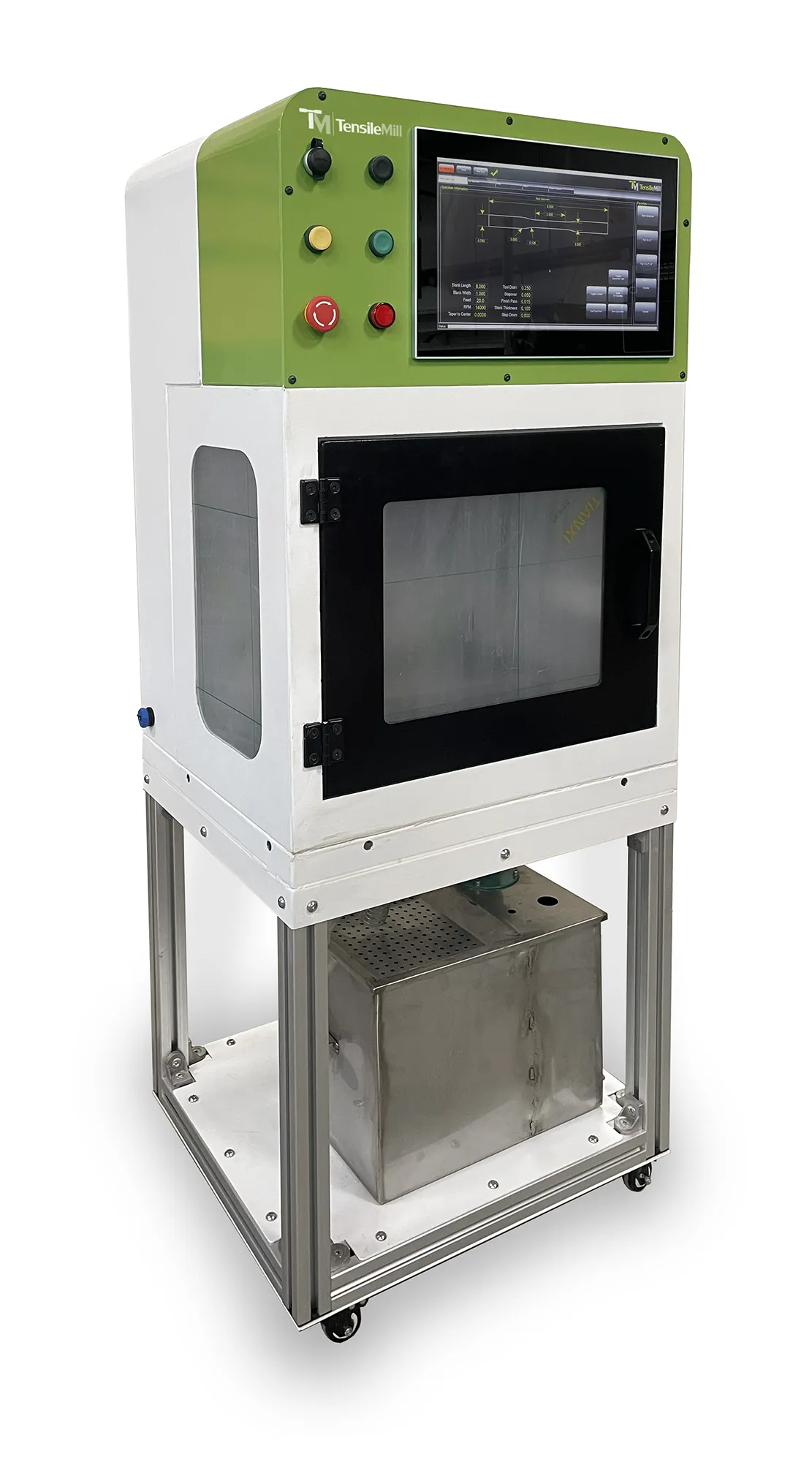
Our MICRO is built for labs that need precise flat coupon preparation without moving into full industrial CNC scale. It is a compact 2-axis system for flat tensile and impact specimens in metal, plastics, and composites, intended for environments where repeatability matters but sample volume does not justify a larger machining setup.
MICRO is usually the better fit when the priority is controlled geometry with lower infrastructure burden. It combines a compact footprint, single-phase 220 V power, and a guided touchscreen workflow in a format designed for dedicated specimen preparation rather than broader shop work. Custom baseplates and tensile jigs support two-sided machining in one cycle without re-clamping, which helps reduce handling variation and preserve symmetry from part to part.
MICRO is built for that kind of work, with ±0.03 mm positioning accuracy, ±0.02 mm repeatability, an 18,000 rpm spindle, a 3.5 kW spindle motor, and machine dimensions of about 20.5" × 24" × 59". The focus is controlled geometry, lower variation, and cleaner preparation in the reduced section.
When The TensileMill CNC MINI Makes Sense
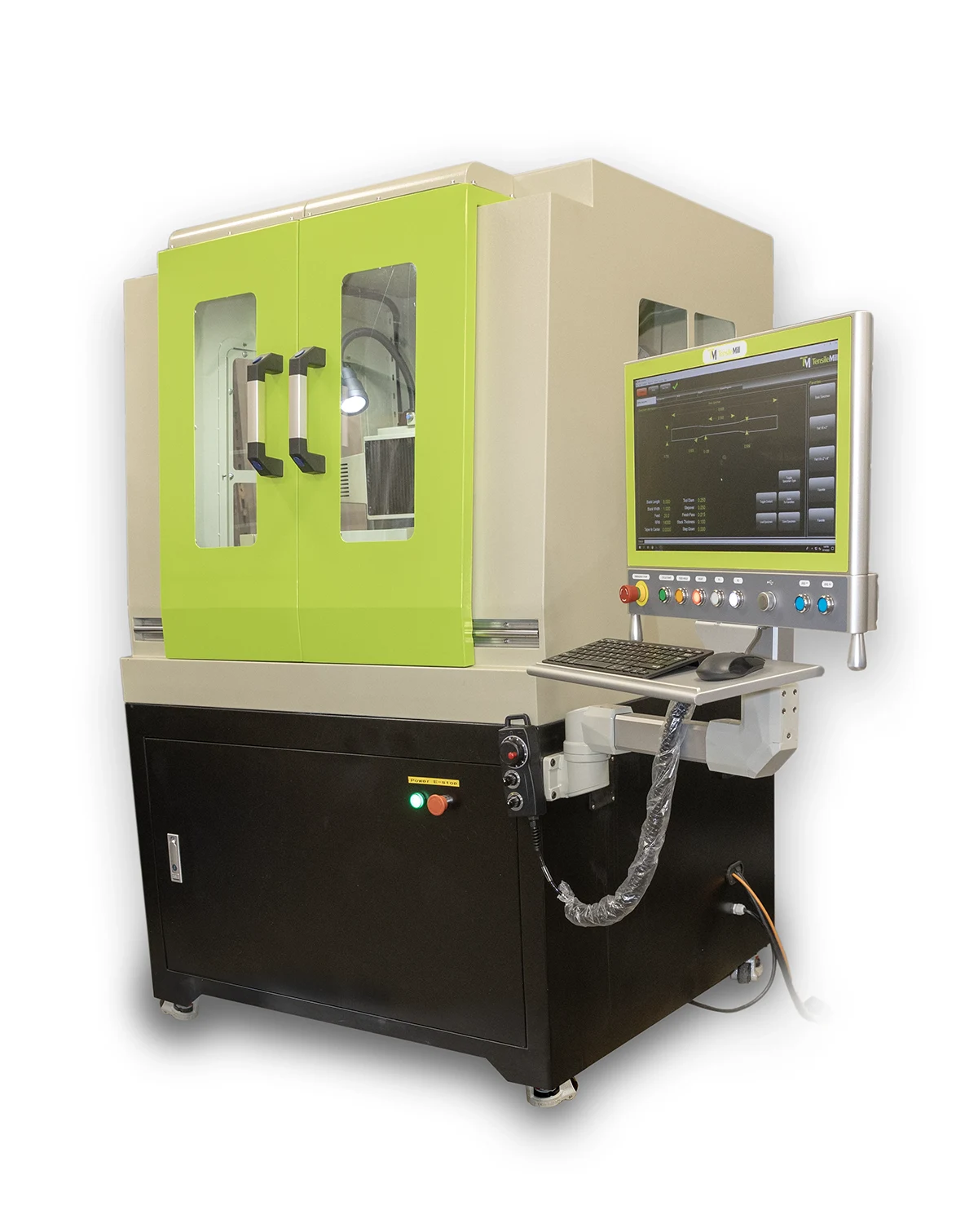
Our MINI fits a slightly different workflow. It is better suited for labs with recurring flat tensile specimen demand that need a compact, guided, repeatable system for small-batch daily work. We designed MINI around flat specimen preparation, standards-oriented setup, and a more structured workflow for repeated use.
That makes it a strong fit for labs that want a clearer operating routine across repeated flat-specimen preparation. MINI uses a 10-inch touchscreen interface with ASTM, ISO, DIN, and JIS geometry entry, along with a triple sample fixture that can hold up to three blanks or stacked sets in one setup. That setup helps reduce variation across repeated preparation cycles.
MINI is configured for recurring flat coupon preparation, with a 24,000 rpm spindle, a 2.2 kW (3 hp) water-cooled spindle, 220 V single-phase input, 3.3 kW total power, and 0.01 mm / 0.0003 in position repeatability accuracy. It is also designed for labs producing about 5 to 45 flat specimens per day, where repeatability, setup consistency, and small-batch throughput matter more than broad machining range.
A Practical Decision Framework For Small Labs
The right setup depends less on machine size and more on the operating model. A small lab does not need to solve the same problem as a production machine shop. The main variables are usually turnaround, repeatability, operator burden, floor space, and how often the same specimen families repeat. ASTM E8/E8M and ISO 527 both support that logic from the standards side: the priority is controlled specimen preparation and comparable conditions, not a specific machine category.
A practical way to think about the decision looks like this:
- If outsourcing works only because volume is low: It can still be a reasonable choice for occasional or irregular work. That changes when shipping, vendor queue time, and recurring per-specimen cost start slowing down routine decisions. Typical ASTM E8 machining charges and U.S. ground transit times show how quickly those delays and costs can accumulate.
- If the lab mainly runs standardized flat specimens: Broad machining flexibility may not be the main requirement. In that case, the better fit is often a system built around repeatable geometry, controlled fixturing, and a simpler recurring workflow.
- If repeatability matters more than machining range: The decision should favor the process that gives the lab better control over geometry, handling, and turnaround from one batch to the next. ASTM E8/E8M makes clear that preparation defects and dimensional variation can affect the result itself.
- If technician usability matters: Guided workflows, specimen libraries, and dedicated fixtures can reduce setup variation and reduce dependence on full CNC programming depth for repeated specimen types.
- If floor space and utilities matter: Compact systems with single-phase power and a smaller installation footprint are easier to absorb into a lab environment than a larger machining setup built for broader shop work. Our MICRO and MINI both use 220 V single-phase power and are designed for compact integration.
For many small-to-mid-volume tensile testing environments, that comparison leads to the same conclusion: the best fit is often the option that brings specimen preparation closer to the testing process without bringing unnecessary overhead with it.
A Practical Comparison At A Glance
Before choosing a direction, it helps to compare the three common paths on the factors that usually matter most:
|
Decision Factor |
Outsource Specimen Machining |
Oversized General-Purpose CNC In-House |
Compact Dedicated CNC In-House |
|
Primary cost structure |
Recurring per-specimen fees, add-ons, sectioning, shipping, handling |
Higher capital, installation, programming time, broader maintenance scope |
Capital plus consumables and lighter routine maintenance; lower recurring external spend in repetitive workflows |
|
Turnaround |
Vendor queue plus shipping; ground transit is commonly 1–5 business days each way in the contiguous U.S. |
Can be fast once set up, but small batches may still absorb setup and programming time |
Better suited to recurring standardized geometries and repeat small-batch work |
|
Footprint |
No machining footprint in-house |
Typically larger footprint and more shop-oriented integration needs |
Compact footprints; MICRO about 20.5" × 24" × 59", MINI about 44.5" × 42" × 70" |
|
Operator burden |
Low in-house, but high dependence on vendor capability and scheduling |
Higher setup and programming depth for repeated small-batch work |
Guided interfaces and dedicated specimen workflows reduce variability in repeated tasks |
|
Repeatability control |
Depends on outside process and communication handoffs |
Can be excellent, but depends heavily on setup discipline and broader machining practice |
Designed around repeatable specimen preparation workflows and dedicated fixturing; still requires validation under the lab’s own quality plan |
|
Utilities and integration |
Minimal in-house utility demand |
Often more demanding overall integration |
MICRO and MINI both use 220 V single-phase power and about 3.3 kW total power |
|
Best fit |
Low-frequency, irregular work where capital is hard to justify |
Labs that already have machining staff and broader machining needs |
Small-to-mid-volume labs focused on recurring standardized tensile specimen preparation |
Choosing The Right Fit For Your Lab
Reliable tensile data depends on specimen preparation quality. ASTM E8/E8M is explicit that improper preparation can produce incorrect results, and the same standards logic carries through specimen consistency, dimensional control, and defect avoidance.
Outsourcing and oversized equipment both solve part of the problem, but each brings its own trade-offs in cost, timing, and workflow burden. For labs running recurring flat tensile specimen work, compact purpose-built systems can offer a more balanced path: closer process control, repeatable preparation, and a setup that fits the scale of the lab.
Our TensileMill CNC MICRO and MINI are built around that need. Explore the systems, request a quote, or talk with our team about the right fit for your lab.