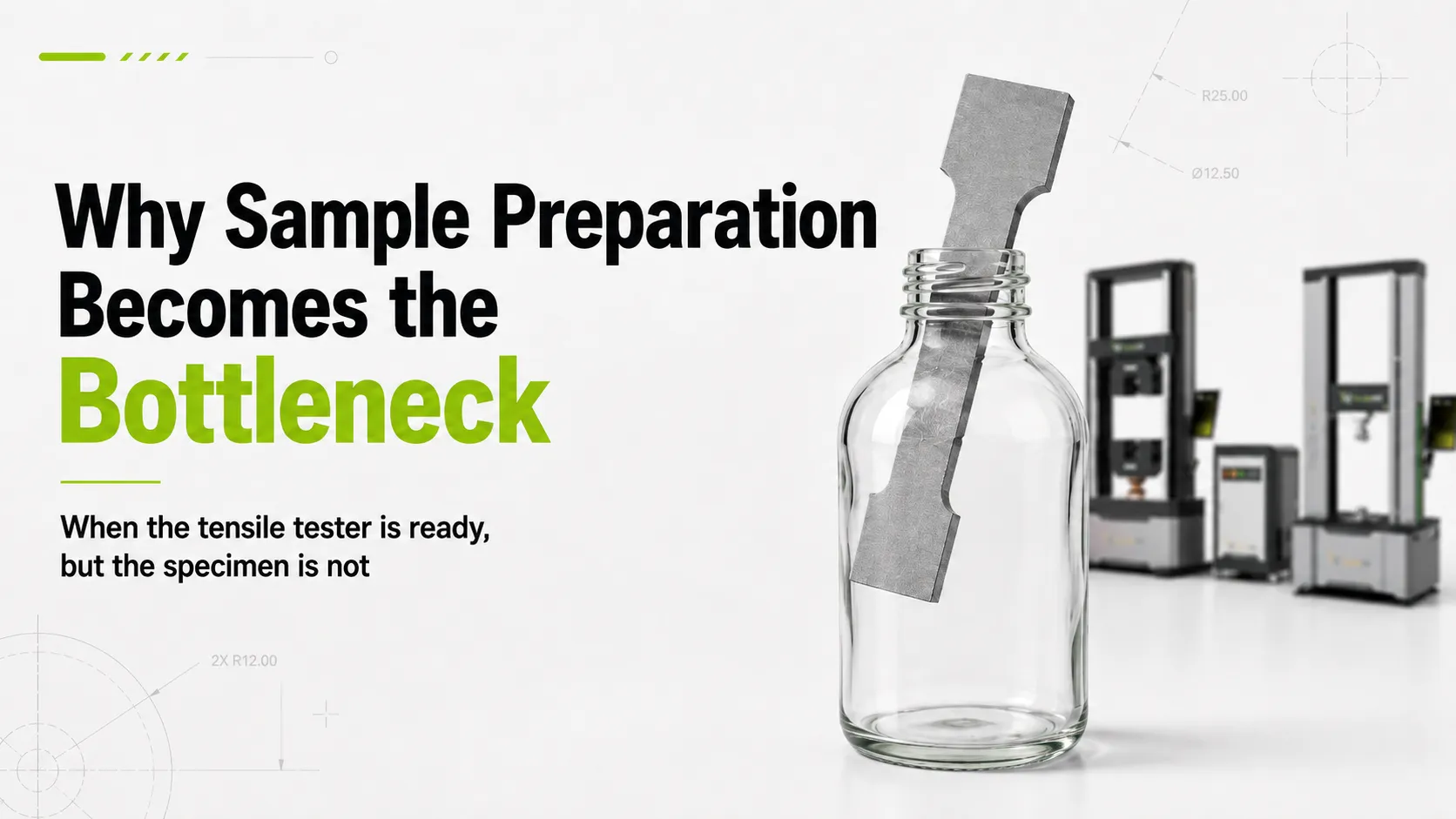
In many QC labs, the tensile testing machine is not the bottleneck. The bottleneck is preparing the specimen correctly, consistently, and on time.
A lab may already have the right UTM, the right test method, and trained staff ready to run the test. But if every flat or round specimen still depends on a skilled CNC machinist, a CNC programmer, an outside machine shop, or one experienced operator, the testing schedule can slow down before the specimen ever reaches the grips.
That delay matters. Tensile test results are often needed for material release, supplier approval, production QC, R&D comparison, heat treatment verification, or customer documentation. When sample preparation is delayed, the entire testing workflow is delayed with it.
This is why more labs are looking at guided tensile sample preparation workflows. A better setup reduces the amount of manual CNC programming required for routine specimens and gives trained QC operators a clearer way to prepare samples in-house.
For labs dealing with limited machining capacity, operator turnover, outsourcing delays, or growing test volume, non-machinist-friendly tensile sample preparation can make routine specimen work easier to schedule, repeat, and document.
Why Tensile Sample Preparation Still Depends on Skilled Machinists
Tensile sample preparation looks simple only after the specimen is finished. Before that, the process depends on several details that affect whether the sample is usable: controlled geometry, clean edges, a consistent gauge section, proper shoulder transitions, repeatable width or diameter, and stable fixturing during machining.
Traditional tensile specimen preparation often sits closer to the machine shop than the QC lab. The operator may need CNC programming knowledge, material handling experience, correct tooling selection, fixture setup, and enough machining judgment to recognize problems before they affect the specimen. A skilled machinist knows how to avoid poor edge quality, chatter marks, overheating, misalignment, bad clamping, or a cut that leaves the sample outside the required dimensions.
That skill still matters, but availability often creates the bottleneck. Many labs do not have a dedicated machinist assigned only to tensile specimens. The same person may also be needed for production parts, repairs, tooling, prototypes, or urgent shop work. In other cases, the lab depends on an outside machine shop, which adds scheduling time and makes quick retesting harder.
Manufacturing teams are also dealing with broader skilled labor pressure. Many facilities are trying to keep QC, production, and R&D moving with fewer specialized people available for every small machining task. In that environment, routine tensile specimen preparation can become a QC bottleneck even when the testing machine itself is ready.
The Real Cost of Machinist Dependency in QC Labs
When tensile specimen preparation depends on one machinist, one CNC program, or one outside shop, the first cost is usually schedule delay. The UTM may be available, the operator may be ready, and the test method may already be approved, but the lab still waits for specimens.
A small delay can affect the whole QC schedule. For example, if a lab needs 12 tensile specimens for a material lot and the internal machine shop can only fit the job in tomorrow afternoon, the test result moves by at least one day. If one specimen is machined outside the required width, thickness, diameter, or shoulder geometry, the lab may need to remake it, remeasure it, and move the test again. For production release or supplier approval, that delay can hold more than a single test. It can hold a batch, shipment, or customer report.
The same problem appears with retesting. If an operator finds a questionable break, an outlier, or a specimen preparation issue, the lab may need another sample quickly. When preparation depends on a busy CNC machinist, a simple retest can become a scheduling problem. A 20-minute machining task can turn into a half-day or full-day delay if the right person, program, fixture, or machine is not available.
Machinist dependency can affect several parts of the lab workflow:
- Daily sample throughput
- Retesting speed
- Production release timing
- Supplier approval
- R&D iteration
- Consistency between operators
- Scheduling flexibility
There is also a training cost. If the setup lives mostly in one person’s experience, new operators cannot easily repeat the process. They may know which specimen is needed, but not which program to use, how the blank should be clamped, which dimensions must be checked, or what to do when the material changes. The workflow becomes fragile because too much of it depends on memory instead of a repeatable process.
For QC labs, the practical risk is clear: routine tensile specimen preparation can slow down testing when only a few people know how to run the workflow. A guided process helps shift repeat jobs from specialist-only work toward a controlled lab procedure that trained operators can follow more consistently.
What “Non-Machinist” Tensile Sample Preparation Actually Means
“Non-machinist” does not mean untrained. It means the workflow is designed so trained QC or lab personnel can prepare routine tensile specimens without writing CNC code from scratch.
The operator still needs to understand the basics of the process: machine safety, material handling, fixture setup, blank orientation, sample labeling, measurement, and final inspection. These steps still matter because the specimen has to match the required geometry before it goes into the tensile test.
The difference is in how much of the machining logic the operator has to build manually. In a traditional workflow, the operator may need to create or edit a CNC program, choose toolpaths, check dimensions from a drawing, and rely on machining experience to avoid setup mistakes. In a guided tensile sample preparation workflow, more of that process is built into the machine and software: specimen type selection, standard geometry, custom dimensions, prompts, and repeatable setup steps.
This makes routine tensile sample preparation easier to transfer between trained users, shifts, and repeat jobs. A QC operator does not need to become a full CNC programmer to prepare common tensile specimens, but the operator still needs a controlled process and clear inspection requirements. That distinction is important: the workflow becomes more accessible, not careless.
What a Guided Tensile Sample Preparation Workflow Should Include
A non-machinist-friendly tensile sample preparation workflow needs more than a simplified start button. It should guide the operator through the decisions that normally require CNC experience: specimen type, dimensions, blank setup, clamping, toolpath selection, and repeat jobs.
The most useful systems reduce manual programming without hiding the critical setup steps. The operator still needs to select the correct specimen, load the blank properly, confirm the setup, and inspect the finished sample. The software and machine should make those steps easier to repeat.
|
Workflow Need |
Why It Matters |
|
Standard specimen libraries |
Reduces manual setup for common ASTM, ISO, DIN, and JIS-style specimens |
|
Touchscreen input |
Helps operators select or enter specimen details without writing CNC code |
|
Guided blank alignment |
Helps reduce setup variation between users |
|
Fixture and clamping prompts |
Makes the physical setup easier to repeat |
|
Automatic toolpath generation |
Lowers dependency on manual CNC programming |
|
Saved specimen dimensions |
Helps repeat common jobs faster |
|
Clear operator sequence |
Supports training, shift-to-shift consistency, and fewer setup mistakes |
For a QC lab, the main value is repeatability across operators and shifts. If three trained operators can follow the same guided workflow, select the same specimen geometry, use the same clamping sequence, and repeat the same saved setup, the lab is less exposed to delays caused by one unavailable machinist or one undocumented CNC program.
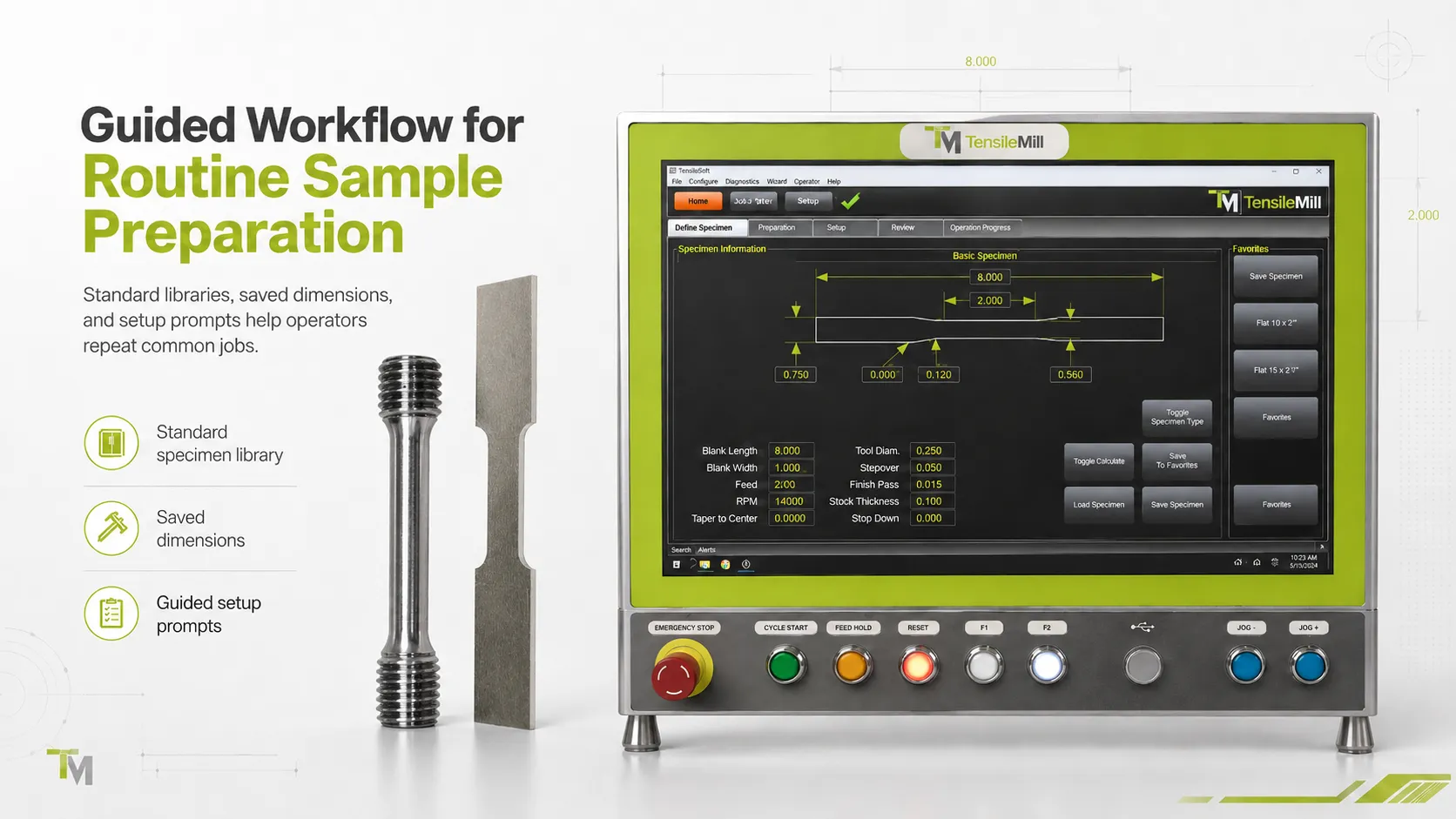
A non-machinist-friendly workflow should not hide important setup steps. It should guide trained operators through specimen selection, dimensions, blank alignment, fixturing, and repeat jobs while reducing manual CNC programming. The goal is a process that different trained users can repeat consistently across shifts.
Where TensileSoft Fits Into This Workflow
TensileSoft is the software layer used with TensileMill CNC systems to guide specimen setup and machining. It is built around tensile sample preparation, not general-purpose CNC machining, which matters for labs that need repeatable specimens without creating a new CNC program for every routine job.
In a traditional setup, the operator may need to interpret the specimen drawing, create or adjust the toolpath, confirm the gauge section, and manage the machining sequence manually. With a guided workflow, TensileSoft helps the operator select a standard specimen or enter custom dimensions, follow setup prompts, and generate the machining path based on the specimen details.
On compatible TensileMill CNC systems, the workflow can include touchscreen control, standard specimen libraries, custom dimension entry, guided blank alignment, fixture clamping prompts, and automatic toolpath generation. Some systems also save previously entered specimen sizes, which helps recurring jobs move faster.
For a QC lab, this reduces the amount of manual CNC programming required for routine tensile specimen preparation. The operator still needs training, safe machine handling, correct fixturing, and final inspection, but the software makes the repeatable parts of the workflow easier to standardize across users.
Flat and Round Specimen Workflows Need Different Support
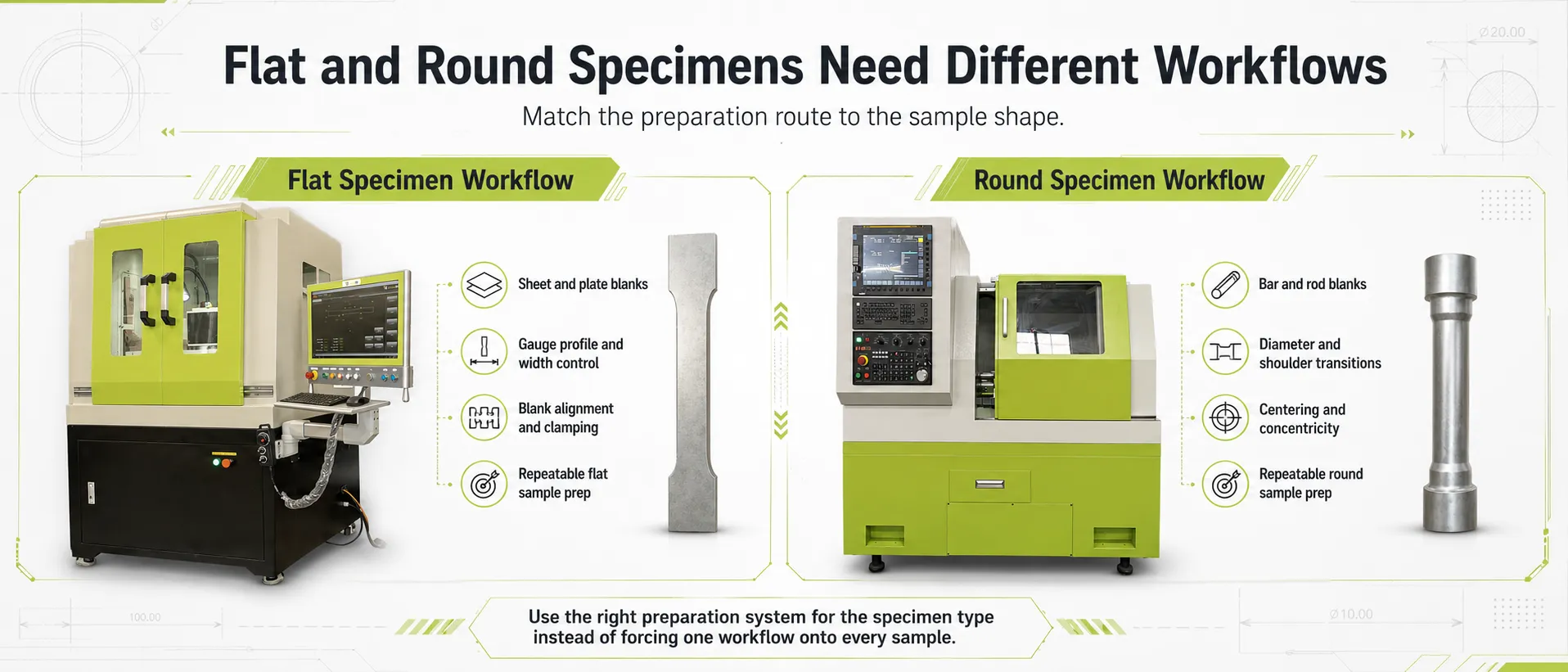
Flat and round tensile specimens do not create the same preparation problems. Both specimen types need to be ready for tensile testing, but the machining workflow is different.
Flat specimens usually start from sheet, plate, or flat blanks. The operator has to manage blank positioning, clamping, gauge width, reduced section geometry, shoulder transitions, edge quality, and sometimes two-sided machining. Small setup errors can affect the specimen profile or make the next sample difficult to repeat.
Round specimens bring a different set of controls. The workflow is closer to turning: diameter control, shoulder transitions, concentricity, stock shape, and surface finish become more important. A round bar, square blank, or irregular starting piece may require a different setup than a flat coupon.
The preparation route should match the specimen type. A flat specimen workflow should help the operator select the correct profile, dimensions, clamping approach, and machining sequence. A round specimen workflow should support the turning process, diameter targets, transitions, and stock setup.
TensileMill CNC systems are built for flat tensile specimen preparation. TensileTurn CNC systems are built for round tensile specimen preparation. TensileSoft connects the operator workflow to the specimen type, required dimensions, and repeatable preparation steps, so the lab is not trying to force one workflow onto every sample shape.
Why This Matters for Small and Mid-Sized Labs
Small and mid-sized labs often need tensile testing capacity without having a full machine shop attached to the QC department. They may rely on one machinist, one external supplier, or one experienced engineer who knows how the specimen preparation workflow is supposed to run.
That arrangement can work when specimen volume is low, retesting is rare, and schedules are flexible. It becomes harder when the lab needs faster retesting, same-day material release, supplier approval, or repeated R&D trials. If the person who knows the setup is busy, off shift, or unavailable, routine tensile sample preparation can slow down the entire testing process.
Bringing specimen preparation closer to the lab can reduce those delays. The lab gains more control over scheduling, repeat work, sample identification, and inspection before the specimen reaches the UTM. Guided software makes this more realistic because trained operators are not starting from a blank CNC program every time they need a standard specimen.
For smaller labs, the question is often practical: can routine tensile samples be prepared in-house without building a full machining department? A non-machinist-friendly workflow helps answer that question by combining dedicated tensile preparation equipment, guided software, standard specimen libraries, and repeatable setup steps.
What Still Requires Training and Process Control
A guided workflow makes tensile sample preparation easier to repeat, but operator training remains essential. Operators need to understand machine safety, material handling, fixture setup, tooling condition, measurement, inspection, and sample identification.
The software can help standardize the sequence, reduce manual CNC programming, and make routine preparation easier for trained lab personnel. Final verification still belongs to the lab. Before a specimen moves to the tensile tester, the operator should confirm that the sample matches the required method and is ready for testing.
Before testing, operators should verify:
- Specimen type and standard
- Blank orientation and clamping
- Correct saved program or entered dimensions
- Material and tooling selection
- Final width, thickness, or diameter
- Surface condition and edge quality
- Sample ID and batch traceability
This is where process control matters. A non-machinist-friendly workflow helps the lab make routine preparation more repeatable, but the finished specimen still needs to be measured, inspected, and linked to the correct material record before the tensile test begins.
How TensileMill CNC Helps Reduce Dependence on Skilled CNC Operators
TensileMill CNC systems are designed around tensile specimen preparation, not general-purpose machining. The operator is not starting with a blank CNC environment. The workflow is built around specimen shapes, standards, dimensions, fixturing, and repeatable preparation steps.
TensileSoft supports this workflow by guiding the operator through routine setup. Built-in specimen libraries and custom dimension entry reduce the need to manually program common tensile samples from scratch. Touchscreen controls, guided setup steps, and saved specimen dimensions help trained lab personnel repeat jobs with less dependence on a CNC programmer for every sample.
The product direction changes with the specimen type. TensileMill CNC systems support flat tensile specimen preparation, while TensileTurn CNC systems support round specimen preparation. For labs that prepare both flat and round samples, the workflow can be matched to the specimen type instead of forcing every sample into the same preparation process.
Support also matters after the machine is installed. Training, consumables and tooling, software updates, and service support help keep the workflow stable over time. A guided system still needs proper tools, maintained fixtures, trained operators, and inspection steps, but it gives the lab a clearer process for routine tensile specimen preparation.
Choosing the Right Non-Machinist-Friendly Setup
The right setup depends on the specimens the lab prepares, the standards it follows, and where the current bottleneck appears. A lab preparing occasional flat specimens has different needs from a lab producing round specimens every day or switching between materials, standards, and customer requirements.
Before choosing equipment or software, define the workflow clearly:
- Flat specimens, round specimens, or both
- Standards used: ASTM, ISO, DIN, JIS, or internal methods
- Material types, hardness, and blank sizes
- Daily or weekly specimen volume
- Current bottleneck: outsourcing, machinist availability, programming time, rework, or throughput
- Operator experience level
- Need for polishing, consumables, support, and training
For mostly flat specimens, the lab should review TensileMill CNC flat systems. For round specimens, TensileTurn CNC is the more relevant direction. For mixed workflows, both flat and round preparation should be reviewed together so the lab is not solving only part of the bottleneck.
Operator experience also matters. If the lab has limited CNC experience, the setup should prioritize the TensileSoft-guided workflow, standard libraries, custom dimension entry, training, and support. If the lab has high repeat volume, saved jobs, fixtures, consumables, and throughput planning become more important.
A practical selection process starts with the sample, not the machine name. Define what needs to be prepared, how often it needs to be prepared, who will run the workflow, and what inspection requirements must be met before the specimen reaches the tensile tester.
Build a Tensile Sample Preparation Workflow That Does Not Stop at the Machine Shop
Skilled machinists remain valuable, especially for complex setups, unusual materials, troubleshooting, and process development. Routine tensile specimen preparation, however, should not stop every time machining support is unavailable or an outside shop is delayed.
Guided software, standard specimen libraries, touchscreen workflows, and dedicated tensile sample preparation machines give QC labs more control over routine preparation. They help trained operators prepare specimens more consistently without starting from manual CNC programming for every job.
TensileSoft and TensileMill CNC systems support routine tensile sample preparation that needs to be repeatable, understandable, and easier to transfer between trained users. For labs trying to reduce delays, retesting problems, or dependence on one experienced person, that can make the preparation step more stable.
If your lab depends on a machinist or outside shop for routine tensile specimens, send TensileMill CNC your specimen type, standard, material, blank size, current preparation method, and expected sample volume. The team can help review whether a flat, round, or combined tensile sample preparation workflow fits your lab.